Equity is usually treated as a headquarters instrument in retail. Directors and above receive grants. Store associates, shift leads, and distribution center staff receive schedules and hourly rates.
New research suggests that division deserves a second look.
A study of more than 41,000 establishment-year OSHA injury records, spanning 629 U.S. companies over a decade, found that granting stock options to rank-and-file employees causally reduces work-related injury rates. Retail supplied roughly one-third of that sample, more than any other industry. And the effect was strongest under the conditions that define retail operations: high employee mobility, dense local competition, and locations far from headquarters.
What The Research Means For Retail Leaders
Researchers from City University of Hong Kong, Melbourne Business School, and T A Pai Management Institute matched OSHA’s establishment-level injury data with compensation records to determine if rank-and-file stock options predict injury rates. They controlled for establishment size, hours, strikes, shutdowns, leverage, firm size, and executive option pay. The negative relationship remained consistent across all measures and samples.
The headline result: a one-interquartile-range increase in broad-based employee options was associated with a 7.44% reduction in injury rates, a larger effect than existing estimates for penalty-imposing OSHA inspections or plant unionization.
Retail's position in the data matters. With 14,112 establishment-year observations, retail was the largest industry in the study by a wide margin, and its average injury rate of 7.3 per 100 employees ran above the full-sample average of 6.6.
Causation was established through a 2005 accounting rule change, FAS 123R, which forced companies to expense options at fair value. Rank-and-file grants fell sharply, creating a natural experiment. Before the change, injury trends at affected and unaffected firms were identical. Afterward, injury rates rose significantly at the firms that cut the most, and kept rising for years.
Why The Effect Is Strongest In Retail Conditions
The study tested where the benefit of broad-based options is amplified. Three findings describe retail operations almost exactly.
- High labor mobility. The effect was roughly three times stronger at high-mobility companies, meaning mobility determines how much protective value a frontline equity program delivers.
- Dense local competition. The effect was significantly stronger in organizations where many competitors operate in the same geographic area, giving employees ready access to nearby alternatives.
- Distance from headquarters. The effect was strongest at locations far from headquarters, where oversight is costly and inconsistent. No retailer can place a supervisor behind every associate across hundreds of stores. Group incentives extend accountability.
How Stock Options Drive Safety: Retention and Teamwork
Employees do not work more carefully because of a vesting schedule. The mechanisms are structural, and both are familiar to retail leaders.
Retention. Unvested equity gives experienced employees a reason to stay and functions as safety infrastructure. New employees carry the highest injury risk; injury rates decline as tenure grows and workers learn a location's hazards, equipment, and protocols. In retail, where early-tenure departures are routine, equity that vests over time holds people through the highest-risk window.
Cooperation. Options are a group incentive that ties individual value to collective performance. Prior research finds that employees who hold equity engage in more informal peer training and are more willing to address a coworker who is cutting corners. On a sales floor or in a fulfillment center, peer accountability can act as an additional real-time safety mechanism.
The financial outcomes can be substantial; another study found that the cost of a single additional workplace injury is roughly $270,000. Across hundreds of locations, the upside is significant.
How to Structure Frontline Stock Option Programs
Broad-based equity cannot reduce injuries at a company that does not grant it broadly. Pave's The New Age of Equity: 2026 Equity Program Trends, based on millions of grants, shows how far most programs are from that standard:
- Entry-level participation is limited. Just 55.4% of P1 employees receive new hire equity, and only 25.1% receive ongoing refresh grants, compared with 83.3% of P6 employees.
- Function matters as much as level. Among P1–P2 new hires, 94% in R&D receive equity, versus 66% in go-to-market and 49% in G&A. Customer-facing and operational roles consistently trail technical roles at junior levels.
That gap is also an opportunity. Frontline retail talent is contested across industries, not only within retail; associates weigh offers from fulfillment, hospitality, and healthcare support roles. A retailer extending meaningful equity to store-level roles differentiates in a market where almost no competitor does.
Designing And Communicating a Frontline Equity Program
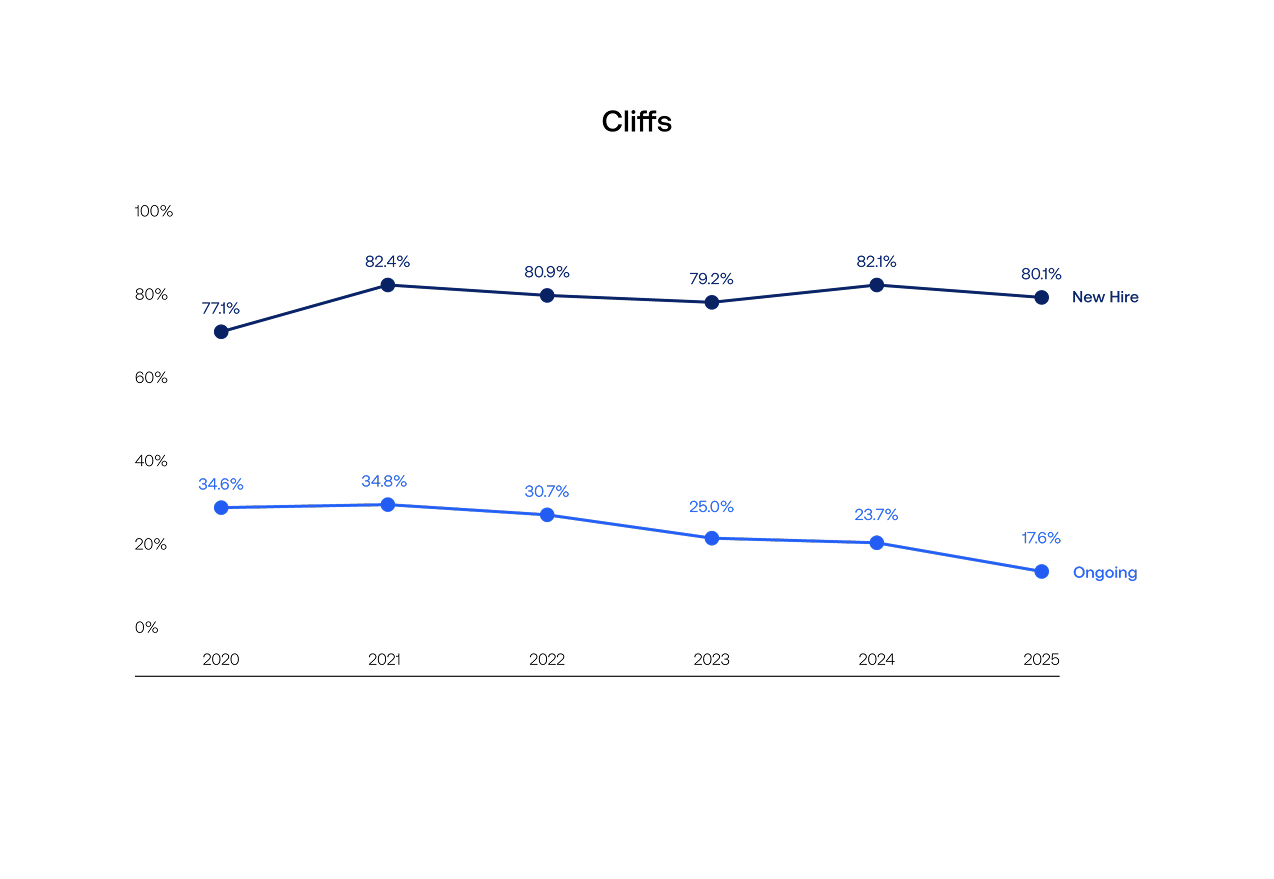
The mechanism depends on unvested value. An employee with nothing left to vest has no structural reason to stay, which makes vesting design, refresh cadence, and comprehension as important as grant size. Market practice offers a blueprint: in 2025, 80.1% of private-company new-hire grants included a vesting cliff, while cliff usage on ongoing grants fell to 17.6%.
Execution requires four elements:
- Benchmark at frontline levels. Real-time equity benchmarks show what peers actually grant by level, function, and location, so design reflects current practice rather than survey data collected before the last hiring cycle.
- Execute refresh decisions consistently. Compensation Planning embeds equity guidelines into the manager workflow and surfaces vesting-cliff risk mid-cycle, while managers retain final decision authority.
- Explain equity at the offer stage. Most frontline candidates have never received equity. Visual Offer Letter presents pay, bonus, equity, and benefits as one package and lets candidates explore the potential value of their equity across scenarios.
- Reinforce understanding after hire. Equity that is not understood cannot retain anyone. Total Rewards portals give employees ongoing visibility into their total rewards package and how their equity vests over time.
Takeaways for Retail Compensation Leaders
- Retail was the largest industry in the research linking broad-based equity to lower injury rates, and its injury rate ran above the study average.
- The effect was strongest under high mobility, dense local competition, and distance from headquarters—the defining conditions of retail operations.
- Retention and peer cooperation drive the effect; experienced, invested employees produce safer locations.
- Frontline participation remains low across the market, which is both why the lever is underused and why it differentiates.
- Equity only works when employees understand it. Pair real-time benchmarks with clear communication at offer and after hire.
Retail leaders have long treated turnover and safety as separate programs with separate budgets. The evidence indicates they share a lever, and that most retailers have never pointed it at the frontline.
Curious how retailers structure frontline equity? Benchmark your program against real-time market data

Charles is a member of Pave's marketing team, bringing nearly 20 years of experience in HR strategy and technology. Prior to Pave, he advised CHROs and other HR leaders at CEB (now Gartner's HR Practice), supported benefits research initiatives at Scoop Technologies, and, most recently, led SoFi's employee benefits business, SoFi at Work. A passionate advocate for talent innovation, Charles is known for championing data-driven HR solutions.


.avif)