Accurate job matches are the foundation of great compensation benchmarking—and the stakes are high.
Bad job matches lead to inconsistent compensation survey results, which erodes confidence in your team’s recommendations, creates pay equity risks, and leads to budgeting mistakes. Yet, companies continue to rely on the time-consuming, error-prone process of manual job matching, and often leave this important task to junior professionals.
Importantly, even if everyone involved in manual job matching works really hard and does their absolute best, there is no practical way to ensure manual decisions made across thousands of companies are fully consistent.
Thankfully, job matching and job leveling are perfect applications for AI and machine learning. Our approach at Pave gets the job done fast, accurately, and consistently across every company. Let’s take a look under the hood of Pave’s AI-powered job matching model—and dig into the details your key stakeholders need to know.
Our AI-Powered Process
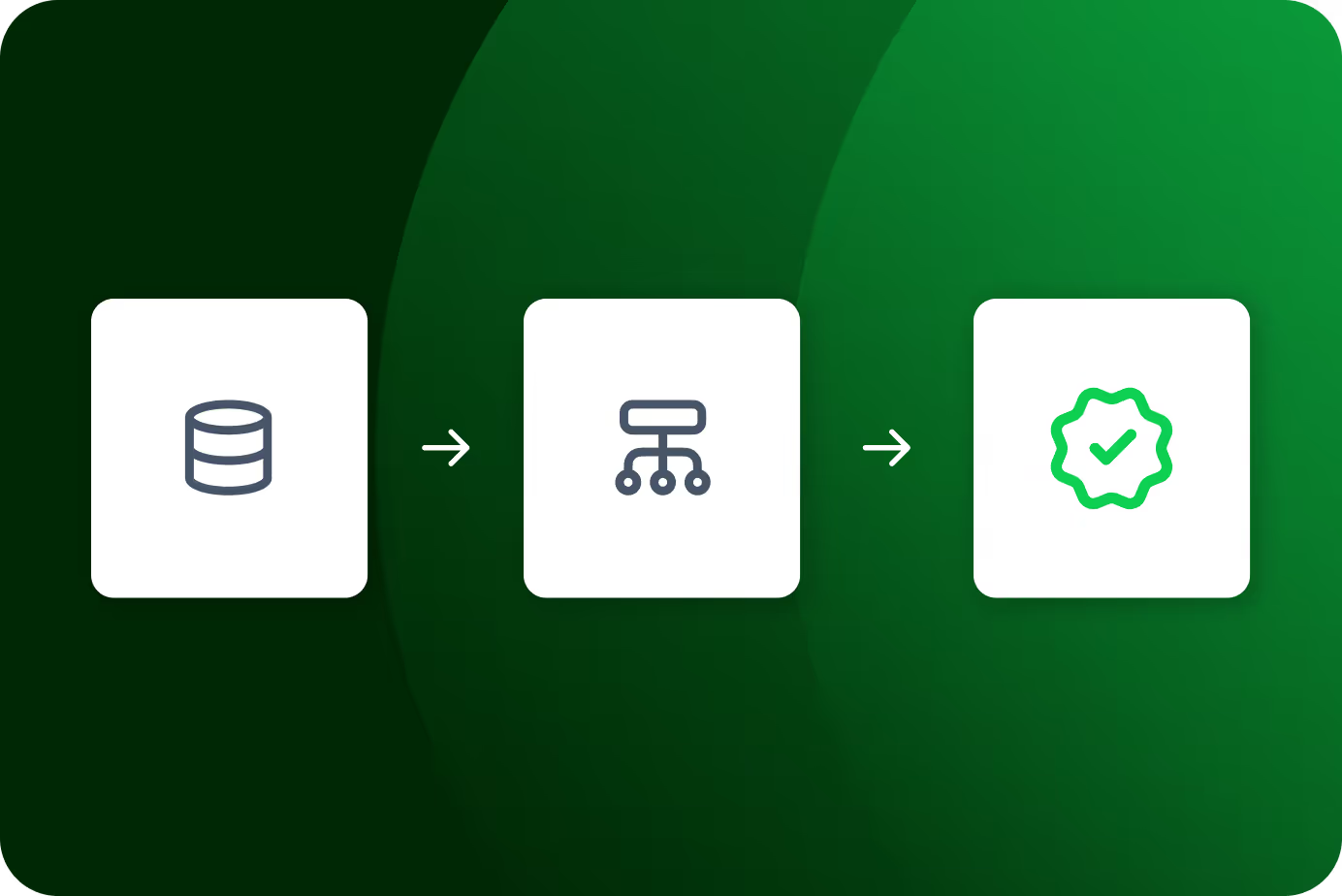
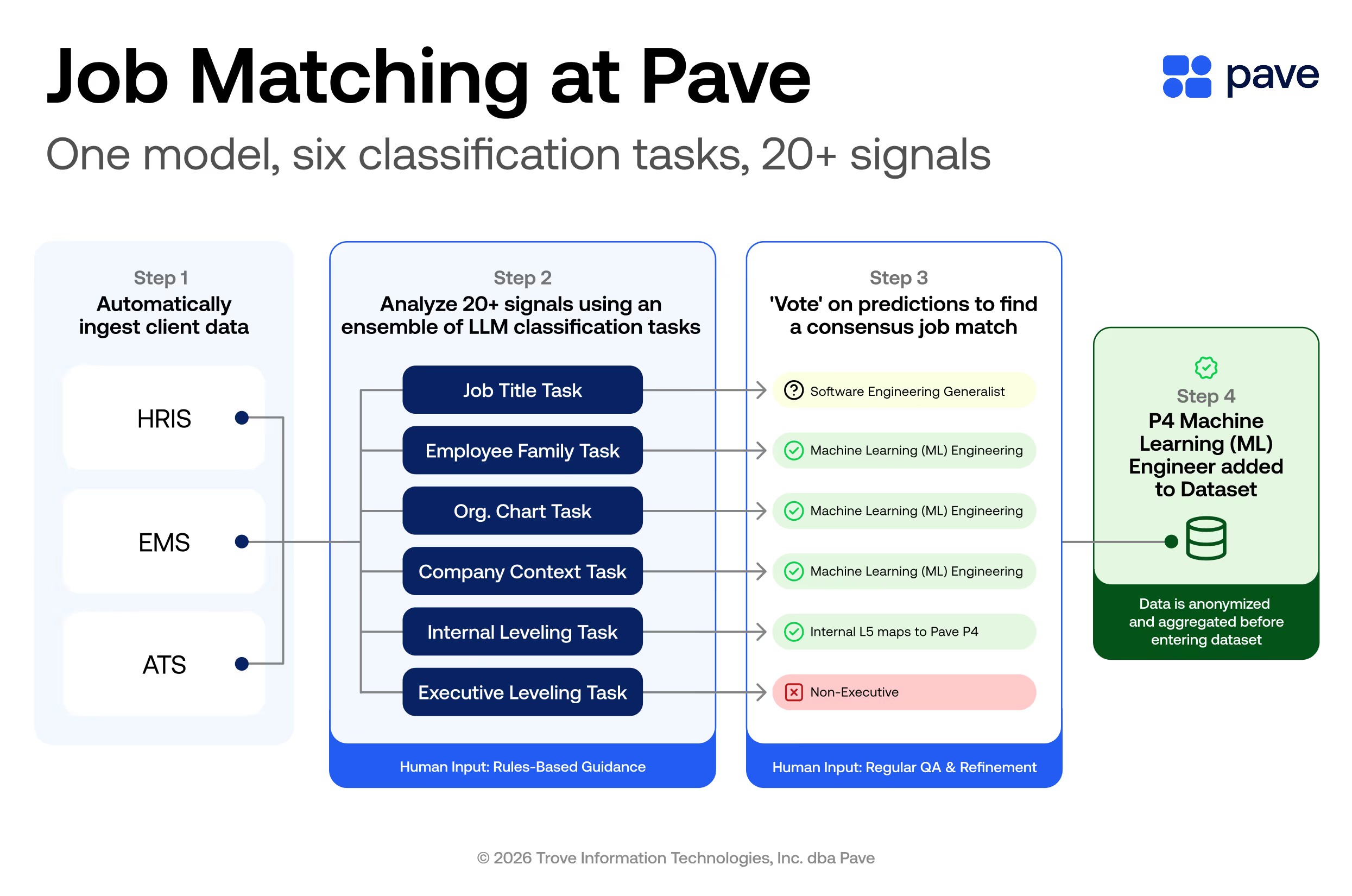
Pave’s approach to AI-powered job matching and job leveling breaks down into four simple steps:
- Step 1: Ingest data directly and automatically from client systems, including HRIS, EMS, and ATS platforms.
- Step 2: Analyze 20-plus signals from client systems through an ensemble of six distinct LLM classification tasks designed to match employees to Pave's job catalog.
- Step 3: Combine all predictions for a given employee into a series of ‘votes’ to produce a consensus ‘best fit’ job and level match, where no single variable or task can control the outcome.
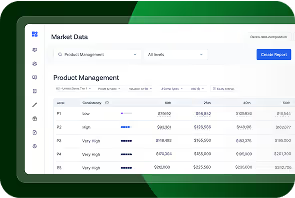
- Step 4: Anonymize and aggregate pay data for matched employees to generate real-time compensation benchmarks.
Importantly, as more data runs through this process, the results get better and better over time. Today, more than 8,600 companies rely on Pave for real-time compensation benchmarks, all produced using the four basic steps outlined above.
Behind the Model: Much More Than Job Titles
Let's dig deeper into Step 2 of our process, which is where the real differentiation happens. Pave’s comprehensive approach delivers consistent, accurate job matches at scale while eliminating bias, and this is only made possible through the use of AI and machine learning.
Our proprietary job matching and job leveling model leverages six independent large language model (LLM) classification tasks, which collectively analyze more than 20 signals for every employee simultaneously. These classification tasks return a prediction, or ‘vote,’ for how an individual employee matches to Pave's job catalog. The model then determines a final match when consensus is achieved across the independent classification tasks.
If the term 'classification task' is new to you, just think of it as a very specific type of LLM prompt where you're asking an AI model to categorize inputs into predefined classes. Instead of asking an LLM an open-ended, general question, as most humans do, our model is asking the task to consider a very specific set of signals to match employees to our predefined job catalog. And critically, to refine the recommendations, we run certain classification tasks multiple times to ensure all available signals are considered.
The 20-plus signals we consider fall into four general categories of HR data:
- Company-Specific Job Data: Most HRIS platforms include fields for job titles, job families, departments, functions, internal levels, internal job codes, and sometimes even complete job descriptions. We use all of this information to gain insight into the roles and responsibilities performed by a given employee.
- Organizational Context: Next, we consider where an employee is positioned in the org chart. Who do they report to? Who does their manager report to? And so on. We analyze these relationships, along with hierarchy levels, span of control (i.e., a person’s number of direct and indirect reports), and team composition. This helps us understand whether someone labeled as a "Manager" is leading no one, two people or twenty—a critical distinction for accurate job matching and job leveling.
- Compensation Patterns: Pay mix and pay type eligibility tell us a lot about whether an employee is a recent college graduate or a seasoned executive. For this reason, we examine base salary levels, salary normalized to location, variable and bonus pay eligibility, equity grants, and pay mix.
- Company Context: Roles and responsibilities vary significantly by company size, stage, industry, and location. A Vice President of Sales at a 50-person startup has a fundamentally different job than a Vice President of Sales at a 5,000-person enterprise. Our models account for company size, stage, ownership structure, industry, geographic location, market dynamics, organizational complexity, and the types of compensation utilized at the company.
In summary, Pave’s proprietary job matching and job leveling model stands out for its nuanced use of LLM classification tasks and multi-layered analysis of employee data, drawing on a diverse set of signals ranging from organizational context to compensation patterns.
As a result, it delivers highly accurate, bias-free matches tailored to each company’s unique structure and workforce. This comprehensive approach ensures that every employee is matched with the role that best fits their level and responsibilities.
AI-Powered vs. Manual Job Matching
While some highly specialized roles may always require additional context and manual scrutiny to job match correctly, the vast majority of employees can now be matched extremely accurately using AI-powered methods. AI is particularly well-suited for this work because of its ability to rapidly analyze and synthesize large volumes of data, run parallel analyses, and quickly determine employee-job alignment.
Pave’s AI-powered job matching and leveling process delivers:
- Speed: Pave executes job matches for thousands of employees in moments versus the weeks and months required for manual survey submissions. Now your compensation data and strategy can now move at the pace of your business.
- Consistency: Our algorithmic approach fully eliminates the analyst-to-analyst variation that plagues manual matching. Our model always analyzes every available signal for every employee in a consistent fashion.
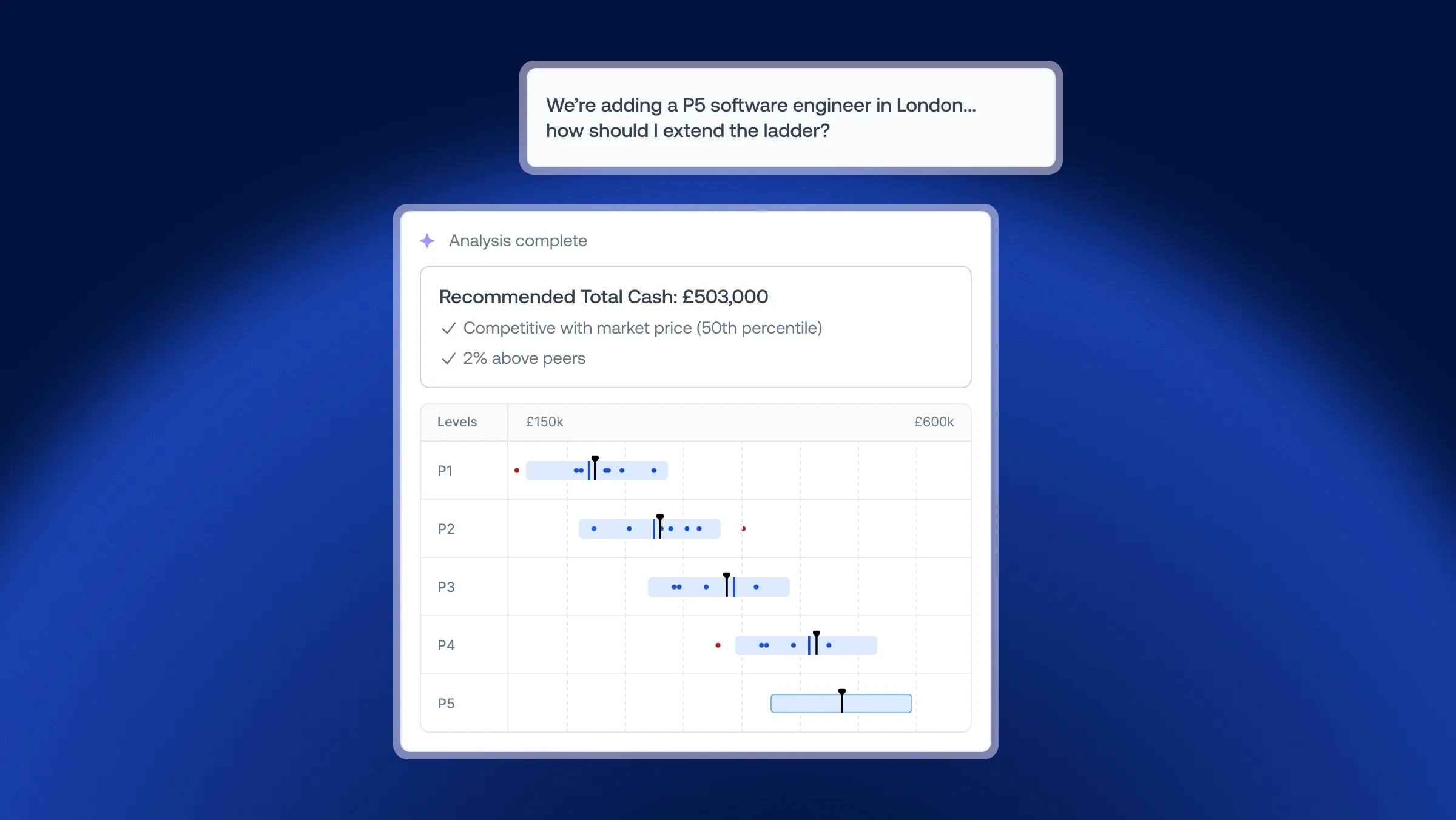
- Relevancy: With real-time access to underlying data sources, our AI provides always-on job matching that adapts as your organization evolves. In contrast, traditional surveys give you a once-a-year snapshot. With Pave, when someone is promoted, their level changes. When someone moves into a new role, their job changes. And when you hire an AI Research Scientist or Machine Learning Engineer for the first time, they're matched immediately—you’re never waiting for next year's survey cycle.
- Cost Savings: AI-powered job matching is included in Pave's platform for free. This eliminates costly job matching consultants who charge tens of thousands of dollars per year to complete survey submissions and frees up your team to focus on more strategic initiatives.
- Accuracy: Multi-signal validation, drawing from 20-plus data signals, outperforms title-only or description-only job matching, which is where even experienced analysts usually stop. Our proprietary ensemble approach means errors don't compound—they're voted out.
Understanding the Risks of Manual Job Matching
Pave’s process operates in stark contrast to the outdated manual method of job matching and job leveling, which is what traditional compensation surveys are built on.
You know the drill: a compensation leader receives a survey provider's job catalog and job matching booklet, and begins the painstaking work of mapping each role within their organization to an appropriate job code. In large companies with hundreds or thousands of employees, this becomes extraordinarily difficult when you're trying to understand hundreds of distinct roles.
In many cases, this work ultimately falls to a new or entry-level analyst, an intern, or an external consultant who may lack the necessary context and understanding of each role. The result? Inconsistencies and errors can permeate across survey datasets, making it hard to trust data that is critical to every pay decision your organization faces.
Even the most studious and well-intentioned professionals can make mistakes when job descriptions differ by only a few keywords or when they lack visibility into an employee's full scope of responsibilities.
The Future of Compensation Benchmarking
The shift from manual to AI-powered job matching and job leveling represents far more than an efficiency play or technological upgrade. It's critical to the transformation of compensation benchmarking from an annual guessing game into a strategic, always-on capability that operates in real-time.
Our approach allows us to process and update data as organizational changes occur, meaning our benchmarks reflect today’s market, not what was happening six, nine, or even 12 months ago. This allows you to act with confidence and operate as a more credible business partner.
Think about the next investment conversation you want to have with your CHRO or CEO. Do you want to be making a case for an extra intern or analyst to do another round of annual manual job matching, or do you want to ask for Pave so your team can demonstrate how AI is actually saving you time and money while making the data you use substantially better?
Ready to see how AI-powered job matching can improve your compensation data? Book a demo of Market Data Pro today.

Charles is a member of Pave's marketing team, bringing nearly 20 years of experience in HR strategy and technology. Prior to Pave, he advised CHROs and other HR leaders at CEB (now Gartner's HR Practice), supported benefits research initiatives at Scoop Technologies, and, most recently, led SoFi's employee benefits business, SoFi at Work. A passionate advocate for talent innovation, Charles is known for championing data-driven HR solutions.