Accounting Salary Benchmarks 2026 For Employers
Compensation and talent leaders rely on Pave to build accounting pay programs grounded in real-time market intelligence. Access accounting salary benchmarks by experience level, build competitive pay bands, and move faster on every hiring and retention decision.

Accounting Salary Trends Shaping 2026 Pay Strategies
Accounting salary benchmarking in 2026 is happening against a backdrop of structural workforce change. The Bureau of Labor Statistics projects accounting employment to grow 5% from 2024 to 2034, faster than the average for all occupations, with approximately 124,200 openings per year—many driven by retirements.
Pave's own data shows the share of new hires in accounting and financial operations fell 43% in under two years, from 3.45% in Q4 2023 to 1.98% in Q3 2025, across 8,600+ companies.This signals that organizations are rethinking headcount composition as automation reshapes entry-level functions.
Against this backdrop, pay pressure for experienced accounting talent remains real. Overall, finance and accounting pay increased 3.5% in the past 12 months, according to the Controllers Council 2025 Corporate F&A Talent Study, and Controllers and Assistant Controllers rank as the most challenging roles to recruit.
That aligns with Pave's 2026 compensation budget data, which shows a 3.5% median salary increase this year across 243 companies—modest growth that makes accurate benchmarking essential for staying competitive without overspending. Organizations relying on annual survey data to set accounting pay bands are already operating on figures that may not reflect today's market.
Where Pave’s Accounting Compensation Data Comes From
Traditional compensation surveys ask companies to submit data once a year through manual processes—and publish results that are, on average, six months old before they reach you. Pave works differently.
Pave collects compensation data through automated, persistent connections to HRIS, ATS, and equity management systems. Once your platforms are connected—a process that can take as little as 15 minutes—Pave aggregates and de-identifies employee records continuously, then publishes refreshed benchmarks monthly. The result is accounting salary data that reflects how the market is actually paying today, not how it paid last year.
Machine learning drives Pave's job matching, mapping employee records to standardized job families and levels with far greater speed and accuracy than manual methods. For accounting roles specifically, this means benchmarks that account for career level, scope of responsibility, and reporting structure—not just job title.
No stale data
Benchmarks updated monthly from live HRIS, ATS, and equity management system connections.
Aggregated and de-identified
All data is anonymized before entering Pave's database. Individual companies and employees are never identifiable in published benchmarks.
ML-powered job matching
Eliminates manual matching effort and ensures accounting roles are benchmarked against truly comparable positions.
Stop Benchmarking Accounting Salaries With Outdated Data
Annual compensation surveys were built for a slower world. Real-time market data—powered by automated feeds from ATS, HRIS, and equity management systems—is changing how compensation decisions get made. Pave's free whitepaper, A New Era in Compensation Benchmarking, explores why that shift is happening and what it means for your accounting pay strategy.
- Where traditional compensation surveys fall short—and the hidden cost of acting on stale data
- How the real-time market data revolution offers companies a better, faster path to accurate benchmarks
- What's holding compensation teams back from realizing the potential of live compensation intelligence
Annual Accounting Compensation Growth Trends
How accounting salaries are changing by experience level, CPA certification, and specialization—with guidance on calculating competitive salary bands that hold up to scrutiny.
Turn Market Insights Into Confident Accounting Pay Strategies
Real-time accounting salary data is only valuable if your team can act on it. Pave connects market intelligence to the full compensation workflow—so insights don't sit in a spreadsheet; they drive decisions.
From benchmarking individual accounting roles to running organization-wide merit cycles, Pave gives compensation leaders a structured, scalable process for every stage of the pay program lifecycle.
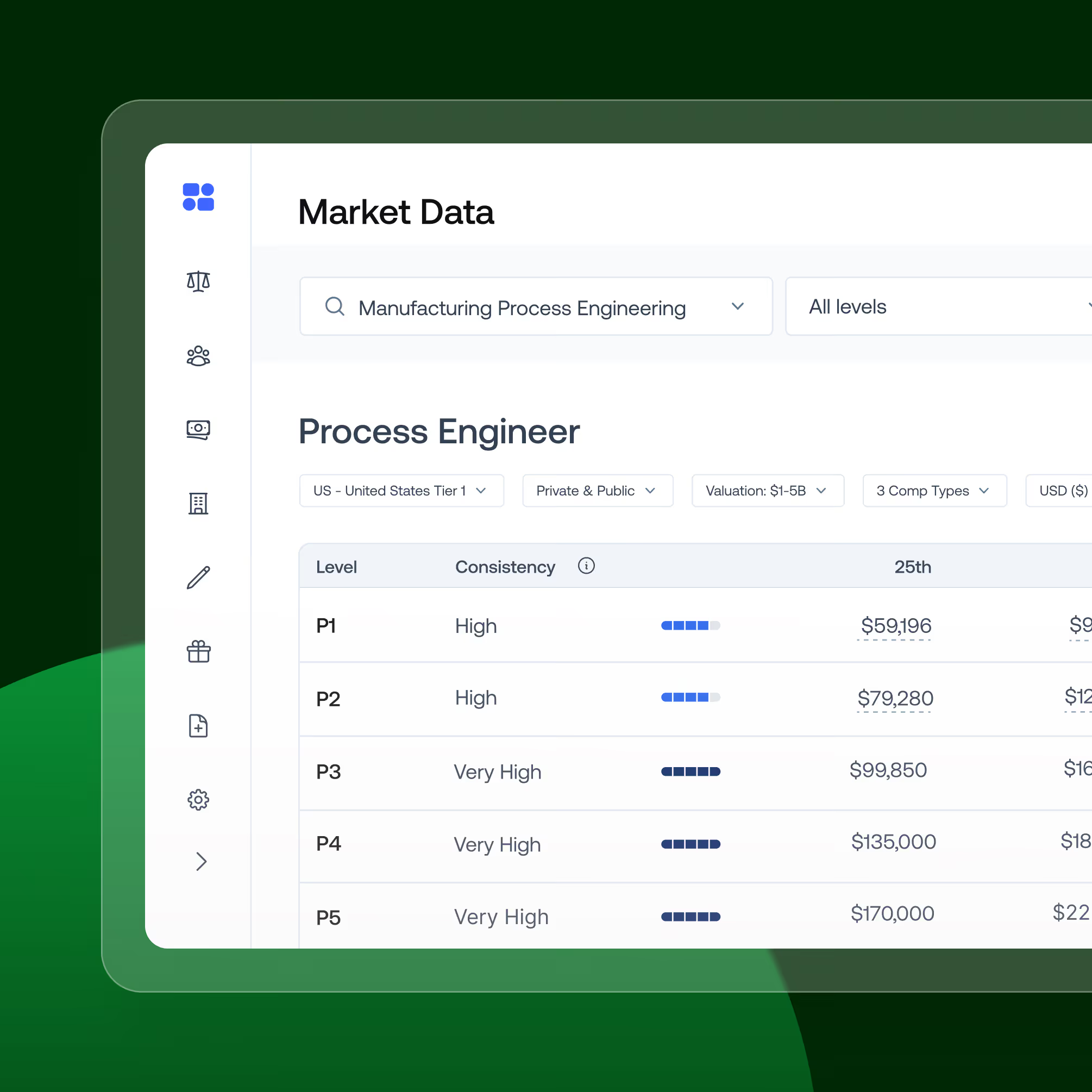
Market Data & Market Pricing
Benchmark accounting roles against live data and slot them accurately into your pay structure
Compensation Planning
Run merit cycles and promotion reviews with structured workflows and built-in budget controls
Team View
Identify pay gaps across your accounting team before they become retention risks
Total Rewards & Visual Offer Letter
Give candidates and employees a complete picture of accounting compensation that wins offers and builds loyalty
Business outcomes:
- Stronger accounting talent retention
- Faster, more competitive offers
- Pay band consistency at scale
- Proactive workforce planning
- Reduced time on manual benchmarking
- Auditability for every pay decision
Bring structure, speed, and confidence to your accounting compensation process.
Accounting Salary & Compensation Benchmarks FAQs
You have questions, we have answers. Explore some frequently asked questions about accounting salary and compensation benchmarks.
Accounting salary benchmarks are built by aggregating compensation data across a defined set of companies and standardizing it by role, level, and geography. Pave's benchmarks are created through automated connections to HRIS, ATS, and equity management systems—so data is collected continuously, de-identified, and refreshed monthly rather than relying on annual survey submissions. Machine learning accelerates job matching by mapping employee records to standardized accounting job families, ensuring benchmarks reflect genuinely comparable roles.
The most significant factors are geographic market, experience level, company size, and specialization (public versus private accounting). Geography has an outsized effect: accounting salaries in Tier 1 markets like San Francisco and New York can run above national medians. Company size influences total compensation mix, while experience level drives substantial base salary differentiation, particularly for senior and specialized roles like Controllers and CFOs.
For most accounting roles, yes. While base salary is the most visible component of an offer, variable pay, including annual bonuses, profit sharing, and, for senior finance roles, equity, often represents a meaningful portion of total compensation. Benchmarking only on base salary can lead to structurally uncompetitive offers if your variable pay programs are not accounted for. Pave provides benchmarks across base salary, bonus, and equity components so teams can assess the full compensation picture.
Yes, Pave's benchmarks include equity compensation data for accounting roles, including new hire equity awards, refresh grants, and unvested equity holdings. Equity is more common for senior accounting roles (Controllers, VP of Finance, CFO) at venture-backed and public companies, and Pave's real-time connections to equity management systems make it possible to benchmark these components with a level of accuracy that traditional salary surveys typically cannot match.
CPA certification consistently commands a salary premium over non-certified accountants at comparable experience levels—particularly in roles where licensure is required or preferred, such as public accounting, financial reporting, and senior finance management. The premium varies by role and market, and tends to compound with experience: at the Manager and Director level, the CPA premium is generally more pronounced than at entry or developing levels. Organizations building accounting pay bands should apply separate range structures for CPA-required and non-required roles to ensure accuracy.
Median accounting salary varies substantially by role, experience level, and geography. According to the Bureau of Labor Statistics, the median annual wage for accountants and auditors was approximately $79,880 in 2023—but this figure covers a wide range from entry-level staff accountants to senior Controllers and Finance Directors. Senior accounting roles in Tier 1 markets like San Francisco, New York, and Seattle are considerably above the national median. For current, role-specific benchmarks, Pave's Market Data provides real-time percentile data updated monthly.
Entry-level accountants (0–2 years) typically earn in the lower percentiles of market ranges, while career-level professionals (4–7 years) see meaningful step-ups in both base salary and bonus eligibility. Senior and principal-level accounting roles, particularly those managing teams or overseeing financial close and reporting, command the highest base salaries. A bachelor's degree in accounting or finance is the standard floor; a master's degree or CPA certification accelerates advancement into higher-paying roles. Pave benchmarks accounting compensation across Pave's standard career tracks—from Entry Level through Management and VP roles.
Maximize the impact of every pay decision with Pave