AI Engineer Salary Benchmarks 2026 For Employers
Pave gives compensation and talent leaders real-time AI engineer salary benchmarks by role, experience level, and location, with structured tools for building competitive pay bands in one of the fastest-moving talent markets of 2026.

AI Engineering Paygrade Trends Shaping 2026 Compensation Strategies
AI engineering compensation is moving faster than almost any other role category, and annual survey data is not keeping up. The BLS projects computer and information research scientist employment to grow 20% from 2024 to 2034, driven by industries seeking to develop and harness AI technologies. Pave's data shows the share of companies with AI/ML engineers grew from 11.9% in 2023 to 18.2% by mid-2025, meaning a significant share of organizations are pricing these roles for the first time without reliable benchmarks to anchor to.
Talent scarcity is compounding the challenge. Sign-on bonuses, retention packages, and equity refreshes are all being used to compete for a narrow pool of qualified AI engineers, creating compensation structures more complex and variable than most pay frameworks handle well.
Pave's 2026 data shows a 3.5% median salary increase across surveyed companies, but AI engineering market rates move independently of broad merit budgets. Applying a flat increase to a pay band already behind market defers the retention problem rather than solving it. Pave gives compensation teams real-time, location-specific AI engineer salary benchmarks and pay band management tools to price these roles accurately before attrition forces the issue.
Key stats:
- +20% — Projected computer and information research scientist employment growth 2024–2034 (BLS)
- 18.2% — Share of companies with AI/ML engineers by mid-2025, up from 11.9% in 2023 (Pave)
- 3.5% — Median salary increase in 2026 across surveyed companies (Pave)
Where Pave's AI Engineering Compensation Data Comes From
Pave collects compensation data through automated, persistent connections to HRIS, ATS, and equity management systems, publishing refreshed benchmarks monthly. For AI engineering roles evolving faster than job titles can track, monthly refresh cycles and specialization-level job matching are essential.
AI and machine learning handle job matching across 200+ job families by level, career track, and specialization. An AI Engineer, an ML Engineer, and a Prompt Engineer at the same nominal level are benchmarked against genuinely comparable roles, not grouped by keyword match.
- No stale data: Monthly updates from live system connections, not annual survey submissions
- Aggregated and de-identified: No individual companies or employees are identifiable in published benchmarks
- AI-powered job matching: AI engineering roles benchmarked by specialization and level, not title alone
Data coverage: 9,000+ companies | Monthly benchmark refresh | 55+ countries | 200+ job families incl. AI/ML engineering, prompt engineering, and GTM engineering | Base, Bonus, and Equity | Integrations: Workday, Rippling, BambooHR, Gusto, Greenhouse, ADP, Carta, and 30+ more
Stop Benchmarking AI Engineering Salaries With Outdated Data
AI engineering is one of the fastest-moving compensation categories in the market. Annual surveys six months old at publication are of limited use for a role where market rates can shift within a quarter. Pave's free whitepaper, A New Era in Compensation Benchmarking, explains what is driving the shift to real-time data.
- Where traditional compensation surveys fall short for specialized roles like AI engineering
- How automated HRIS, ATS, and equity management system feeds are transforming AI compensation decisions
- What is holding organizations back from realizing the potential of real-time compensation data
Annual AI Engineering Compensation Growth Trends
How accounting salaries are changing by experience level, CPA certification, and specialization—withAnnual AI Engineering Compensation Growth Trends
AI engineering compensation is moving at different speeds across specializations. Base salary growth, sign-on and retention bonus prevalence, and equity mix vary meaningfully between AI/ML engineering, prompt engineering, and GTM engineering roles.
How to calculate competitive AI engineer salary bands: Anchor to role-level market data at the 25th, 50th, and 75th percentiles for your target geography and company size. Apply separate band structures for AI/ML engineering, prompt engineering, and GTM engineering; each has distinct market rates and should not be grouped under a single band. Factor in specialization premiums for model fine-tuning, inference optimization, and AI infrastructure. Review alignment quarterly; AI engineering rates can shift faster than any other role category.
Turn Market Insights Into Confident AI Pay Strategies
Pave connects market intelligence to the full compensation workflow, from structuring pay bands across AI specializations to running merit and retention cycles for distributed teams competing against Big Technology and well-funded startups.
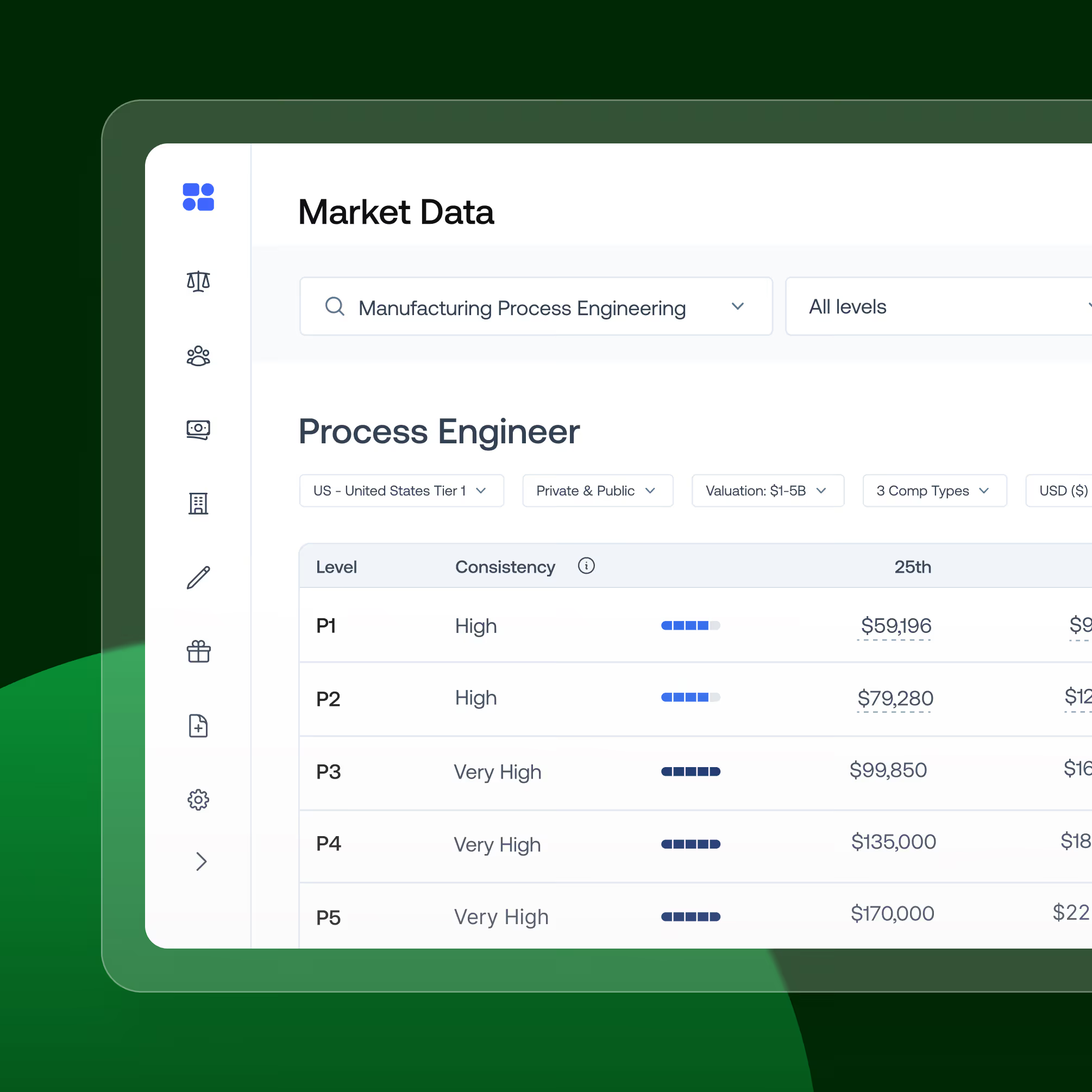
- Market Data and Market Pricing: Benchmark AI engineering roles by level, specialization, and location, then slot them into your pay structure
- Compensation Planning: Run merit and retention cycles with structured workflows, budget guardrails, and audit trails
- Team View: Give managers insight into the complete pay picture for the AI engineering teams
- Total Rewards and Visual Offer Letter: Win offers against the most competitive employers in the market
Business outcomes: Stronger AI talent retention | More competitive offers in a tight talent market | Pay band consistency across AI specializations | Defensible merit and retention decisions | Proactive planning against 20% projected industry growth
See how Pave powers your entire AI engineering compensation workflow from benchmarking to pay cycles, in one unified platform.
AI Engineer Salary & Compensation Benchmarks FAQs
You have questions, we have answers. Explore some frequently asked questions about AI Engineer salary and compensation benchmarks.
Compensation data is aggregated across companies and normalized by job family, level, geography, and specialization. Traditional providers collect annually, producing benchmarks often six to twelve months stale, a significant gap for a role where rates can shift within a quarter. Better approaches use automated HRIS and ATS connections to collect continuously and publish monthly. Specialization-level job matching also matters: benchmarks that group AI/ML engineers, prompt engineers, and GTM engineers together will misprice all three.
Technical specialization, geographic market, experience level, and company stage. Model fine-tuning, inference optimization, and AI infrastructure expertise command different rates than generalist AI engineering. Tier 1 markets pay well above national medians. Company stage drives significant equity variation, a meaningful component of an AI engineer's total compensation.
Yes. Equity is significant at growth-stage and public companies, and sign-on and retention bonuses are increasingly standard, given talent scarcity. Base-only benchmarks understate the real cost of competitive offers.
The best ones do. Equity benchmarking requires grant-level data from equity management systems, which traditional surveys typically do not collect. Sign-on and retention bonuses should also be factored in. Providers sourcing directly from the cap table and equity management platforms deliver more complete benchmarks.
Prioritize high data freshness, meaningful sample sizes of AI engineering roles, specialization-level coverage, and transparent methodology. Annual survey providers lack the refresh cadence AI engineering requires. Real-time platforms collecting from HRIS and ATS systems and publishing monthly are better suited to how fast AI engineering rates move.
Government sources like the BLS provide broad occupational data but limited AI specialization depth. Crowdsourced platforms have volume but lack normalization. Specialized compensation benchmarking platforms that collect from HRIS and ATS systems, segment by AI specialization and level, and refresh monthly are the most reliable for employer planning. Pave's real-time Market Data covers AI/ML engineering, prompt engineering, and GTM engineering roles across 9,000+ companies.
Look for structured leveling frameworks, percentile breakdowns at the 25th, 50th, and 75th, band construction tools, and direct HRIS and ATS integration. One-time reports go stale quickly for AI engineering; ongoing subscriptions with frequent refresh cycles are more appropriate. General technology platforms that added AI roles as an afterthought often lack the specialization, depth, and sample size to produce reliable benchmarks.
Maximize the impact of every pay decision with Pave