.avif)
The Atlantic’s March 2026 cover story examined America’s readiness for AI’s impact on jobs. Dario Amodei, CEO of Anthropic, stated that AI could eliminate half of all entry-level white-collar jobs. Jim Farley, CEO of Ford, estimated that half of white-collar roles could disappear within a decade.
The article also highlighted that hundreds of thousands of U.S. factory and construction jobs remain unfilled. Farley noted a significant shortage of highly skilled, well-compensated technicians in the auto industry, whose roles are difficult to automate.
These trends reveal a misalignment in talent supply and demand: AI reduces white-collar opportunities while increasing the need for skilled technical labor in manufacturing. Leaders now have a rare opportunity to reshape the workforce and strengthen their organizations.
The “Double Jeopardy” of Talent Pipelines
Macro data supports what manufacturing HR teams observe. Randstad’s analysis of 50 million job postings shows demand for skilled trades is rising three times faster than for professional roles. Demand for robotics technicians is up 107% and HVAC engineers are up 67%. Electricians, welders, and construction workers are also highly sought after. According to Randstad’s CEO, the main global growth constraint is not technology or capital, but a shortage of people to build and maintain AI and manufacturing infrastructure.
Modern manufacturing jobs are increasingly technical and specialized. Industrial Equipment News highlights emerging roles such as Robot Wranglers, AI Systems Integrators, Predictive Maintenance Engineers, and Human-Robot Collaboration Specialists. The industry is projected to need approximately 3.8 million new workers by 2033, requiring new skill sets.
However, the talent pipeline is not self-sustaining. Randstad found that for every 100 young people entering manufacturing, 102 leave. It now takes longer to hire a skilled tradesperson (56 days) than a desk-based professional (54 days). Additionally, 86% of supply chain leaders surveyed by Gartner believe that agentic AI will require entirely new talent-pipeline processes. As a result, job structures and salary bands are being redefined in real time.
Traditional manufacturers are responding by redesigning talent acquisition and rewards strategies. For example, General Motors recently posted a robotics-focused AI position in Mountain View, California, reporting to the Chief AI Officer. The job description resembles that of a tech startup, signaling GM’s intent to attract and compete for technical talent. Electric Boat is hiring 8,000 workers in Groton, CT and spends $100 million a year on training them.
Two different ends of the manufacturing talent spectrum, same underlying problem: the demand for technical, physical-world workers has outstripped supply, and traditional recruiting approaches can't close the gap.
Talent Is Physically Moving Towards Manufacturing
Another key workforce trend is the physical relocation of talent to manufacturing cities and towns.
The Atlantic also reported that three of the five fastest-growing metro areas in the country are in the Midwest. Rockford, Illinois—an hour and a half from Chicago and home to Woodward, Collins Aeropsance, and Stellantis production facilities—was the most popular city for home shoppers last year, according to Zillow. Dearborn, Michigan (Ford Motor Company), and Toledo, Ohio (Johns Manville, Owens Corning, and Libbey Inc.), made the top five. More people are moving to Milwaukee, Cincinnati, Grand Rapids, Columbus, and Indianapolis.
Meanwhile, record numbers are leaving Austin, Miami, Tampa, and Fort Lauderdale. Domestic migration to the Sun Belt peaked in 2021-22 and has since declined sharply.
This migration trend coincides with a shrinking number of entry-level white-collar roles. Pave’s data shows organizations shifting from a pyramid to a diamond-shaped workforce, with fewer entry-level positions and more skilled roles. The Stanford “Canaries Paper” reported a 13% decline in employment among 22- to 25-year-olds since late 2022. Pave’s own data also shows this trend.
As a result, more technically skilled but career-uncertain young workers are entering a job market with fewer expected options, and many are relocating to manufacturing regions.
These candidates are now more accessible, but they are unlikely to use traditional manufacturing job boards. Reaching them requires a new approach to communicating the employee value proposition.
Compensation as the Capture Mechanism
Many manufacturing compensation teams see pay as a cost, while leading companies use it strategically to drive growth, accelerate hiring, fill key roles, and retain talent.
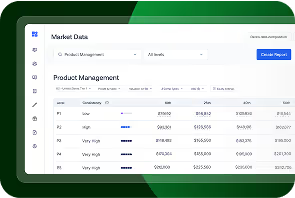
For example, according to Pave data, a P5-level robotics hire at the 50th percentile receives about $589,000 in new-hire equity, while the 75th percentile receives $894,000—a $305,000 difference.
However, losing and replacing a hire at this level costs more than this gap. In this case, designing an equity program that rewards at the 75th percentile and retaining talent for three years is more cost-effective than paying at the 50th and replacing them every eighteen months.
This provides a clear business case for the CFO. Rather than saying, “We need to pay more because the market moved,” compensation leaders can demonstrate that their compensation strategy addresses six-figure replacement costs for critical roles, prevents losing candidates to tech companies and data center operators, and leverages a unique window to attract talent previously unavailable. Competitive compensation is more cost-effective than maintaining the status quo. This shifts the conversation from cost to growth infrastructure and changes the organization's view of talent investment.
The offer letter is the final mile. When compensation packages include equity or other complex elements, a static PDF does not effectively communicate value or persuade candidates to join. Tech candidates expect visual breakdowns of total rewards and clear vesting schedules. In our example of a manufacturing company hiring P5 engineers and competing against big tech, the presentation of the offer is as important as the offer itself.
The Window Won’t Stay Open
Manufacturers now compete for talent with tech companies and the broader AI infrastructure and technology sectors. The expanding talent pool benefits decisive organizations. White-collar displacement brings new candidates, and more people are relocating to manufacturing hubs. New factory roles are attractive, well-compensated, and difficult to automate. An organization’s compensation strategy will determine success in this environment.
Ultimately, the ability to capitalize on this opportunity depends on how well a business’s compensation strategy aligns with current market dynamics. Updating compensation is the key to securing a talent advantage.
See how Pave’s market data helps companies benchmark against the right competitive set.

Charles is a member of Pave's marketing team, bringing nearly 20 years of experience in HR strategy and technology. Prior to Pave, he advised CHROs and other HR leaders at CEB (now Gartner's HR Practice), supported benefits research initiatives at Scoop Technologies, and, most recently, led SoFi's employee benefits business, SoFi at Work. A passionate advocate for talent innovation, Charles is known for championing data-driven HR solutions.