Three-quarters of manufacturing organizations are retooling their learning and development programs. Nearly 60% are establishing entirely new roles focused on digital and smart manufacturing. The commitment is substantial.
Yet Gartner's study found 30% of manufacturing workers often consider quitting, and 21% actively search for new jobs. Training budgets grow, but retention doesn't always improve.
The issue isn't necessarily what manufacturers are teaching—it's what workers can or can't see about the link between learning and earning.
Why Training and Compensation are Disconnected
Most manufacturers separate workforce development and compensation. Training stays with operations; pay bands with HR. Workers experience both yet see no connection between them.
Lack of visible advancement is now a top-five reason for quitting—not because growth isn't available, but because it's invisible. If completing certification or learning a new machine doesn't change their paycheck, it may have just made a more skilled worker look for a better offer.
Pave’s cross-industry data gives a clear incentive analysis: the median merit increase for meeting expectations is 3.5%. Promotions yield a 9.7% increase—nearly triple. That spread represents a key retention lever. Success hinges on visibility: employees must understand the pathway, required skills, and expected financial outcomes.
Legacy Pay Bands Don’t Fit Modern Manufacturing Roles
The problem grows as manufacturing roles change. In 2026, many manufacturers are adding new jobs in digital and smart manufacturing—such as data-literate operators and robotics techs. These positions don't fit legacy pay structures designed for legacy jobs.
If your comp bands haven't been rebuilt to reflect what smart manufacturing actually demands, you're either underpaying the new roles and losing people, or overpaying the old ones and wasting budget.
Benchmarking via industry averages is insufficient. While production workers average $29.51/hour, this metric does not reflect the varied, specialized talent markets for roles in today's manufacturing environment. Benchmarks must be tailored at the role level.
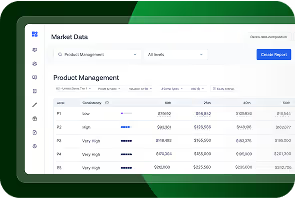
The gap is even starker for emerging roles. BLS classifies robotics engineers under "electro-mechanical and mechatronics technologists and technicians"—and in manufacturing, that role tops out at roughly $80,500 at the 75th percentile. Compare that to Pave's cross-industry dataset, where entry-level robotics engineers (P1) start at $81K and the role scales to over $270K at the senior end. The manufacturing pay ceiling for this role is barely the cross-industry entry point.
If your robotics talent is benchmarked against BLS manufacturing data, you're likely underpaying. As more industries start hiring in this area, you may find yourself facing a larger talent management issue than you’d like.
Make the Skill-to-Pay Connection Visible
You can train someone to operate a cobot or certify them on a new line, but if they can't clearly see on their phone how it affects their rewards, they won't stay. You've only made them more marketable.
Apply the kitchen table test: can employees articulate their current compensation, future earning potential, and the specific rewards tied to skill advancement—including benefits, shift premiums, or higher pay bands?
If this connection is unclear, expect your training program to operate as a cost center rather than a retention driver.
Most manufacturers have a gap. Comp bands are maintained in an HR spreadsheet. Training programs are in the break room. Workers see neither. A modern communication portal connecting the two—showing career progress and its financial value—turns training spend into employee retention.
Companies making the deal visible win. Those who don't spend millions training people who leave.
Aligning Comp Strategy with Training: Where to Start
Manufacturing has the right instinct: invest in people. But that ROI depends on aligning comp strategy with training. Link training directly to pay. Make pathways visible—benchmark new roles, not old averages.
The organizations that figure this out won't just close the skills gap. They'll close the retention gap, too.
This article is part of Pave's ongoing series on manufacturing compensation strategy. See also: The New Manufacturing Compensation Playbook, How AI, Gen Z, and Labor Shortages Are Rewiring Manufacturing Compensation, and 5 Reasons Manufacturing Workers Quit.

Charles is a member of Pave's marketing team, bringing nearly 20 years of experience in HR strategy and technology. Prior to Pave, he advised CHROs and other HR leaders at CEB (now Gartner's HR Practice), supported benefits research initiatives at Scoop Technologies, and, most recently, led SoFi's employee benefits business, SoFi at Work. A passionate advocate for talent innovation, Charles is known for championing data-driven HR solutions.