Chemical manufacturers recognize the competition for talent but often underestimate the range of industries they compete against.
A recent Skills Alliance analysis found that compensation packages among chemical sector employers are now largely indistinguishable, with similar salary bands, commission structures, and bonus frameworks. Experienced commercial professionals see little financial incentive to move between chemical companies, as differentiation has diminished.
The greater risk is not from a local competitor with a similar offering, but from employers in other industries offering more attractive packages.
Intersection of High-Demand Sectors
Chemical manufacturing operates at the intersection of several high-demand sectors, and the talent it requires is sought across multiple industries.
Process engineers, among the most difficult roles to fill in the chemicals industry, are also recruited by pharmaceutical companies, energy producers, semiconductor manufacturers, and advanced materials firms. These industries compete for the same individuals, often offering larger budgets and stronger employer brands. Professionals who combine chemical engineering expertise with data science, automation, or sustainability are highly sought after across all sectors.
The data underscores this challenge: nearly 22% of the U.S. chemical workforce is eligible to retire within ten years, and the sector directly employs approximately 334,00 workers.
Searches for chemical plant managers average 90 to 150 days, among the longest in industrial hiring. Extended vacancies pose production, safety, and revenue risks that increase each week the position remains unfilled.
This dynamic also affects EHS specialists, maintenance professionals with specialized certifications, and formulation chemists. These candidates are typically passive, already employed, and receiving outreach from multiple industries at once.
Sales & Technical Talent are Cross-industry Battlegrounds
The challenge is even greater for commercial teams. This year, 72% of employers globally report difficulty filling sales and marketing roles quickly. Chemical companies compete not only with industry peers for technical sales talent, but also with sectors such as medical devices, industrial automation, SaaS, and others that require professionals skilled in selling complex products to technical buyers.
When compensation packages among chemical employers are similar, candidates prioritize leadership quality, career progression, product differentiation, and decision-making speed. The underlying issue is that chemical companies often benchmark against each other using annual surveys that are 12 to 18 months old, while adjacent industries move faster and use more current data to create more attractive total rewards.
Technical sales professionals with expertise in formulation chemistry, distribution models, and industrial applications are rare. This profile is also highly attractive to specialty materials companies, agricultural technology firms, and clean energy startups, which may offer equity, faster promotion timelines, or compensation structures that chemical manufacturers have not traditionally matched.
The Comp Infrastructure Gap
Production worker hourly earnings in chemical manufacturing increased by 2.4% year-over-year, with average wages surpassing $30 per hour for the first time in April 2026. However, headline wage growth does not reflect the significant movement occurring at senior technical and management levels, where competition from adjacent industries is most intense.
The challenge is not only what chemical companies pay, but also their awareness of broader market compensation and their ability to communicate the full value of employment. Relying on annual industry surveys means offers are based on outdated data. When candidates cannot see the complete scope of total rewards, including base, bonus, benefits, and development opportunities, they focus solely on base salary. As Skills Alliance notes, chemical companies are nearly indistinguishable on this metric.
The companies that succeed in attracting talent will not necessarily be those that pay the most, but those that understand the market in real time, clearly communicate the full value of their opportunities, and act quickly to secure candidates before adjacent industries do.
Don’t Let the Next Great Hire Slip Away
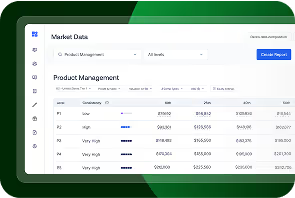
Do not let your next key hire be lost to an unexpected competitor. Pave Market Data provides real-time compensation benchmarks across chemicals and adjacent sectors actively recruiting your talent. The Total Rewards Portal enables candidates and employees to view their complete compensation, benefits, and growth opportunities. The Visual Offer Letter presents your offer in a distinctive format and highlights the full value your company provides.

Charles is a member of Pave's marketing team, bringing nearly 20 years of experience in HR strategy and technology. Prior to Pave, he advised CHROs and other HR leaders at CEB (now Gartner's HR Practice), supported benefits research initiatives at Scoop Technologies, and, most recently, led SoFi's employee benefits business, SoFi at Work. A passionate advocate for talent innovation, Charles is known for championing data-driven HR solutions.