
Retail depends on its frontline employees: those who greet customers, stock shelves, run kitchens, and keep operations moving. According to UKG's 2025 frontline workforce study, which surveyed over 8,000 workers in 10 countries, retail, hospitality, and food service workers face intense pressure, which is driving frontline worker turnover.
78% report chronic burnout. 62% live paycheck to paycheck, the highest rate of any industry. 40% are actively job-hunting, also the highest of any sector. Burned-out frontline workers report clear consequences: 84% say they are less productive, 72% make more mistakes, and 41% begin searching for new employment. These effects are quickly visible in customer-facing roles.
The UKG data highlights several key challenges and a shared opportunity to reconsider how compensation and rewards are structured and communicated.
The Financial Pressure Extends Beyond Hourly Wages
Low pay remains the leading reason frontline workers left their jobs in both 2024 and 2025. Retail’s 62% paycheck-to-paycheck rate is six points higher than the global frontline average, indicating the greatest financial strain among all industries surveyed.
45% of frontline workers say that two paycheck errors would start a job search. Retail payroll is often more complex than in other industries due to variable hours, tips, and shift differentials, which increases the risk of errors and erodes trust. Reliable payroll systems that allow employees to easily report issues are as important as pay rates.
There is also a lack of visibility. Many retail employers provide competitive benefits, but employees are often unaware of them. When considering competing offers, workers typically compare hourly rates, as these are most familiar. Health coverage, tuition reimbursement, retirement matching, shift premiums, paid time off, and other benefits are frequently overlooked or poorly communicated.
Mobile-first total rewards statements can address this gap. Every employee should be able to answer: “What is the full value of my compensation here?” If they cannot, retention will suffer, and pay increases alone will not resolve the issue.
Scheduling Has Become a Critical Factor
For the first time in 2025, work schedules ranked among the top five reasons frontline workers quit. Half of these workers report difficulty changing shifts for personal reasons, and 49% say their schedules prevent them from maintaining a healthy lifestyle.
This challenge is most pronounced in retail, where weekly hours fluctuate, seasonal changes are significant, and last-minute adjustments are common. Employees who cannot plan their lives around work will seek employers who offer flexibility. Scheduling flexibility, shift swaps, and control over overtime should be included in total rewards discussions alongside pay and benefits.
Growth & Recognition Remain Overlooked
Lack of career advancement became one of the top five reasons for quitting in 2025. Retail has the highest turnover, and career paths often end at the shift lead level. When employees do not see a clear path forward, they leave—even if pay is adequate. Connecting compensation progression to skill development and defined milestones encourages retention.
Recognition is a less visible issue. Retail employees are often dispersed across locations with limited interaction with leadership. Spot bonuses, peer-nominated awards with monetary value, and acknowledgment tied to specific achievements resonate with frontline workers. Employees who keep operations running during peak times need to feel recognized.
Benchmarking Pay May Be Too Limited
Retail compensation and HR teams often benchmark pay only against other local retailers. However, retail associates now compare offers with positions in warehouse fulfillment, gig platforms, healthcare, and logistics. Frontline talent pools span multiple industries, especially in metropolitan areas with competitive labor markets.
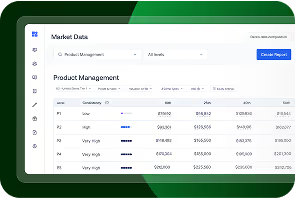
If benchmarking is limited to NAICS codes, employers may overlook competitors attracting their employees. Tools such as Pave Market Data can reveal trends across industries that compete for the same frontline workforce.
Implications for Retail HR Leaders
Retail’s frontline workforce is experiencing burnout, financial strain, and a greater willingness to leave than in any other industry. The key challenges are clear, and solutions lie within total rewards: make the full value of employment visible in accessible formats, benchmark against the broader cross-industry market, and address scheduling, career development, and pay accuracy as integral components of rewards.
The hourly talent market has changed significantly in the past five years. Total rewards strategies for retailers should evolve accordingly.
Discover how Pave supports total rewards leaders in benchmarking, pricing, rewarding, and communication.

Charles is a member of Pave's marketing team, bringing nearly 20 years of experience in HR strategy and technology. Prior to Pave, he advised CHROs and other HR leaders at CEB (now Gartner's HR Practice), supported benefits research initiatives at Scoop Technologies, and, most recently, led SoFi's employee benefits business, SoFi at Work. A passionate advocate for talent innovation, Charles is known for championing data-driven HR solutions.
Frequently Asked Questions:
Why is retail employee turnover so high?
Retail, hospitality, and food service workers report the highest active job-search rate (40%) of any industry, driven by low pay, inflexible scheduling, limited career advancement, lack of recognition, and poor visibility into benefits. 62% live paycheck to paycheck, and 78% report chronic burnout.
What benefits do retail workers value most?
Beyond base pay, frontline retail workers value health coverage, paid time off, tuition reimbursement, retirement matching, and shift premiums—but these benefits frequently go unnoticed because they're poorly communicated. Most employees default to comparing hourly wages when evaluating competing offers, because that's the number they can see. Scheduling flexibility and shift-swap control also rank highly, particularly as work schedules have entered the top five reasons for quitting for the first time in 2025. Making the full value of these benefits visible—through mobile-first total rewards statements—is one of the highest-leverage retention moves available to retail employers.
How can retailers reduce frontline employee burnout?
Retailers can reduce burnout by giving workers more control over their schedules, ensuring payroll accuracy, making total rewards visible on mobile devices, and creating clear career progression paths beyond entry-level roles.
What should retail companies benchmark compensation against?
Retail comp teams should benchmark against warehouse fulfillment, logistics, gig platforms, and healthcare aide roles—not just other retailers. Frontline talent pools are cross-industry, especially in metro areas where hourly workers have multiple options within commuting distance.
Why do frontline workers quit over scheduling?
Work schedule entered the top five reasons for quitting for the first time in 2025. Half of frontline workers say it's difficult to change shifts for personal reasons, and 49% say their schedule makes a healthy lifestyle impossible. In retail, where hours change weekly and seasonal swings are steep, lack of schedule control is a direct turnover driver.
What is a total rewards statement, and why does it matter for retail workers?
A total rewards statement is a personalized summary of everything an employee receives in exchange for their work—base pay, health and retirement benefits, paid time off, tuition assistance, shift premiums, and other perks—expressed as a single complete picture rather than just an hourly rate. For retail workers, who are more likely than workers in any other industry to evaluate job offers based on wages alone, total rewards statements make the full value of employment visible and comparable. Mobile-first formats are especially effective for frontline workforces, since most retail employees don't sit at a desk. When workers understand what they actually earn, retention improves—without requiring a pay increase.