A recent Gartner survey of over 10,000 employees confirms a significant shift in employee priorities for 2026. Work-life balance, career growth, and individual pay differentiation have become less important for most workers. Instead, employees now prioritize financial stability and protection from unforeseen events.
For compensation leaders developing next year's total rewards strategy, this represents a major change, and may open the door to a 2027 realignment of budget allocations.
The Shift for Total Rewards
Gartner's 2026 survey shows that the top 15 most valued total rewards offerings now focus on financial stability and protection from future costs, rather than flexibility and growth-oriented perks. Gartner advises CHROs to redirect total rewards investments to attract and retain key talent while managing costs.
Gartner points to three shifts worth acting on:
- Employees seek long-term wealth over short-term incentives. Future base pay increases, long-term incentive (LTI) target amounts, and LTI vesting periods now take precedence over merit pay differentiation and short-term incentives. Employees also value more frequent recognition through spot bonuses, even as they deprioritize short-term incentives overall.
- Well-being programs require reassessment. A separate early 2026 Gartner survey found that fewer than 35% of employees report high overall wellness, despite significant investment.
“Employee well-being has not meaningfully improved in the past three years, despite significant organizational investment,” said Joe Coyle, vice president analyst in the Gartner HR practice. “Employees do not value most individual well-being benefits, except for LSAs, GLP-1 access, and fitness subsidies, offering CHROs the opportunity to make targeted changes to the well-being benefits offered.”
Gartner recommends discontinuing unused benefits and reinvesting in flexible, fund-based options employees can manage themselves.
- Medical cost anxiety is a primary concern. Employees are focused on the financial risks of accessing care and the burden of ongoing healthcare costs. Gartner advises auditing benefit investments to address these concerns and communicating the results clearly.
The Problem? Communication as Much as Design
Compensation leaders should note that these shifts do not require adding new benefits. Instead, they involve reallocating existing investments to align with employee preferences, eliminating underused well-being benefits, and increasing transparency about current offerings.
This reallocation is effective only if employees are aware of the changes. Employees may not recognize a shift from a well-being budget to a lifestyle spending account, or view an improved LTI structure as long-term wealth without clear communication. As discussed in Compensated, But Not Convinced, most companies have the tools to communicate pay, but comprehension, not communication reach, remains the challenge.
Where Pave Agentic Workflows Fit Into a 2027 Reset
If you plan to act on Gartner's findings, the Pave platform aligns with several key areas of this work, while some aspects fall outside its scope:
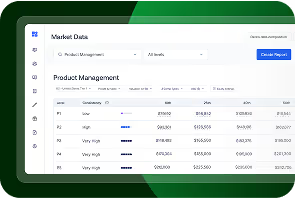
- Benchmark the wealth-creation shift using Market Data. Gartner's first finding, that employees prioritize future base pay, LTI target amounts, and LTI vesting periods over merit differentiation, is fundamentally a benchmarking issue. Market Data provides real-time, reliable benchmarks for base pay growth and equity practices, ensuring decisions about LTI targets and vesting schedules reflect current market trends. Once benchmarks are set, equity motivates employees only if they understand its long-term value, including vesting timelines and projected value, not just the initial grant amount.
- Implement the new philosophy with Compensation Planning. Shifting toward long-term incentives and away from merit differentiation requires consistent application in each compensation cycle. Compensation Planning translates your updated pay philosophy into guided, structured workflows, ensuring the strategic reset is reflected in every recommendation, regardless of the compensation planner, not just in presentations.
- Address the comprehension gap with the Total Rewards Portal and Team View. After reallocating well-being budgets to LSAs or reframing medical benefits to protect costs, employees must be able to see the value. The Total Rewards Portal provides a comprehensive, always-available view of the full benefits package, while Team View equips managers with the same information, enabling them to communicate changes confidently. This is essential, as most managers are expected to discuss pay without extensive training; effective communication requires that they be well-prepared.
Use The Pave Agent to Model the Impact on Your Workforce
Gartner's findings represent averages across thousands of companies. The key question for a CHRO or CFO is not whether the trend is real, but how a shift, such as employees prioritizing LTI vesting periods over merit differentiation, affects your workforce, given your specific plan design, job architecture, and pay philosophy.
The Pave Agent is designed to address these questions by analyzing your organization's data, rather than simply summarizing Gartner's findings. When applied to a trend, it can synthesize:
- How your current LTI target amounts, vesting periods, and merit differentiation practices compare to the market using real-time Market Data.
- Where your job architecture and leveling framework are most affected by such a shift, identifying which levels or functions rely most on merit pay versus LTI, and where reallocation may have the greatest impact or create compression risk.
- What would a reallocation cost within your current budget constraints, modeled against your Compensation Planning guidelines, before making recommendations to the CFO.
The result is a set of company-specific findings, including data sources and confidence levels, that can be presented and defended in CHRO or CFO discussions. The Pave Agent synthesizes the information and provides transparency, while your team determines the best course of action for your organization.
These tools do not replace the need for informed judgment about funding decisions. The Agent provides data, highlights exposure, and outlines trade-offs, but your team determines your 2027 pay philosophy. If you are considering AI-assisted compensation strategies, assess your total rewards approach on the AI maturity curve before allocating budget to any changes.
Source: Gartner Survey Finds Employee Total Rewards Preferences Have Shifted Toward Stability in 2026, Gartner, Inc., August 26, 2026.

Charles is a member of Pave's marketing team, bringing nearly 20 years of experience in HR strategy and technology. Prior to Pave, he advised CHROs and other HR leaders at CEB (now Gartner's HR Practice), supported benefits research initiatives at Scoop Technologies, and, most recently, led SoFi's employee benefits business, SoFi at Work. A passionate advocate for talent innovation, Charles is known for championing data-driven HR solutions.