.avif)
According to Bureau of Labor Statistics data, there are currently nearly 500,000 openings for manufacturing jobs in the United States. While far from the pandemic-era peaks, this still presents a significant talent supply gap for manufacturing leaders across the country.
Part of this is the broader macroeconomic story affecting many US employers, but manufacturing faces a few challenges that are unique to the industry. NPR's Planet Money recently identified three reasons manufacturing cannot fill its half-million open jobs: pay, perception, and skills.
In this article, uncover the challenges facing the industry in attracting and retaining top talent, and dive into three key tips for compensation leaders looking to fill key manufacturing jobs.
Attracting & Retaining Manufacturing Talent
The pressure on manufacturing is about to increase. The Federal Reserve of St. Louis has tracked record levels of construction investment into manufacturing over the last few years, which means more facilities in more towns looking for similar types of workers.
The data on what works is clear. 93% of manufacturing leaders consider competitive compensation their most effective retention strategy, according to PwC and the Manufacturing Institute. However, nearly half rated the overall quality of their employee experience, including total rewards, as average or below average. The gap between recognizing the importance of compensation and actually offering competitive pay is a key driver of attrition.
That level of attrition is costly. Research from Wharton, based on 1.3 million employees across 20 major employers, estimates replacement costs for technical roles at 50% to 200% of annual salary. At current robotics compensation levels, a single poor hire can cost more than the compensation premium required to retain a strong one.
Meanwhile, AI is rapidly transforming organizations' work across every function. This means that, for many manufacturing HR and Compensation professionals, there is a step change in how they will work to meet the moment.
Three Actions for Compensation Leaders
For compensation leaders in the manufacturing industry, there are some clear actions to consider:
- Expand your talent search to include tech professionals from outside manufacturing.
- Don’t rely solely on in-industry compensation benchmarks; take a broader look at talent competitors.
- Turn your offer letter into an opportunity to persuade and secure candidates by clearly presenting all elements of value.
1. Expand Where Manufacturing Talent is Sourced
The traditional manufacturing talent pipeline has cracks. America's apprenticeship participation rate is 0.3%; by comparison, Switzerland's is 3.6%, 12 times higher than America's, reflecting a stronger manufacturing talent pipeline per capita.
The “silver tsunami” of the aging workforce will also have a significant impact on manufacturing. Over 65% of manufacturers told Deloitte and the Manufacturing Institute that recruiting and retaining workers is their number one business challenge. And HBR has reported that more than two million manufacturing jobs could sit unfilled across the U.S. by the end of this decade.
But the shift to tech-enabled roles opens candidate pools that didn't exist before. Software engineers interested in physical systems. Data analysts drawn to real-time production environments. Automation specialists from adjacent industries. These people are out there—they're just not typically looking at manufacturing job boards.
Strategic workforce planning involves determining which roles AI can assume, which require redesign, and which must be filled by recruiting outside the traditional manufacturing talent pool. A Gartner survey of 509 supply chain leaders found that 86% believe that adopting agentic AI will require new processes for developing talent pipelines. This is not limited to training current employees; it also requires a reconsideration of candidate qualifications for these roles.
The companies aligning their workforce needs with the broader tech labor market, rather than only with the manufacturing sector, will gain access to candidates that their competitors may overlook.
2. Understand Robotics Engineer Compensation
As manufacturing companies increase their investment in robotics, supervisors across the country are noticing that the factory floor increasingly resembles a high-tech environment of heavily orchestrated hardware and software.
In order to land this high-tech talent, you have to meet market expectations. And those expectations have shifted significantly over the last few quarters.
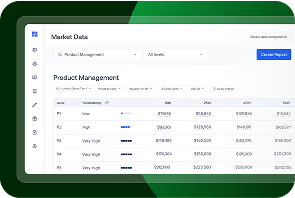
Robotics engineer market benchmarking data show that base salaries for mid- to senior-level individual contributors (P4–P6) range from $176,000 to $227,000 at the 50th percentile. At the manager level, M5 and M6 robotics engineer roles range from $250,000 to $293,000 in base pay alone.
But base salary is only part of the picture. Traditionally, equity compensation was reserved for only the seniormost members of leadership in manufacturing. In the current labor market, robotics professionals are increasingly included in equity programs.
The benchmark reflects this, showing the 50th percentile, a P5-level robotics engineer hire receives roughly $589,000 in new-hire equity grant value. At the 75th, that climbs to nearly $894,000. For P6-level hires, the 75th percentile exceeds $1.46 million.
These compensation packages are comparable to those offered by Series B startups, as they target the same candidate pool.
3. Position the Offer Letter as a Strategic Differentiator
When your total rewards package includes substantial equity grants, a static PDF doesn’t effectively communicate value. It may even obscure it. Equity gets listed without the context and benefits get buried in attachments. The overall value of your offer, which differentiates you from competitors, is not visible when it matters most.
Candidates from the technology sector expect transparency. They are accustomed to visual breakdowns of total rewards, equity modeling tools, and clear vesting schedules. When recruiting a P5 engineer from a software company into manufacturing, the presentation of the compensation package is as important as what’s in it.
This is especially true when candidates are unfamiliar with manufacturing. You are not only competing on compensation but also presenting a new and compelling career narrative. A poorly executed offer can result in the loss of candidates and reinforce the perception that the industry has not modernized.
Filling Manufacturing Jobs Today
AI and robotics fill part of the gap. Strategic workforce planning fills another. Neither works without compensation that is grounded in market expectations.
The manufacturing companies winning this talent war aren't necessarily the ones with the biggest automation budgets. They're the ones who've figured out that talent strategy and technology strategy aren't two separate workstreams.

Charles is a member of Pave's marketing team, bringing nearly 20 years of experience in HR strategy and technology. Prior to Pave, he advised CHROs and other HR leaders at CEB (now Gartner's HR Practice), supported benefits research initiatives at Scoop Technologies, and, most recently, led SoFi's employee benefits business, SoFi at Work. A passionate advocate for talent innovation, Charles is known for championing data-driven HR solutions.