Compensation benchmarks are supposed to reflect the overall market. But there are times when benchmarking the entire population might not be enough. In today’s hiring market, some roles are seeing compensation move faster than others (check out Pave’s Hot Job Index) and blending those in with the overall market might be creating a compensation blind spot.
Let’s say a recruiter escalates an offer above your band, citing a competing offer 15% over your P75. Your comp team has no way to verify whether that reflects a genuine market shift or a one-off negotiation tactic. So you're left with two options: approve the exception and risk disrupting the entire band, or deny it and risk losing the candidate.
This is the problem we set out to solve with the Recent Hire Filter, now available in Market Data Pro.
The Gap Between Your Ranges and Reality
Compensation leaders already know the theoretical issue with benchmark lag. Traditional surveys collect data annually, process it over months, and publish results that reflect a point in time that has already passed by the time you read them. Pave's real-time dataset of 9,000+ companies already solves that problem at the macro level—but even real-time data includes employees hired years ago whose compensation may reflect a different labor market.
We are seeing this matter more in certain job families—AI engineering, cybersecurity, specialized product roles—where the market can shift meaningfully in a matter of months. When that happens, the full-population benchmark smooths out the very signal you need to see.
This is the gap that creates friction across the hiring process. Recruiters escalate exceptions. Hiring managers question your ranges. Candidates walk away. And the comp team is stuck defending the numbers without a clear way to show whether they still hold.
How the Recent Hire Filter Works
The Recent Hire Filter gives you a diagnostic lens that isolates what's happening right now in the market for any role. Here's how it works:
Filter Recent Hires. The feature automatically isolates employees hired within the last six months from Pave's real-time dataset. This gives you a clean view of what companies are actually paying to bring people in the door today.
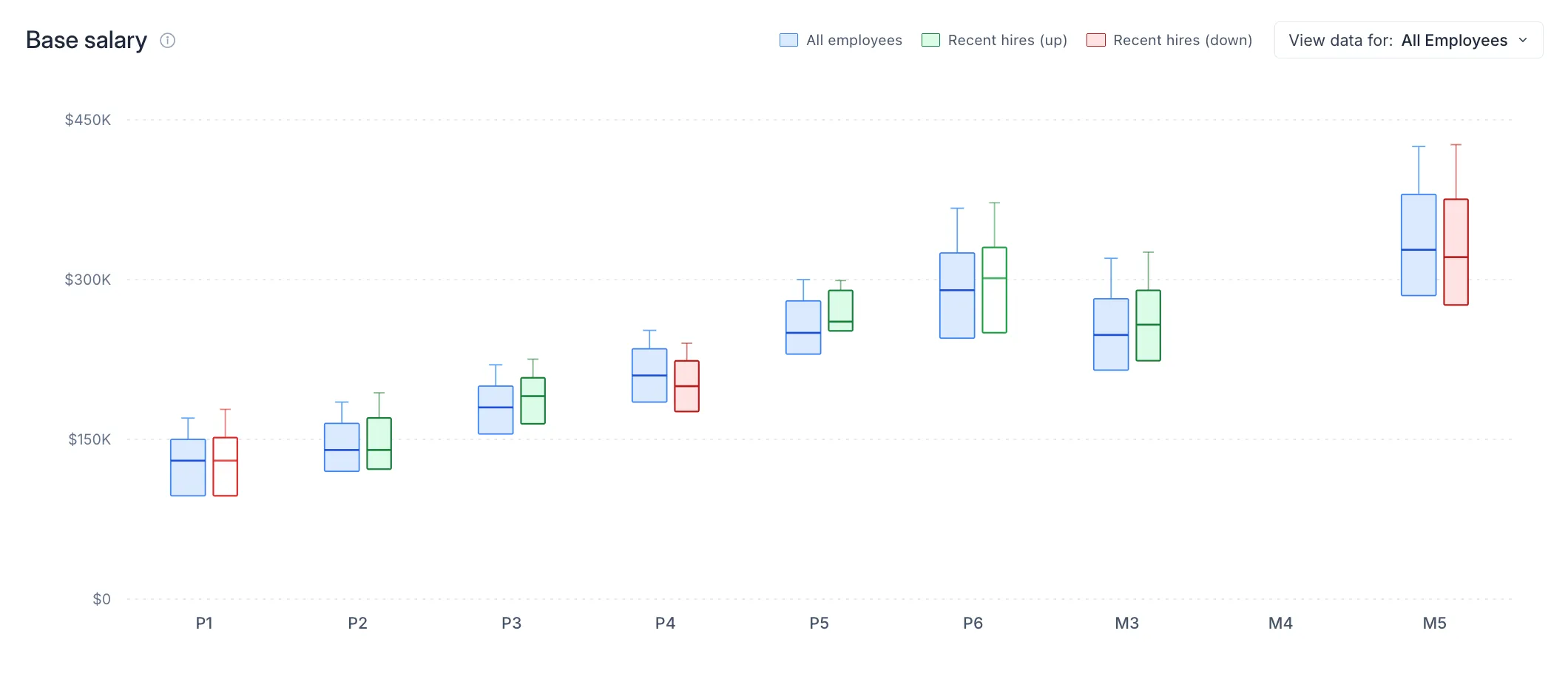
Compare Against the Full Population. You can view recent hire compensation side-by-side with the complete benchmark at every percentile—i.e., P25, P50, P75—to see where pay is shifting and by how much. This comparison is the key, as it helps you analyze the single data point you are hearing from a candidate against the actual market conditions.
Assess Statistical Significance. This is where it gets interesting. Not every movement in compensation data means the market has shifted. Small samples, seasonal hiring patterns, and outlier offers can all create misleading signals. The Recent Hire Filter flags whether the difference between recent hires and the broader population is statistically significant—a real signal—or just noise.
Why Statistical Significance Matters
Let's pause on that third point because it's what separates useful market intelligence from misleading data.
There are tools in the market that will show you offer data. That's helpful at a surface level. But raw data without statistical rigor can actually make your decisions worse. If five companies in your market made aggressive offers for a single role last quarter, that can look like a market shift when it's really a small-sample anomaly. Without a mechanism to distinguish real movement from noise, you're just replacing one form of guessing with another.
Pave's statistical significance scoring solves this. When you pull up the Recent Hire Filter for a given role and market, you’re seeing whether that number is backed by enough data, across enough companies, to represent a meaningful trend. That distinction gives you confidence to either hold your ranges with evidence or escalate with a defensible case. Either way, you're operating from a position of data, not intuition.
When to Use the Recent Hire Filter (and When Not To)
The Recent Hire Filter is designed to complement your existing census benchmark, not replace it. Think of it this way:
Your full census benchmark remains the right tool for setting and maintaining compensation ranges, annual planning, pay equity analysis, board reporting, and governance. It provides maximum sample size, smooths out short-term fluctuations, and is built for defensibility.
The Recent Hire Filter is for a different set of questions: Has the market moved for this role? Is the recruiter's escalation backed by real data? Are our ranges still competitive for the talent we're trying to hire right now? It surfaces shifts before they appear in full-population data, giving you an early warning system for market movements.
The Recent Hire Filter is a diagnostic tool that shows you where the market is moving so you can make informed decisions in real time. It's built to validate escalation requests, inform recruiter conversations, and build the case for your next range review. It does not export to Market Pricing or automatically reset your bands, because that's not the right workflow for directional intelligence. It informs decisions; it doesn't make them for you.
Used together, the full census benchmark and Recent Hire filter give you both the stability you need for governance and the agility you need for real-time talent decisions.
Turning an Escalation Into a Data-Backed Decision
To make this concrete, imagine this scenario: A recruiter is pushing to offer a Senior Software Engineer above your band, insisting the candidate has competing offers well above your P75. Without the Recent Hire Filter, you're choosing between blowing up your band structure or potentially losing the candidate.
With the Recent Hire Filter, you pull the data for Senior Software Engineers in that market. You see exactly how recent hires across 9,000+ companies are trending relative to the full population. The statistical significance indicator tells you whether this is a real shift or an outlier. If the data supports a move, you arm the recruiter with evidence to meet the candidate at market—without setting a precedent that undermines your entire range. If it doesn't, you have the data to hold your line confidently.
Comp team credibility stays intact. The candidate receives a competitive, data-driven offer. And your band structure survives to fight another day.
The Bottom Line
The market doesn't wait for your annual survey cycle, and the candidates you're competing for certainly aren't checking whether your ranges were refreshed this quarter. Every week that your team operates with stale intelligence is a week of unnecessary risk—overpaying where you didn't need to, losing candidates where you shouldn't have, and defending ranges with nothing more than conviction.
The Recent Hire Filter gives you direct insight into what companies are paying right now, validated by statistical significance, layered on top of the deepest real-time compensation dataset on the market. It's the difference between reacting to the market and seeing it move in real time.
Ready to see the Recent Hire Filter in action? Book a demo of Market Data Pro today.

Pave is a world-class team committed to unlocking a labor market built on trust. Our mission is to build confidence in every compensation decision.