
Key Takeaways
- Salary bands create structured pay ranges that improve consistency, transparency, and budget predictability across hiring and promotions.
- Effective band design reflects role specialization, market demand, and company philosophy, not just generic industry averages.
- Role-specific band structures reduce internal pay compression and better align with distinct labor markets, especially in AI and technical fields.
- Geographic pay strategy must be intentional and clearly communicated to maintain trust and fairness.
- Structured salary bands make pay equity measurable and actionable, reducing negotiation-driven variance and improving long-term compensation discipline.
Your compensation lead asks for guidance on an offer for a mid-level software engineer. Your recruiter needs a salary range for tomorrow’s job posting. Finance wants to understand how hiring plans will affect next quarter’s payroll.
Without structured salary bands, these decisions often rely on ad hoc judgment. Each conversation starts from scratch, making compensation harder to manage consistently across hiring, promotions, and budgeting.
Salary bands solve this problem by defining structured pay ranges for each job level. These ranges typically include a minimum, midpoint, and maximum that reflect market benchmarks and internal equity. With a clear band structure in place, organizations can align compensation decisions with both market realities and long-term workforce planning.
Why Salary Bands Matter
Compensation is no longer treated as a back-office administrative function. Organizations are increasingly expected to explain how pay decisions are made, why ranges exist, and how employees can progress over time.
Well-designed salary bands create a shared framework for those decisions. Hiring teams can move faster because ranges are already defined, while finance teams gain greater predictability in payroll planning. Leaders also gain clearer guidance when managing promotions, merit increases, and compensation adjustments across departments.
Structured bands reduce negotiation-driven variance as well. When compensation decisions depend too heavily on urgency or individual negotiation leverage, disparities accumulate over time. Defined ranges help organizations identify inconsistencies early and address them before they become systemic.
Salary bands also clarify career progression. Employees understand how compensation grows within a role and what is required to move into the next level. That transparency strengthens trust and reduces speculation around how pay decisions are made.
Organizations with formalized pay structures are also better equipped to respond to fast-changing labor markets, particularly in high-demand areas such as engineering and artificial intelligence.
Understanding Salary Bands: Core Components
Every salary band is built around three core reference points. These anchors provide structure while still allowing flexibility for experience, performance, and skill development.
The minimum represents the entry point for someone developing into the role. It allows room for growth while ensuring that starting compensation remains competitive in the market.
The midpoint serves as the market anchor. It reflects the typical compensation for a fully proficient employee performing at expectations in that position.
The maximum defines the upper boundary of the range. When compensation approaches the top of the band, it often signals that the employee may be ready for expanded responsibilities or a promotion to the next level.
Together, these reference points bring structure to compensation decisions while still allowing organizations to recognize performance and progression within a role.
Benefits of Implementing Salary Bands
Structured salary bands deliver several advantages that extend beyond compensation administration:
- Budget Predictability
Salary bands establish financial guardrails that help leaders forecast payroll growth, manage promotion budgets, and align compensation strategy with business planning cycles.
- Hiring Efficiency
When recruiters operate within clearly defined ranges, offer approvals accelerate, and negotiations tend to be more straightforward. Structured compensation frameworks also reduce uncertainty during hiring decisions. Research from Pave and Newfront on the true cost of hiring highlights that compensation decisions involve more than base salary alone, reinforcing the importance of clear compensation planning when evaluating the full cost of a new hire.
- Pay Equity and Transparency
Defined bands allow organizations to measure compa-ratios and range penetration. This makes pay equity audits structured and defensible, particularly as pay transparency expectations expand.
- Clear Career Progression
Employees can see how compensation evolves within a band and what progression requires. That clarity reduces speculation and helps employees better understand their growth path within the organization.
- Strategic Workforce Planning
Salary bands provide a consistent framework for aligning merit cycles, promotions, and budgeting decisions. Over time, they shift compensation from reactive adjustments to intentional planning.
Creating Your Band Structure
Designing salary bands is not just about setting pay ranges. It is about defining how compensation decisions scale as your organization grows.
A well-built structure should reduce ambiguity, prevent pay compression, and support both growth and equity over time. For organizations building compensation bands from the ground up, Pave's Practical Guide to Building Compensation Bands provides step-by-step methodology for band construction, market positioning, and ongoing maintenance.
Below are several best practices for creating a sustainable band framework:
Step 1: Define Your Grouping Strategy
The first strategic decision is how roles will be grouped into bands. This choice shapes how flexible, scalable, and defensible compensation decisions become over time.
Role-specific bands provide the highest level of precision. Each major function and specialization operates within its own structure. For example, backend engineering, machine learning engineering, and product management typically require different band logic because they compete in different labor markets.
Research and compensation trends from Pave show that AI-focused roles increasingly operate in distinct hiring markets. When specialized roles are grouped into generalized bands, companies either underpay scarce talent or create internal compression. Role-level precision reduces that risk and creates clearer career paths.
Department-level bands are often used by growing organizations that are still building specialization depth. In this model, all engineering roles might share one structure, while sales and marketing have their own. This simplifies administration and works during early growth stages.
However, department-level bands eventually become too broad. As specific skills grow more competitive in the market, generalized band structures struggle to keep pace. Many companies transition toward role-specific bands as their workforce grows.
Company-wide bands are typically limited to very early-stage organizations. While simple to implement, they rarely reflect the real differences between labor markets for specialized roles.
Precision in grouping is not about adding complexity for its own sake. It is about maintaining fairness and predictability as hiring needs evolve.
Step 2: Address Geographic Differences
Geographic compensation strategy is one of the most visible and sensitive elements of band design.
Some organizations adjust compensation based on employee location. In this approach, pay reflects regional labor markets. This strategy can help control cost structure while maintaining competitiveness in high-demand hiring hubs.
Other organizations adopt location-agnostic pay, where compensation is anchored to a single reference market regardless of employee location. This approach simplifies communication and often reinforces an equity-driven compensation philosophy.
Neither model is inherently better. What matters most is clarity and consistency. Employees should understand whether geography affects their pay and how that decision connects to company philosophy.
Hybrid approaches are also common, particularly among global organizations. Some differentiate internationally while maintaining domestic consistency. Others apply geographic adjustments only at certain seniority levels. The key is establishing clear rules and applying them consistently.
Step 3: Anchor to Reliable Market Data
Salary bands are only as reliable as the data behind them.
Traditional survey data often reflects historical market conditions rather than current hiring realities. Many compensation teams also reference labor market wage data from sources like the U.S. Bureau of Labor Statistics when evaluating compensation competitiveness.
Modern compensation teams increasingly rely on continuously refreshed data sources. Pave provides real-time benchmarks through integrated systems, helping organizations calibrate bands to current market dynamics rather than outdated snapshots.
Strong band management involves disciplined review cycles. Most organizations conduct structured annual reviews while recalibrating more frequently for roles experiencing market shifts.
Ensuring Pay Equity Through Structured Bands
Salary bands create the structure needed to measure and address pay equity.
Without defined ranges, compensation decisions often depend on negotiation leverage, urgency, or individual manager discretion. Over time, those variables introduce disparities that are difficult to identify and even harder to explain.
Structured bands change that dynamic. When pay ranges are clearly defined, compensation leaders can evaluate how employees are distributed within them, assess whether starting pay is consistent across comparable roles, and determine whether progression aligns with performance expectations.
Inequities that might otherwise remain hidden become visible. Visible problems are far easier to address.
The strategic advantage of a well-designed band structure is not only consistency, but also the organizational trust that develops when companies can clearly explain how compensation decisions are made.
Modern Compensation Platforms for Creating Market-Accurate Salary Bands
Accurate salary bands require more than spreadsheets and static survey data. Modern compensation teams increasingly rely on technology that provides real-time visibility into both internal workforce data and external market benchmarks.
These platforms integrate with HRIS, ATS, and equity management systems. These integrations reduce manual data entry while ensuring that compensation decisions reflect current organizational data rather than outdated records.
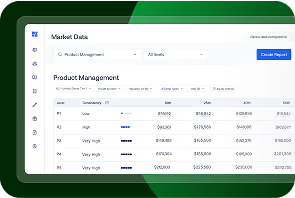
Pave is designed to support organizations in building and maintaining salary bands at scale. The platform aggregates compensation insights from thousands of companies through direct system integrations, helping compensation teams access continuously refreshed benchmarks.
Instead of waiting months for traditional survey cycles, organizations can evaluate roles against current market conditions.
Beyond benchmarking, Pave supports the broader compensation lifecycle. Teams can design structured salary bands, manage merit cycles, analyze pay equity, track compa-ratios, and monitor adherence to approved compensation ranges within a single platform.
Salary Bands as a Strategic Advantage
Salary bands form the foundation of a scalable compensation strategy. They bring structure to hiring decisions, clarity to promotions, and guardrails to pay equity.
Over time, their value compounds. Decisions about band design, market positioning, and geographic strategy shape how adaptable compensation programs remain as organizations grow.
Companies that manage compensation effectively do not treat salary bands as a one-time initiative. They build them using reliable market data, review them regularly, and integrate them into every major compensation decision across the employee lifecycle.
If you’re ready to build market-accurate salary bands that scale with your organization, explore how Pave can support your compensation strategy today.

Pave is a world-class team committed to unlocking a labor market built on trust. Our mission is to build confidence in every compensation decision.
Frequently Asked Questions
What is a salary band level?
A salary band level is a defined pay range assigned to a specific role or career stage within an organization. Each band typically includes a minimum, midpoint, and maximum that reflect market benchmarks and internal equity considerations. The midpoint often represents the expected compensation for a fully proficient employee performing the role at standard expectations.
What are the different salary bands?
Salary bands typically correspond to job levels, functions, and seniority. Many organizations structure bands around early-career, mid-level, senior, and leadership roles. Early-career bands are usually narrower, while senior and executive bands provide greater flexibility to reflect scope and strategic impact.
How to explain salary bands to employees?
Clear communication is essential. Start by explaining that each band represents the pay range for a role based on market benchmarks and internal equity. Then show where the employee currently sits within the band and how experience, performance, and skill development influence progression. Finally, clarify how promotions move employees into higher bands. When employees understand the structure, compensation conversations become more transparent and constructive.
What determines the structure of salary bands?
Salary band structures are determined by several factors, including job level, role specialization, market benchmarks, and company compensation philosophy. Most organizations design bands around defined career levels, with each band containing a minimum, midpoint, and maximum pay range. These ranges help ensure that compensation decisions remain competitive in the market while maintaining internal equity across teams. As organizations grow, band structures are often refined to reflect specialized roles, geographic considerations, and evolving labor market conditions.