
Operating the sales motion at an early stage company is one of the hardest startup jobs out there. The team is fighting an uphill battle to sell product vision while grappling with the cold-hard truth that the plane is being built during take off.
In order to make sure the sales team is properly motivated, founders have an even harder job to design a compensation structure that balances the need to reward performance while leaving enough room for reps to navigate the ambiguity of a not-yet-solidified sales process.
So what is sales compensation, exactly? It is the total pay package a company offers its sales team: a base salary (cash) plus variable commission earned against a quota. These standard components roll up to your on-target earnings (OTE) and set the stage for what is expected of your reps.
So how much of OTE should come from base salary?
We looked at the compensation of thousands of Account Executives across the United States. The answer is clear as day.
A 50 / 50 split between base compensation and variable commission is the most common sales compensation structure.
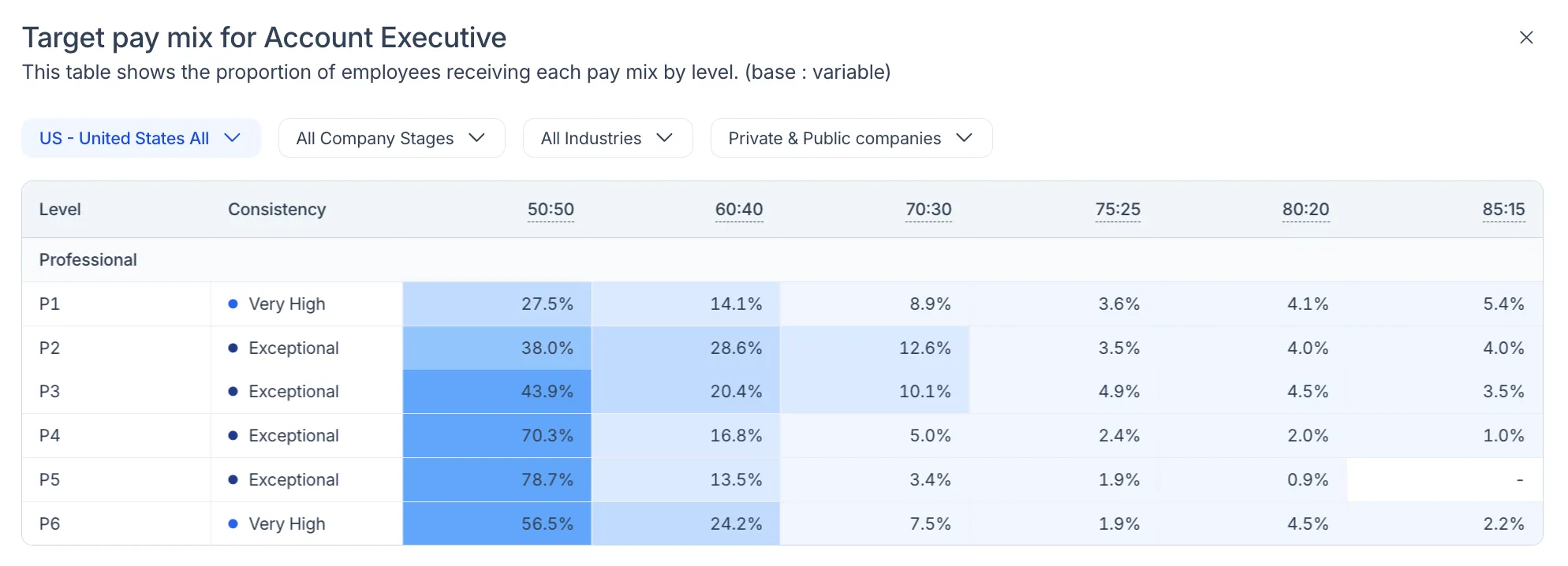
This result isn’t surprising. Companies want to leave enough room for high achieving reps to blow through their quota and make some real money, but without cleaning out the company entirely.
Word travels fast when your sales team is getting rich, fueling the go-to-market flywheel as you attract better and better talent.
But at the same time, if there’s a tough quarter, you want them to be able to put food on the table with that 50% base salary buffer.
Does the 50 / 50 split hold for every sales role?
Not really. The 50 / 50 benchmark is an Account Executive number, and it tracks how much of the deal a rep actually owns.
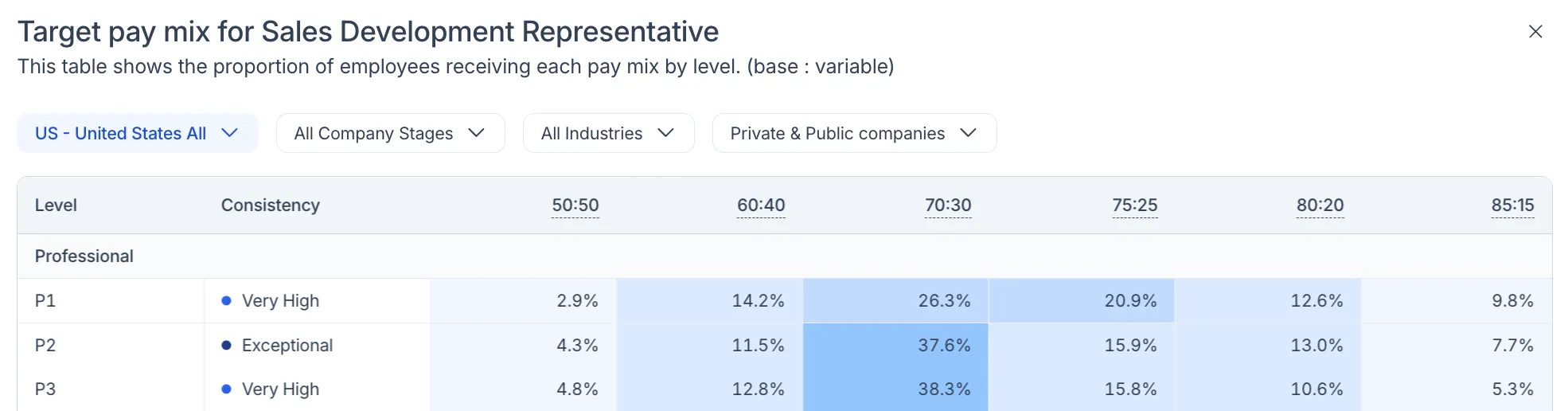
Sales Development Representatives sit at the other end. Across P1 to P3, the most common sales compensation structure is 70:30, and fewer than 5% of SDRs are on a 50 / 50 split. SDRs book meetings rather than close revenue, so tying half their pay to a number they don't control would penalize them for someone else's conversion rate.
Account Management lands in between, and it moves with seniority. Junior AMs cluster at 70:30. By P5 the most common mix is 60:40, and at P6 it finally tips to 50 / 50. As the role shifts from supporting accounts to owning renewal and expansion revenue, the pay mix shifts with it.
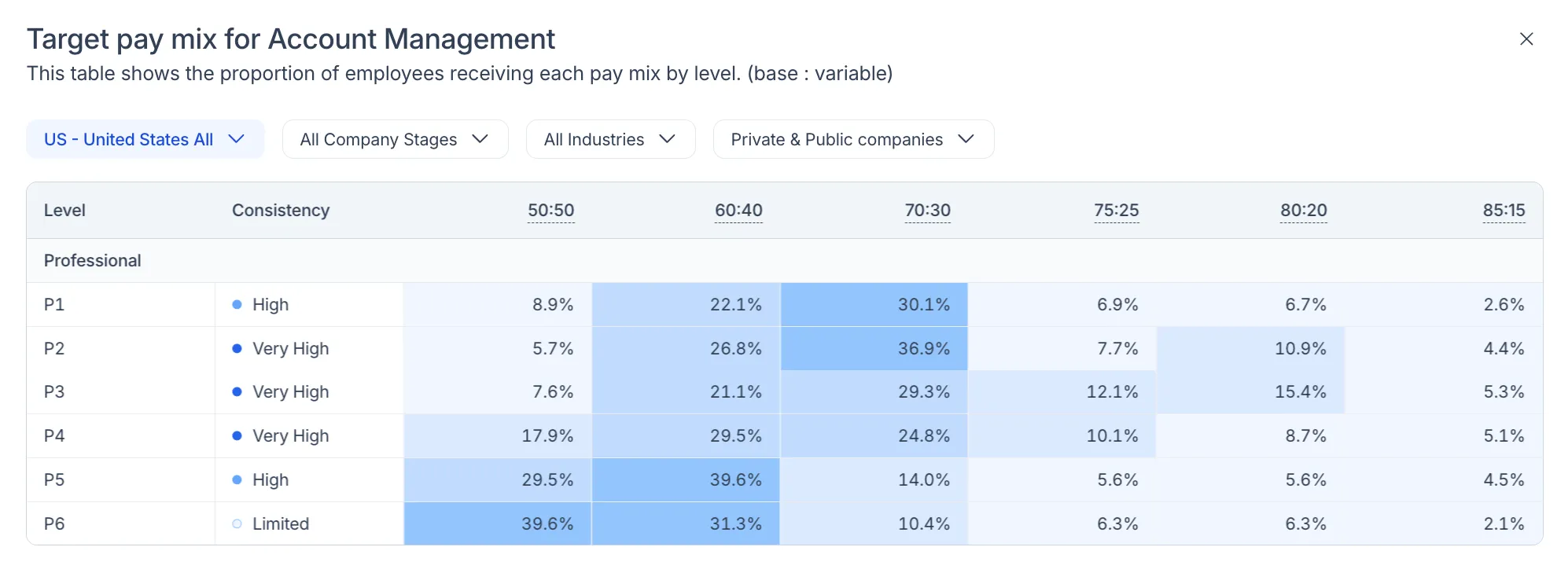
The useful way to read all three: choose your sales compensation model based on how much of the outcome the role controls, rather than applying one company-wide ratio.
So the answer shifts by role. What about company stage? If your only experience selling comes from the founder-led sale, does the 50 / 50 benchmark still hold?
Do early-stage companies stick to the 50 / 50 compensation structure?
50 / 50 is the gold standard everywhere.
Except in the early stages of a start-up.
Base salary frequently represents over 50% of OTE.
Why in the world would an early stage company pay more base salary than variable?
- Quotas are a shot in the dark: It’s extremely challenging pre-product market fit or pre-revenue to determine what a reasonable quota should be.
- Lower risk for the rep: A sales rep could fall below 50% of their quota given the company might still be finding product-market fit, but that rep might still be a stellar performer.
- Lower risk for the company: On the other hand, if a rep blows out the number, it produces an unnecessary strain on cash and souring of a relationship if a quota increase is warranted.
- Focused on the right deals: Signing bad deals is the death of an early stage company. By taking the pressure of 50% variable off the rep, the interests are more properly aligned to avoid signing deals that take the product in the wrong direction
Overall, it takes a few cycles to figure out the sales motion. And quotas should be set thoughtfully given the well-being of the company and rep are at stake.
Types of sales compensation plans
The 50/50 split is one point on a spectrum. Most sales compensation plans are variations on a handful of sales compensation models:
Base plus commission. The structure this article's data describes, most commonly at a 50/50 split. The default for AE roles at SaaS companies.
Commission-only. All variable, no base. Maximum leverage, maximum risk; rare in SaaS outside of fractional or agency arrangements.
Salary-only. No variable at all. Sometimes used for sales engineers or team-selling models where individual attribution is noisy.
Tiered commission. Base plus commission with accelerators: the rate steps up once a rep passes quota, protecting the company below plan and rewarding outperformance above it.
Draw against commission. A guaranteed advance on future commission, common for new reps ramping to full productivity.
The best sales compensation plans stay simple enough that a rep can compute their own payout on a napkin. Complexity is where trust, and selling time, goes to die.
What does this mean for you?
Two main takeaways:
- Most of the time, 50/50 is the magic number. If you’re not there yet, know that most of your peers are on their way to a 50 / 50 split in base vs variable compensation.
- More base if you’re launching a new company or even a new product. Many companies launching new products will put reps on flexible ramp schedules so they can focus on building the business and finding product-market fit. It’s not a permanent solution, but it helps you get to the final number.
In general, neither 0% variable nor 100% variable are viable long-term options for most SaaS companies. You’ll probably end up close to 50 / 50 for most AE roles, but the path to land there might not always be straight forward.

The only data-driven blog powered by real-time HRIS & Equity integrations.
What is the most common sales compensation structure?
A 50/50 split between base salary and variable commission is the most common sales compensation structure for Account Executive roles. Pave's data across thousands of AEs in the United States shows the pattern clearly, with early-stage companies as the main exception: they typically weight base above 50% of OTE while quotas are still guesses.
What does a 70/30 split in sales compensation mean?
A 70/30 split means 70% of on-target earnings come from base salary and 30% from variable commission. Companies use it when sales cycles are long, quotas are hard to forecast, or the role is more consultative, the same reasons early-stage companies weight base more heavily than the 50/50 standard.
How do you build a sales compensation plan?
Start with on-target earnings for the role, then set the base-to-variable mix; 50/50 is the standard for AEs. Add a quota grounded in real pipeline data, keep accelerators simple, and revisit the plan as the sales motion matures. A sales compensation plan that a rep cannot explain back to you is a plan that will not motivate anyone.
.jpg)