


Key Takeaways
- Where RevOps sits in the org has direct implications for how compensation is benchmarked, leveled, and defended across the revenue organization.
- Operations is the most common reporting line for RevOps teams at companies in Pave’s dataset with 51-3,000 employees.
- Finance ranks second, with higher representation at earlier company stages.
- Sales reporting grows significantly with company size, reaching 33% at organizations with 3,001 or more employees, largely driven by the rise of the CRO role at scale.
- There is no single correct RevOps team structure. The right reporting line depends on your executive team's experience and the maturity of your go-to-market motion.
Where RevOps reports have a direct impact on how compensation teams benchmark, level, and pay everyone in the revenue org. Pave's analysis of companies with dedicated RevOps teams shows that Operations is the most common reporting line, followed by Finance at roughly 9–20% and Sales growing to 33% at the largest companies.
Pavilion CEO Sam Jacobs argues that RevOps should report to Finance, and that siloed ops functions create fragmented data and executive meetings that devolve into competing narratives.
Pave's data tells a more complicated story, and the right answer for your RevOps team structure depends heavily on your company's stage.
Where RevOps Actually Reports: The Data
Pave's analysis covers 746 companies with employees in the RevOps job family, segmented by company size. Operations leads across every stage, but the distribution shifts meaningfully as companies grow.

Bottom line: Operations is the majority reporting line for RevOps across most company sizes, at 22–40% depending on stage. Finance levels off at around 9% for companies with 200 employees. Sales reporting grows to 33% at companies with 3,001 or more employees, driven largely by the CRO reporting structure.
What Changes at Scale
Operations leads at almost every stage, but its share narrows: At companies with 501–1,000 employees, 40% of RevOps teams report into Operations. At companies with 3,001 or more employees, that share drops to 22%. As the org matures, the reporting line diversifies.
Finance is strongest at the earliest stages: At companies with 51–100 employees, 20% of RevOps teams report to Finance, the highest Finance representation in the dataset. At very small companies, Finance and Operations often overlap, and early-stage founders sometimes structure RevOps close to the CFO when no CRO exists yet.
Sales reporting grows sharply at scale, driven by the CRO: At companies with 3,001 or more employees, Sales is the most common reporting line at 33%. Pave's analysis includes CRO reporting under "Sales," and CRO roles become significantly more common at larger companies. A RevOps team reporting to a CRO looks like "Sales" in the data, but often functions with the same cross-functional mandate often associated with Finance.
Why Finance-Led RevOps Is Gaining Traction
The core tension in most RevOps organizations is neutrality. RevOps is supposed to own the clean data, the honest pipeline analysis, and the unbiased forecast. When RevOps reports into Sales, the function is structurally incentivized to support the Sales team's narrative. When it reports into Marketing, the same dynamic applies to Marketing's attribution claims.
Finance has less stake in GTM narratives than Sales or Marketing does. A Finance-reporting RevOps function is more likely to be the tiebreaker in an executive meeting than a participant in the internal debate.
The companies where this model works best tend to have a CFO with a strong operational background, a culture of data discipline across the GTM org, and a RevOps function that is resourced to operate strategically rather than just running reports.
What the Best RevOps Team Structure Actually Looks Like
The reporting line is one dimension of RevOps team structure. The more important question is whether the function is set up to do its job regardless of where it sits.
A mature RevOps team covers three core areas:
- Systems and tooling: CRM ownership, tech stack management, and integration architecture across Sales, Marketing, and Customer Success.
- Data and analytics: Pipeline reporting, forecast accuracy, funnel metrics, and revenue attribution.
- Process and enablement: Quota setting, territory design, compensation plan modeling, and onboarding support for GTM teams.
At early-stage companies (roughly 50–200 employees), one or two people often cover all three areas. At mid-market scale (200–1,000 employees), RevOps typically begins to specialize with distinct ownership across systems, analytics, and processes.At enterprise scale, a fully staffed RevOps org often includes a VP or SVP of Revenue Operations with dedicated teams under each pillar.
The reporting line matters most for the analytics and data pillar. Systems and process work is relatively insulated from organizational politics. But who owns the revenue narrative and who has authority to tell an inconvenient truth in an executive meeting depends heavily on where RevOps sits in the hierarchy.
How Long Does It Take for a New RevOps Team Structure to Show Measurable Results?
Structural changes to RevOps, whether that is a new reporting line, a team reorganization, or a shift from siloed ops to a unified function, take time to show up in the metrics that matter.
- Short-term signals (one to three months): Data quality and reporting consistency improve quickly when a single team owns the revenue stack. Stakeholders notice fewer discrepancies between Sales, Marketing, and Finance forecasts.
- Medium-term signals (three to nine months): Pipeline accuracy, forecast reliability, and quota attainment visibility stabilize. GTM leaders start to trust the data enough to make faster decisions.
- Longer-term validation (nine to 18+ months): Revenue growth, sales productivity, and GTM efficiency metrics become attributable to structural decisions. RevOps roles that were under-leveled relative to actual impact start to create retention risk as the function's value becomes visible.
What This Means for Compensation Strategy
Where RevOps sits in the org directly affects how compensation leaders benchmark and level RevOps roles.
A RevOps team reporting into Finance tends to be benchmarked against Finance and Operations roles, with emphasis on analytical rigor, data governance, and business partnership. A RevOps team under Sales is often benchmarked closer to Sales Operations, where variable pay components are more common, and the role is positioned as revenue-adjacent.
Neither framing is wrong, but inconsistency creates problems. If your RevOps team is scoped like a Finance function but benchmarked against Sales Ops pay ranges, you will have a compensation gap that is hard to explain and harder to close. And when that reporting line changes, the compensation recalibration that follows takes longer than most teams expect.
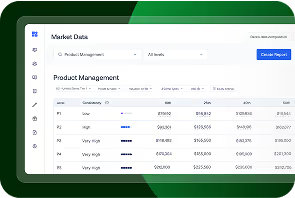
Pave's Market Data tool lets you benchmark RevOps roles by level, function, and company size, so the pay ranges you build reflect the actual scope of the role rather than a generic operations average.
Build Your RevOps Team on Real Data
The reporting line question matters, but it is downstream of a more fundamental decision: are your RevOps roles scoped, leveled, and compensated in a way that reflects what the team is actually doing?
Book a demo with Pave to benchmark RevOps roles against real-time market data across function, level, and company size.

Pave is a world-class team committed to unlocking a labor market built on trust. Our mission is to build confidence in every compensation decision.
Frequently Asked Questions (FAQs):
What is the best RevOps team structure for a scaling B2B company?
There is no single best structure, but Pave's data shows that Operations is the most common reporting line at 30–40% across company sizes. The more important factor is whether RevOps has enough organizational authority to own the clean data and honest revenue narrative, regardless of where it reports. At scale, many companies move RevOps under a CRO or CFO to reinforce that authority.
How can professionals build a revenue operations team from scratch?
Start with a generalist who can own CRM, basic reporting, and process documentation. As the company grows past 150 to 200 employees, add specialization across systems, analytics, and enablement. The reporting line matters less at the earliest stage than the hire's competency. By the time you have five or more RevOps employees, the reporting line and org design become strategically important decisions.
What roles should be included in a revenue operations org chart?
A mature revenue operations org chart typically includes systems and tooling ownership (CRM, tech stack), analytics and reporting (pipeline, forecast, revenue attribution), and process and enablement (quota setting, territory design, compensation modeling). At early stages, one or two people cover all three. Specialization typically begins around 200 employees and expands from there.
Does RevOps reporting to Finance improve data quality?
In theory, yes. Finance has no GTM agenda, which makes it structurally better positioned to protect the neutrality of revenue data. In practice, success depends on whether the CFO has an operational background and whether RevOps is resourced to operate as a strategic function rather than just a reporting team.
How does the RevOps team structure affect compensation benchmarking?
Where RevOps sits in the org influences how roles are scoped, leveled, and paid. A Finance-aligned RevOps function benchmarks differently than a Sales-aligned one. Inconsistency between how a team is structured and how it is benchmarked creates pay gaps that are difficult to close and can drive attrition in a function that already operates with lean headcount.
.jpg)