
The United States is undergoing its largest infrastructure expansion in decades, and the primary constraint isn’t power, permits, or supply chains. It is the availability of skilled personnel.
The new Data Center Salary Guide from Kelly Digital Infrastructure highlights the scale of this growth: the five largest U.S. cloud and AI infrastructure providers plan to invest over $700 billion in capital expenditures in 2026, and permanent data center employment is expected to reach 650,000 positions this year, a 30% increase from 2023. Success depends on organizations’ ability to hire, retain, and compensate talent at a pace that matches market demand.
Many operators are struggling with this challenge, resulting in significant financial losses.
Key takeaways:
- Workforce planning failure—not power or land—is now the delay driver most fully within an operator's control, and the only one they can fix without waiting on a utility or a permitting office.
- A commissioning delay on a typical 60 MW facility costs roughly $14.2 million per month in lost revenue, and a six-month workforce-driven slip can cut a project's return nearly in half.
- Data center trade roles already pay 25% to 30% more than comparable jobs in other industries, so benchmarks built on outdated or generic pay data will consistently lose candidates.
- Only 15% of applicants currently meet minimum qualifications for modern data center roles, so mispriced offers rarely get a second chance at the same candidate pool.
- Roughly a quarter of data center staff are hired away by competitors each year, making retention-focused total rewards as urgent as first-offer competitiveness.
The Primary Constraint on Data Center Growth? The Workforce Shortage.
Previously, data center delays were attributed primarily to power availability and land. This is shifting. The report indicates that workforce planning failures now represent a greater constraint on construction and operations than power or land, and this is a factor organizations can control. Fifty-three percent of operators report difficulty finding qualified candidates, up from 38% in 2018, and 90% identify staffing shortages as a critical barrier to building or expanding.
The financial risk is substantial. A commissioning delay for a typical 60 MW facility results in approximately $14.2 million per month in lost revenue, and a six-month workforce-related delay can reduce a project's return by nearly half. The industry refers to the worst-case scenario as "stranded assets": billion-dollar facilities that are physically complete but cannot become operational due to a shortage of specialized commissioning and operations personnel.
Underpricing Talent is a Rapidly Compounding Error
The report shares an example from a Kelly talent expert, who described a client posting job requisitions for data center technicians at entry-level rates, despite the market requiring experienced professionals with at least five years of experience. By the time the client adjusted its compensation, the most qualified candidates had accepted other offers. As the expert noted, the team "had to re-recruit," resulting in months of delay.
This issue is widespread and reflects a structural challenge. Many organizations, including hyperscalers and industrial firms, are using outdated compensation benchmarks in a market where trade roles command a 25% to 30% premium over similar positions in other industries.
Additionally, about a quarter of data center staff are being recruited by competitors. The most difficult roles to fill, such as commissioning engineers, MEP engineers, and data center superintendents, require months to source and cannot be replaced quickly. Delaying compensation benchmarking until the offer stage increases the risk of unsuccessful hires and gives candidates additional leverage.
Parallels With the Aerospace & Defense Talent Challenge
Data centers are now included in Pave's coverage of manufacturing and related industrial sectors, alongside aerospace and defense, food and beverage, and chemical manufacturing. These industries, characterized by long capital cycles, are now competing for the same technical talent as rapidly growing technology companies, yet continue to use compensation processes suited to slower, more predictable markets.
In aerospace and defense, this challenge is evident in security-cleared engineers accepting offers from technology firms rather than from defense contractors with outdated pay structures. In data centers, it manifests as a projected shortage of construction and operations workers nearing 500,000 by the end of 2026. The report also notes that only 15% of applicants currently meet the minimum qualifications for modern data center roles. With such a limited pool of qualified candidates, it is essential to offer competitive compensation from the outset, as there are rarely any alternatives.
What This Means for Compensation & Total Rewards Strategy
Organizations that manage this challenge effectively share a common approach: they treat workforce planning as a parallel process to equipment procurement, rather than an afterthought once projects are funded. For HR and total rewards leaders, this involves several key actions:
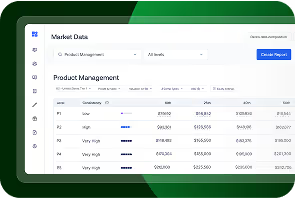
- Benchmark roles using current market data rather than outdated assumptions. In a rapidly changing market, compensation benchmarks can become obsolete within months. Tools like Pave Market Data provide continuously updated benchmarks, ensuring that rate cards remain competitive throughout the year.
- Anticipate competition beyond your own industry. Data center operators are recruiting talent from adjacent sectors such as telecommunications, utilities, and skilled trades, where job titles and compensation structures may differ. Gaining cross-industry insight into compensation helps ensure offers remain competitive, even in markets that may not be immediately apparent.
- Present the complete offer promptly. Some data center positions are filled in less than a week, leaving little time for extended negotiations. Providing a clear, comprehensive offer—including base pay, shift premiums, and advancement-linked certifications—up front can be the deciding factor in securing top candidates.
- Develop retention strategies before making the first hire. With approximately a quarter of data center staff being recruited by competitors, retention must be integrated from the outset. This includes establishing career ladders, certification-based pay progression, and clear communication of total rewards beyond base salary.
The pace of data center expansion continues to accelerate, as does the competition for skilled professionals. Success will not be determined solely by budget size, but by organizations that approach compensation strategy as a core component of infrastructure, planning it as early and deliberately as power and permitting.

Charles is a member of Pave's marketing team, bringing nearly 20 years of experience in HR strategy and technology. Prior to Pave, he advised CHROs and other HR leaders at CEB (now Gartner's HR Practice), supported benefits research initiatives at Scoop Technologies, and, most recently, led SoFi's employee benefits business, SoFi at Work. A passionate advocate for talent innovation, Charles is known for championing data-driven HR solutions.
FAQ
What is the average salary for a data center technician in 2026?
Based on market benchmarks across nine U.S. data center hubs, a Data Center Technician I averages around $68,000, a Technician II around $92,000, and a Technician III around $112,000, according to Kelly Digital Infrastructure. More specialized roles command more: a Commissioning Engineer averages roughly $112,000 to $128,000, and an MEP Specialist averages around $132,000.
Why is there a data center labor shortage?
Fifty-three percent of data center operators report difficulty finding qualified candidates, up from 38% in 2018, and 90% cite staffing shortages as a critical constraint on their ability to build or expand, per Kelly's 2026 guide. The construction workforce shortfall is projected to approach 500,000 workers by the end of 2026.
How much more do data center trade jobs pay than similar roles in other industries?
Trade roles in data centers, including electricians, HVAC technicians, and equipment operators, typically earn 25% to 30% more than comparable positions in other industries, according to Stream Data Centers.
What are the most in-demand data center skills right now?
Employers most frequently cite liquid cooling commissioning, medium-voltage electrical work, GPU cluster operations, AI infrastructure project management, and commissioning engineering as their highest-demand skill areas, per DC Geeks data cited in the Kelly report.
How long does it take to fill a data center role?
The average time to fill a single MEP Engineer position is 4.2 months, but urgent construction-phase requisitions are sometimes filled in under a week, which is part of why compensation has to be priced correctly in the first offer rather than corrected later.