
When you are hiring, should you offer a sign-on bonus to close a candidate? And if you do, how big should it be?
During the low interest era, sign-on bonuses became commonplace. At its peak, Facebook/Meta gave $100k sign-on bonuses to new grad software engineers. $100k!
These days, the marketplace has shifted. Let's explore how sign-on bonuses work and see what benchmarks from Pave's dataset tell us about who offers them and how much they pay.
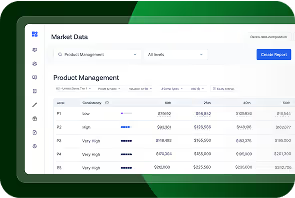
For the latest benchmarks, explore Pave's Market Data—real-time cash and equity benchmarks from 9,000+ companies.
What is a sign-on bonus?
A sign-on bonus is just what it sounds like: a one-time payment offered to a job candidate upon signing their employment contract. They are typically lump-sum cash payments, but they can also take the form of stock options.
How does a sign-on bonus work in practice? The payment usually lands as a lump sum at signing or in the new hire's first paycheck, and it often carries a repayment clause: if the employee leaves before a set date, they pay some or all of it back.
Sign-on bonuses are used by employers to make the compensation package seem more attractive, especially for highly competitive roles or to win over candidates who may have other offers.
Pros and Cons of Sign-on Bonuses
Offering sign-on bonuses as part of your hiring process comes with pros and cons. Here are a few.
Advantages of offering sign-on bonuses:
One advantage is that sign-on bonuses can help companies close candidates faster with point-in-time payouts that don’t disrupt compa ratios. Employees get a monetary boost while still being well positioned within their salary band.
Disadvantages of offering sign-on bonuses:
One disadvantage to sign-on bonuses is that recruiters may begin to normalize this practice and use it as a crutch. This means that sign-on bonuses can quickly become expensive and difficult to forecast over time.
Another disadvantage is that, culturally speaking, employees who joined the organization without receiving a sign-on bonus can feel slighted once they inevitably learn about their colleagues who received bonuses.
{{mid-cta}}
How common are sign-on bonuses today?
Let’s take a look at how common sign-on bonuses are by stage using job offer data benchmarks. Here, we analyzed 50,000+ offers from Greenhouse’s customer base.
Our data science team looked at accepted Greenhouse offers to individual contributors (P1 to P6) and manager level (M3 to M6) employees over the last 18 months and calculated the percentage of companies that included a sign-on bonus in at least one offer. Results are broken out by company headcount.
Sign-on Bonus Trends by Company Size
The findings show that the later stage the company, the more common sign-on bonuses become. Only 33% of small companies with fewer than 100 employees offer sign-on bonuses, while 75% of large companies with 1001+ employees do.
Which job families receive sign-on bonuses?
While larger companies are more likely to offer sign-on bonuses to new hires, there is some additional nuance here. Many organizations are differentiating by job function when it comes to sign-on bonuses, as it’s common to use this practice as an incentive for more in-demand roles.
As we’ve shown before, ML/AI Engineers are at the top of the food chain when it comes to sign-on bonuses, followed by Software Engineers and Product roles.
What is a typical sign-on bonus amount?
If you decide to offer sign-on bonuses, how big should they be? Once again, it depends a lot on job function.
Looking again at Greenhouse offers over the past 18 months across 3,000+ customers, we can see the median (50th percentile) sign-on bonus amounts as a percentage of base salary, broken out by job function.
Again, and unsurprisingly, ML/AI Engineering leads the pack with the median sign-on bonus at 15% of base salary. The 90th percentile notably jumps to 31%—a sign of how competitive the hunt for AI/ML talent has become. For illustrative purposes, 31% of a $200k salary is a $62k sign-on bonus.
.avif)
Matt Schulman is CEO and founder of Pave, the complete platform for Total Rewards professionals. Prior to Pave, he was a software engineer at Facebook focusing on user-centric mobile experiences. A self-proclaimed "comp nerd," Matt is known for sharing data-driven thought leadership around all things compensation and personal finance.
Frequently Asked Questions
How does a sign-on bonus work?
A sign-on bonus is paid once, usually as a lump sum at signing or in the new hire's first paycheck. Many offers attach a repayment clause, so an employee who leaves within a set window (often 12 months) returns some or all of the bonus. It does not raise base salary, which is part of why companies use it to close candidates without disrupting compa ratios.
Are sign-on bonuses taxable?
Yes. A sign-on bonus is treated as supplemental wages and is taxed like other income, with withholding applied at payout. Employees take home less than the headline figure after taxes, so it is worth discussing the gross amount during negotiation.
What is a typical sign-on bonus amount?
It depends heavily on job function. In Pave's data, the median sign-on bonus for ML/AI Engineers is 15% of base salary, with the 90th percentile reaching 31%. Many roles land lower, and amounts tend to rise with company size.
Do you have to pay back a sign-on bonus if you leave?
Often, yes. Most sign-on bonus agreements include a clawback or repayment clause tied to a minimum tenure. Read the contract terms before signing so you know the window and the repayment amount.
What is the difference between a signing bonus and a sign-on bonus?
There is no real difference. "Signing bonus" and "sign-on bonus" are two names for the same thing: a one-time payment offered to a candidate for accepting a job. Some employers also use it as a light retention tool through a repayment clause.