
The opening keynote at this year's WorldatWork Canada Summit began with a striking statistic: three seconds. According to a Microsoft study cited by the speaker, this is the average time a person spends deciding whether to stay on a website, highlighting how attention spans have changed.
This point resonated because it raises a challenging question: Are total rewards and compensation programs designed to align with how employees actually engage, or are they built for the previous way of working?
Below are the most important themes highlighted by speakers throughout the event, followed by a summary of economist Aaron Terrazas's Canada Economic Outlook session for 2027 compensation planning.
Key Themes From the Summit
Throughout the summit, several core themes stood out:
- AI will increasingly handle routine tasks, shifting the focus to storytelling and influence.
- Most organizations are in the early stages of AI adoption, with data readiness and governance as primary barriers.
- Governance is essential, as organizations—not AI—are accountable for decisions.
- Transparency in pay and job architecture is becoming the norm, requiring clear structures and defensible pay ranges.
- Prioritizing fairness in system design is critical as AI is integrated into reward processes.
- Benefits literacy is a core responsibility; rewards teams must ensure employees understand their programs.
- Productivity—not time spent using AI—should be the metric of success.
AI will increasingly handle routine tasks, making storytelling and influence central to the role.
Across the sessions, speakers agreed that AI will take on more of the mechanical work in total rewards, such as data collection, modeling, and initial drafting. However, AI cannot present and advocate for decisions to executive teams or employees, or apply some of the nuance that makes up the “art” and science of the job.
These executives noted that they place greater value on storytelling and on influencing business leaders, and are looking for ways to provide those learning experiences to their teams, now that other aspects of on-the-job training are no longer required.
Pave will be diving right into this as part of our 2026 Total Rewards Live: Rising, a training program and workshop designed for frontline rewards employees.
Most companies are in the early stages of AI adoption and recognize this fact.
When asked to assess AI maturity, most organizations reported low levels. There is significant experimentation with general-purpose tools, but limited integration into compensation workflows.
This aligns with findings from Pave's 2026 AI Maturity in Total Rewards Benchmarking Report. The main barriers for session attendees mirrored what is in the report: data readiness and governance, not technology. To assess your team's status, you can use the AI Maturity Assessment.
Governance is essential, as AI cannot be held legally accountable.
The keynote highlighted that while AI cannot be sued, organizations can be held accountable for the decisions that AI makes.
As AI advances from drafting communications to recommending pay ranges and merit allocations, clear ownership and decision traceability become essential. Pay equity audits, regulatory reviews, and employee trust require that a human be able to explain the rationale behind each decision.
We addressed this in 5 Questions Every CHRO Should Ask Before Deploying AI in Compensation. For even more, see AI Agents in Compensation: Where They Add Leverage Without Adding Risk.
Transparency will become standard, and job architecture must be prepared to support it.
Multiple speakers noted that in an AI-enabled environment, pay information will become accessible regardless of whether it is published. Employees will use digital assistants to compare offers, regulators will expand disclosure requirements, and managers will have default access to pay ranges.
As a result, job architecture must be clear, defensible, and well-documented, with pay ranges that withstand external scrutiny. Without strong job architecture and governance, transparency will expose every questionable decision.
We have addressed this topic in detail. Our strategic roadmap for pay transparency outlines key areas to strengthen before disclosure becomes mandatory, and our guide to job architecture provides a comprehensive framework for building the necessary structure. You can read it here: Preparing for the Pay Transparency Era: A Strategic Roadmap for Enterprise HR Leaders.
Prioritize fairness in design before deployment.
Speakers emphasized that this is a rare opportunity. As AI transforms tools and workflows, total rewards leaders can embed fairness into systems from the outset, rather than retrofitting it later.
Organizations that simply add AI to outdated workflows will face long-term challenges. Those who treat this as an opportunity to rebuild will benefit most.
Benefits literacy is a core responsibility for total rewards teams.
Several sessions emphasized that enhancing employees' understanding of their benefits and total rewards is essential. Programs that are not understood do not deliver their intended value, making literacy a key responsibility alongside design and administration.
Our post on why total rewards statements need to bridge the value gap makes a related argument.
Focus on productivity, not usage metrics.
One of my favorite callouts was regarding practical advice on AI mandates. As executives encourage widespread AI adoption, there is a tendency to measure usage through metrics such as hours logged or prompts sent.
The speaker advised against tracking time spent using AI tools. Instead, organizations should measure output and outcomes, as with other productivity tools. “Have you ever heard of a CEO saying they want all employees to use XLS for 5 hours a day?”
Canada's Economic Outlook for 2027
For teams as data-focused as Pave, Aaron Terrazas's session, "Canada Economic Outlook: What Total Rewards Leaders Need to Know for 2027," was an interesting adjacent discussion from the summit. Terraza noted that this is all influx, especially with the ongoing trade negotiations between the US and Canada.
The economic environment underlying traditional compensation models has fundamentally changed.
Terrazas opened with four demand-side shifts that have reshaped the Canadian economy since 2025:
- Global trade realignment. US-bound exports fell in 2025, while non-US exports rose sharply, led by energy, aluminum, and canola, which found new routes. Roughly a third of Canadian exports now go to non-US destinations, the highest share in decades, and Ottawa has set a target of doubling non-US exports by 2035. But the exposure is uneven: autos, energy, chemicals, and forestry remain overwhelmingly dependent on the US, while metals, agriculture, and raw ores are far more diversified.
- Twin energy shocks. Oil spiked again in early 2026, pushing headline CPI to about 3.0% even as core inflation sat near the Bank of Canada's 2% target.
- The immigration reversal. Non-permanent residents fell by roughly 472,000 in 15 months. Natural population growth turned negative in Q1 2026, and Canada recorded its first quarterly population decline since Confederation.
- AI and the redefinition of skill. Using Anthropic's occupational exposure data, Terrazas showed a wide gap between theoretical AI coverage (highest in computer, math, legal, business, and office work) and observed usage, which remains far smaller. The disruption is real but still concentrated.
Declining unemployment is not the same as a tightening market.
A key insight was that Canada's unemployment rate, which fell to 6.4% by July 2026, no longer carries the same implications as in previous years, driven by the roughly 26,000 net retirements per month. Now, "breakeven" job growth, the number of monthly jobs needed just to hold unemployment steady, down from 40,000 to 50,000 a few years ago to roughly 10,000 to 15,000 today.
A falling unemployment rate alone may not indicate a need to increase market positioning for pay ranges.
Wage data has a three-layer problem.
Terrazas provided clear guidance on interpreting Canadian wage data:
- Convergence risk. July's 2.8% Labour Force Survey wage growth was the slowest in about four years. With headline CPI at 3.0%, real wages briefly turned negative in May.
- The real trend. Nominal wage growth is decelerating and is highly dependent on energy prices.
His recommendation for benchmarking: anchor to the Survey of Employment, Payrolls and Hours (roughly 2.3% in Q2 2026) or posted-wage trackers rather than Labour Force Survey alone, which will over- or under-read the market in any given month.
This is not one labor market.
Terrazas emphasized that the national average is not representative of most organizations’ workforce:
- Youth (15–24): unemployment at 14.3% and rising. Entry-level bands likely have more room than 2022-era comps suggest.
- Prime age (25–54): 6.5%, roughly flat. Sector matters more than the aggregate.
- Senior (55+): 5.1% and falling. This cohort is not softening, and retention spend for senior talent cannot be cut on macro grounds.
The same segmentation holds by province (unemployment rose in Saskatchewan, BC, and Quebec over the past year while falling in Ontario, Alberta, and Atlantic Canada) and by sector (health care added roughly 94,000 jobs year over year; manufacturing lost about 51,000).
Forecast ranges are more valuable than precise point estimates.
Terrazas walked through the outlooks from RBC, TD, Scotiabank, BMO, CIBC, and Vanguard and made the case that the spread is the information, not the point estimates:
- 2027 GDP forecasts range from 1.6% to 2.1%. Consensus on direction (gradual improvement), disagreement on speed.
- Q4 2027 unemployment forecasts range from 5.8% to 6.3%.
- The Bank of Canada consensus is a hold at 2.25%, with Scotiabank as the outlier calling for two hikes in late 2026.
- OECD projects Canadian real wages to fall by 0.7% in 2026, then recover to only +0.4% in 2027.
His planning anchor: nominal wage growth of 2.5% to 3.5% across the full scenario range, with 3.0% to 3.5% bracketing the plausible consensus for a 2027 merit budget. The caveat he stressed is that merit increases that feel generous in nominal terms may still not restore purchasing power.
He also offered a simple two-by-two for scenario planning, with CUSMA stability on one axis and the Bank of Canada's rate path on the other. The consensus quadrant (stable deal, BoC hold) implies a gradual recovery with a 3.0% to 3.5% merit budget and sector segmentation still required. The worst quadrant (trade disruption plus rate hikes) implies deeply negative real wages, peak employee pressure, and a shift from broad merit-based pay to targeted retention spend.
Key considerations for your 2027 budget
Terrazas closed with four principles:
- The Canadian economy has proven resilient, but for an uncomfortable reason. Contracting labor supply has propped up the headline numbers alongside fragile demand.
- There is no single labor market. Industry, region, and experience level diverge enough that a national macro theme is close to meaningless. Localize.
- Sometimes transitory really is transitory. Anchor to core inflation, not headline CPI. Employees live in headline inflation, so be ready to explain why the annual average matters more than the spike.
- Expect more shocks. The consensus calls for a 2027 rebound, but the risks are wide. Build systems that can adapt, not plans that assume stability.
Implications for Compensation Planning
The summit's two main themes were closely aligned. Terrazas emphasized that aggregate data often obscures important details, making segmentation and adaptability essential. The keynote highlighted that AI can enable this approach, but only for teams with strong data foundations, governance, and job architecture.
To identify your starting point, the AI Maturity Assessment quickly highlights your existing foundations. And if you'd like to discuss how other compensation teams are planning for 2027, reach out to the Pave team.

Charles is a member of Pave's marketing team, bringing nearly 20 years of experience in HR strategy and technology. Prior to Pave, he advised CHROs and other HR leaders at CEB (now Gartner's HR Practice), supported benefits research initiatives at Scoop Technologies, and, most recently, led SoFi's employee benefits business, SoFi at Work. A passionate advocate for talent innovation, Charles is known for championing data-driven HR solutions.
FAQs
What is a reasonable merit budget for Canadian employees in 2027?
Economist Aaron Terrazas suggested 3.0% to 3.5% nominal at the 2026 WorldatWork Canada Summit, with 2.5% to 3.5% across bank scenarios. Pave's view: treat that as a starting range, then segment by sector, region, and cohort. Pave's Compensation Planning lets you model multiple budget scenarios before the cycle opens so the number reflects your workforce, not a national average.
Why doesn't a falling unemployment rate mean Canada's labor market is tightening?
Because participation is at its lowest since 1997, driven by roughly 26,000 net retirements per month, so unemployment can fall without hiring getting harder. Headline macro signals are a weak proxy for your actual talent market. Pave's real-time benchmarks show what companies are paying right now for the roles you compete for, which is the signal that matters.
Which wage data should compensation teams use to benchmark in Canada?
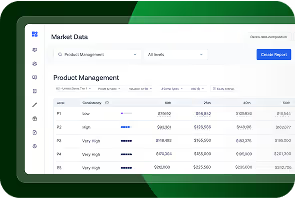
Terrazas recommended SEPH (about 2.3% in Q2 2026) or posted-wage trackers over the Labour Force Survey, which isn't seasonally adjusted and can misread the market in any given month. Pave's Market Data is built on integrated employee records rather than survey responses, giving compensation teams a current, defensible benchmark alongside the government series.
Is Canada's labor market the same across age groups?
No. As of mid-2026, youth unemployment was 14.3% and rising, prime-age was 6.5%, and workers 55 and over were at 5.1% and falling. Retention for senior talent cannot be cut on macro grounds. Pave's Team View gives managers a permissioned view of their own team's compensation history and flags retention risk, so targeted spend goes where the data says it should.