

As our Canadian client base expands, we are attending WorldatWork Canada in Toronto to better understand the unique challenges of the Canadian labor market. We look forward to engaging with compensation and total rewards leaders on what sets the Canadian talent market apart: distinct national pricing compared to the U.S., a surge in AI-driven hiring transforming tech roles, and a pay-transparency landscape that varies by province.
Earlier this summer, we hosted a webinar with White & Gale to address these topics, using Pave's real-time compensation benchmarks for Canada. Ahead of the event, we are sharing key data insights and topics we will explore with attendees this week.
1. AI’s Impact on Canadian Hiring
The data clearly shows a rapid shift in demand. Roles such as AI Engineers, Internal Auditors, and Field Marketers are increasing sharply as a share of new hires in Pave's real-time dataset. In contrast, demand for Web Development, Content Marketing, and HR Generalist roles is declining.
New job titles are emerging in organizational charts. Since 2023, the proportion of companies employing at least one AI Transformation Lead, Forward Deployed Engineer, or Go-to-Market Engineer has steadily increased.
Compensation teams face the challenge that the distinction between software engineers and AI specialists is now a spectrum. Between generalist software engineers and AI researchers are AI-capable software engineers, ML engineers, and AI engineers. Most leveling and pricing uncertainty occurs in this middle range. Key questions for defining a role include: Does the individual understand how models work or only their outcomes? Can they modify models, or are models a black box? Is AI their main deliverable or a primary tool?
At the upper end of this spectrum, new hire equity for AI Engineers, ML Engineers, and AI Research Scientists at private AI companies in Canada is significantly higher than for generalist software engineers. Justifying these packages increasingly resembles executive hiring: Will this individual transform the business? Do they offer new technical capabilities? Is their expertise essential to a key business challenge?
For further details, refer to Pave's Hot Jobs Index.
2. How AI-Native Companies Structure Talent
It is not only individual roles that differ. AI-native companies have a higher proportion of senior and engineering-focused positions than peers of similar size, redefining what it means to be competitive for talent.
3. Equity: A Growing Factor in Canadian Compensation
Equity participation among new hires in Canada, along with associated vesting schedules, warrants careful consideration. This is especially important for companies considering equity as a differentiator against larger, cash-rich competitors.
4. Regional Differences Define Canadian Pay
Talent costs vary significantly across Canadian metropolitan areas, making the decision between a single national pay band and a geographically differentiated approach a strategic choice rather than a default.
5. Looking Back on 2026 Merit Budgets vs. Actuals
Canadian companies projected a 4.5% merit budget increase for 2026, but the actual median raise in the first half of the year was 4.0%. This half-point gap highlights the difference between budgeted and actual allocations.
For further details, refer to Pave's Merit Cycle State of the Union report.
6. The Provincial Patchwork of Pay Transparency
Canadian employers are navigating overlapping obligations: the federal Pay Equity Act for federally regulated employers, British Columbia's Pay Transparency Act requiring ranges on all postings since November 2023, Ontario's new Pay Transparency Act requiring ranges on postings for employers with 100+ employees as of January 2026, and Quebec's long-standing pay equity audit requirements.
What We’ll Be Listening For
A notable aspect of WorldatWork Canada is the diversity of industries represented. This year's attendees include professionals from financial services and insurance, manufacturing, aerospace and defense, retail and consumer co-operatives, energy and mining, healthcare, and the public sector. Many of these industries have traditionally relied on annual compensation surveys, making real-time benchmarks a relatively new concept.
In the coming weeks, we will publish industry-specific analyses of compensation trends in aerospace and defense, retail, and manufacturing as part of our industry series. If you work in one of these sectors and would like to discuss further, please connect with us during the event.
Connect With Us at WorldatWork Canada
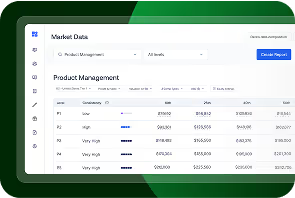
Pave is an AI-driven compensation platform. Our Market Data, the real-time compensation dataset that supports our solutions, is sourced from ongoing integrations with HRIS, ATS, and equity systems across more than 9,000 companies. As a result, our benchmarks reflect current market conditions rather than outdated survey data.
Attending the event? We look forward to seeing you there!

Charles is a member of Pave's marketing team, bringing nearly 20 years of experience in HR strategy and technology. Prior to Pave, he advised CHROs and other HR leaders at CEB (now Gartner's HR Practice), supported benefits research initiatives at Scoop Technologies, and, most recently, led SoFi's employee benefits business, SoFi at Work. A passionate advocate for talent innovation, Charles is known for championing data-driven HR solutions.