
Key Takeaways
- Across Pave's dataset, the median number of employees per customer support rep ranges from 23 at companies with one to 99 employees to 65 at organizations with 3,000 or more.
- Support teams generally become more leveraged as companies scale, with each rep covering more employees over time.
- AI tooling is reshaping customer support staffing benchmarks. The ratios in this dataset reflect current market baselines, and they are expected to shift as conversational AI adoption accelerates.
- Where your support team sits relative to these benchmarks is a direct input into compensation planning, headcount decisions, and how you level and pay support roles.
The right customer support team size depends on your company's stage, product complexity, and increasingly, your AI tooling stack. Company size offers a useful starting benchmark, and Pave's data shows that the median employees-per-support-rep ratio generally increases as employee count does.
But that pattern is now under pressure. Salesforce cut its customer support workforce from 9,000 to roughly 5,000 employees after deploying AI agents, with CEO Marc Benioff explaining he needed fewer staff as AI handled a growing share of customer interactions.
Understanding where your customer support team structure stands today, and how it is likely to evolve, is the foundation of sound headcount and compensation planning.
Employees Per Customer Support Rep: The Data
The benchmarks below come from Pave's analysis of 2,000+ companies with at least one customer support rep, segmented by company size.
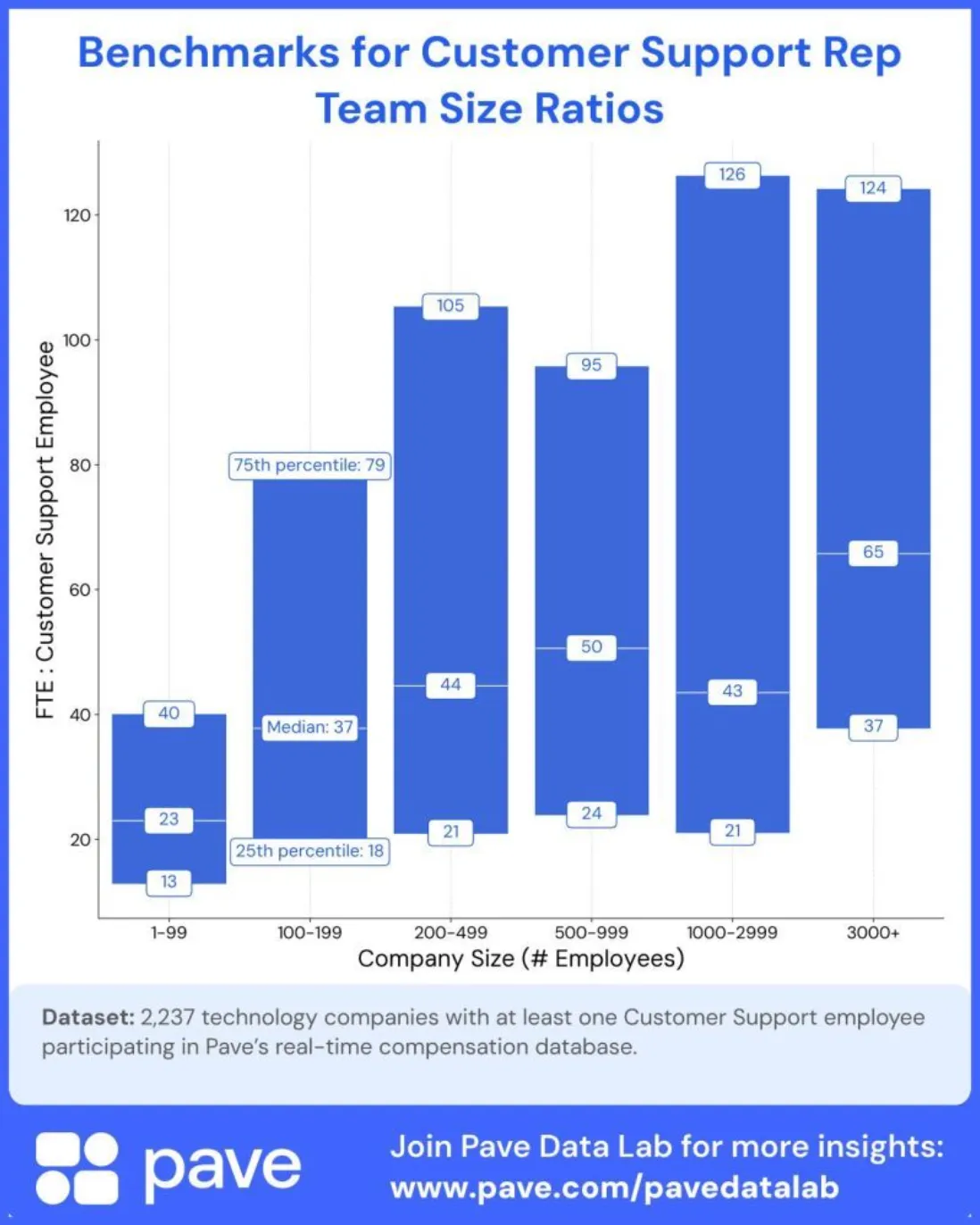
Bottom line: The median employees-per-support-rep ratio ranges from 23 to 65 across company sizes, with the ratio generally increasing as organizations scale. The wide 25th-to-75th percentile spread at larger companies (21 to 126 at 1,000–2,999 employees) reflects significant variation in how organizations choose to staff support at scale.
What the distribution tells us
Leverage increases with scale, but not in a straight line: From one to 99 employees through 500–999 employees, the ratio grows steadily from 23 to 50. As products mature, documentation improves, self-service options expand, and individual support reps handle a larger volume of requests without proportional headcount growth.
The 1,000–2,999 employee band breaks the pattern: The median dips from 50 to 43 at this stage, and the percentile spread is the widest in the dataset: the 25th percentile sits at 21 while the 75th reaches 126. That gap reflects a divergence in how mid-enterprise companies approach support. Some have already invested in self-service infrastructure and AI tooling that drives leverage up. Others are navigating product complexity, new customer segments, and higher SLA requirements that increase headcount before efficiency catches up.
The 3,000-plus band rebounds sharply to 65: At this stage, organizations have typically invested in dedicated support infrastructure, tiered support models, and self-service tooling that absorbs a significant portion of inbound volume.
How Customer Support Team Structure Changes with Scale
The employees-per-rep ratio is one signal. How the team is actually organized tells the fuller story of the customer support team structure.
At early-stage companies (one to 99 employees), customer support is often a generalist function. One or two reps handle the full range of inbound requests, frequently without formal tiering. Roles are loosely defined, escalation paths are informal, and the function often sits close to the product to close the feedback loop quickly.
As companies move into the 100–499 range, structure begins to emerge. Teams typically introduce:
- Tiered support levels (T1 for common issues, T2 and T3 for technical escalations).
- Specialization by product or customer segment as the product surface area grows.
- Defined SLAs that formalize response time expectations and create accountability.
By the time a company reaches 500 or more employees, support is usually a distinct function with its own leadership, tooling stack, and reporting cadence. The question shifts from "how many reps do we have?" to "how do we structure coverage across segments, time zones, and tiers in a way that scales without headcount growing proportionally?"
What This Means for SaaS Companies
Customer support in SaaS is a retention function and a product feedback mechanism. Every ticket is a signal. At early stages, that feedback loop is tight and valuable. As the company scales, maintaining that quality of signal while managing volume is where support team structure decisions become strategic.
For SaaS companies, a few patterns tend to hold:
- Self-service scales faster than headcount: Investing in a strong knowledge base, in-product guidance, and community support reduces inbound volume in ways that let the employees-per-rep ratio climb without sacrificing customer experience quality.
- Customer success and customer support diverge over time: At small companies, these functions often overlap. As scale increases, support handles reactive volume while customer success takes on proactive retention and expansion work.
- AI tooling is compressing timelines: The leverage gains that used to take years of operational maturity to achieve are now accessible to mid-stage companies through conversational AI tools. That changes the headcount math and the compensation benchmarks at every stage.
The AI Factor: How These Benchmarks Are Likely To Shift
Conversational AI tools built specifically for support, including products designed to handle the full resolution cycle without human handoff, are now within reach for companies well below enterprise scale.
That shift has two concrete consequences for compensation leaders.
- Support roles will increasingly concentrate on higher complexity and higher skill levels. Reps handling escalations, managing AI quality, and owning customer relationships will command different pay than reps processing routine tickets. Job architecture and compensation bands need to reflect that transition before it creates pay gaps.
- Headcount planning assumptions built on today's benchmarks may overstate future support staffing needs. Compensation and Total Rewards leaders building workforce plans for 2026 and 2027 should stress-test their support headcount models against the scenario where AI absorbs a significant amount of current ticket volume.
How To Build a Customer Support Team Structure from Scratch
For People and Total Rewards leaders involved in headcount planning, here is how customer support teams typically develop at each stage.
Stage one (one to two support hires, roughly one to 99 employees): Start with a generalist who can handle the full range of inbound requests and feed product insights back to the team. Compensation at this stage is typically benchmarked against Support Specialist or Customer Support Analyst roles. The ratio of roughly 23 employees per rep reflects the expectation that early-stage support is intensive and close to the product.
Stage two (two to 10 support hires, roughly 100–499 employees): Add structure. A T1/T2 split, a dedicated tooling owner, and a team lead or manager create the foundation for scale. This is also when compensation differentiation across levels becomes meaningful. A T1 rep and a technical T2 engineer are different roles with different market rates, and conflating them creates pay equity risk.
Stage three (10 or more support hires, 500+ employees): Support becomes a full function with its own leadership, defined career paths, and specialized roles (technical support, customer success adjacent, AI/automation specialist). At this stage, benchmarking by sub-function and level is essential. Averaging across all support roles will underpay the senior technical staff and overpay the entry-level volume.
Using Support Staffing Benchmarks To Inform Compensation Strategy
When the ratio is low, each rep is handling significant volume and breadth, and that scope should be reflected in compensation and job architecture. When the ratio is high, individual reps are typically more specialized, operating within a tiered structure that enables leverage. Pay ranges for those roles should reflect the specialization, not just the seniority.
Pave's Market Pricing lets compensation teams benchmark support roles by level, sub-function, and company size, so pay ranges reflect actual role scope rather than a blended average. As AI reshapes the support function and role definitions evolve, having access to real-time data is what separates a defensible pay program from one that's already behind the market.
Plan Your Support Team for Where the Market Is Going
Customer support staffing is changing faster than most workforce plans account for. The benchmarks above tell you where the market is today. Building a compensation program that holds up over the next two to three years means planning for a support team that looks different from the one you have now.
Get a demo of Pave to benchmark customer support roles against real-time market data by level, sub-function, and company size, so your pay program keeps pace with how the function is evolving.

Pave is a world-class team committed to unlocking a labor market built on trust. Our mission is to build confidence in every compensation decision.
Frequently Asked Questions (FAQs):
How can professionals build a customer support team structure from scratch?
Start with a generalist who handles the full range of inbound requests and feeds product insights back to the team. As the company grows past 100 employees, introduce tiered support levels, defined SLAs, and specialization by product or customer segment. By the time you have 10 or more support employees, you need a distinct function with its own leadership, career paths, and compensation bands at each level.
What is the right customer support team size for a SaaS company?
Based on real-time compensation data, companies with one to 99 employees typically operate at a median of 23 employees per support rep, rising to 50 at 500–999 employees and 65 at 3,000 or more. The right ratio depends on product complexity, self-service maturity, and AI tooling adoption. Companies investing heavily in conversational AI and knowledge base infrastructure can sustain higher ratios without sacrificing customer experience quality.
How should a customer support team structure change as a startup scales to an enterprise?
Early-stage teams are generalist and flat. As companies grow, the structure shifts toward tiered support models (T1 through T3), specialization by customer segment or product, and dedicated tooling and automation ownership. At enterprise scale, customer support and customer success typically separate into distinct functions with different compensation benchmarks and career paths.
Does AI reduce the need for customer support headcount?
In practice, yes. Salesforce reduced its support workforce from 9,000 to 5,000 after deploying AI agents, with AI now handling roughly half of customer conversations. For most companies, the near-term impact is fewer net new support hires rather than immediate reductions, but headcount planning models built on pre-AI benchmarks will increasingly overstate future staffing needs.
How does support team size affect compensation benchmarking?
The employees-per-rep ratio signals how roles are scoped and what level of specialization is expected. A low ratio (high volume per rep, broad responsibility) typically warrants higher pay for individual contributors. A high ratio (more specialized, tiered structure) means compensation bands need to differentiate meaningfully across levels rather than clustering around a single midpoint.