
Key Takeaways
- An equity grant is an award of company ownership, usually stock options or RSUs, given on a set date and earned over a vesting period. It is compensation, and it should be priced and governed like cash.
- Grant size depends on level, stage, and job family. Mature programs size grants in dollar value against current market benchmarks, and revisit the guidelines as the company grows.
- The equity vehicle changes with scale. Some 90% to 95% of private companies under 500 employees grant options. By 3,000 employees, 90% to 95% have moved to RSUs.
- Consistency comes from equity bands. Build a range per level the way you build a salary range, decide your location policy on purpose, and revisit the guidelines every 12 to 24 months.
An equity grant is an award of ownership in a company, given to an employee as part of their compensation and earned over time through vesting.
Most grants are stock options or restricted stock units (RSUs). Every grant has four defining terms: what is being granted, how much, on what date, and on what schedule it vests.
Most explanations of equity grants are written for the person receiving one. This one covers what employers have to decide: how large equity grants should be at each job level, how to keep them consistent across hundreds of hires, and how to defend the numbers to a board. That is where the real work is.
What is an equity grant?
It is the formal act of a company awarding an employee a stake in the business, documented in a grant agreement approved by the board, with a grant date, a number of shares or units, and a vesting schedule.
Three things separate an equity grant from cash compensation.
- It is earned over time. A salary is paid as work is done. A grant is promised on day one and delivered in pieces, most commonly over four years with a one-year cliff. That is why it works as a retention tool as much as a reward.
- Its value moves. A $20,000 bonus is worth $20,000. A grant of 2,000 options is worth whatever the gap between the strike price and the company's value turns out to be when the employee can act on it.
- It comes out of a finite pool. Every share granted is a share you cannot grant to someone else without expanding the option pool and diluting existing holders. Grant sizing is a budgeting decision as much as a hiring decision.
Equity grants for employees sit alongside base salary and bonus as the third leg of total compensation. At venture-backed and pre-IPO companies they are often the largest leg by potential value. That is exactly why they need the same structure cash pay already has.
How equity grants work
Every grant runs through the same sequence, whatever the company's stage.
- Approval. The board (or the compensation committee) approves the grant, usually in a batch with other new hires and refreshes. Until then, an offer letter describes an intended grant.
- Grant date. The date the award is formally made. For options, this fixes the strike price at the fair market value from the most recent 409A valuation.
- Vesting. The employee earns the grant over a schedule. Four years with a one-year cliff is still the private-company standard. Public companies have been shortening: average grant duration fell from about 3.5 years in 2020 to roughly 3.0 years in early 2025, based on Pave's analysis of vesting schedules across new hire and ongoing grants.
- Vested equity. Once vested, options can be exercised and RSUs settle into shares. Exercise mechanics and tax treatment are their own topic, and they depend on the vehicle, the jurisdiction, and the employee's situation.
What does a mature program look like? A recruiter can tell a candidate the grant range for a role before the interview loop starts, because the range was set by policy before any candidate entered the process.
Types of equity grants
The vehicle a company grants is mostly a function of its stage. Pave's data on equity grant strategies by stage shows a clear progression.
Stock options give the employee the right to buy shares at a fixed strike price. They dominate at early stages because the strike price is low, the upside is large, and no cash changes hands at grant. Incentive stock options (ISOs) and non-qualified stock options (NSOs) differ in tax treatment; they are sized the same way.
Restricted stock units (RSUs) are a promise to deliver shares once vesting conditions are met. There is no strike price, so an RSU always has value as long as the company does. Late-stage private and public companies favor them because they are easier to value, easier to explain, and less exposed to a falling stock price.
Restricted stock is actual shares issued at grant and subject to forfeiture until vested. It is common for founders and very early employees, when the fair market value is low enough that receiving shares outright is practical.
Whatever the vehicle, the sizing logic below is the same. The vehicle changes how value is delivered, not how much value a level should receive.
How employers size equity grants by level
This is the part the glossaries skip. It is also the part that decides whether a program holds together at scale.
There are three ways to express a grant size, and mature programs use all three at different moments.
- Percentage of fully diluted shares. The early-stage default. It communicates ownership directly, and it is how founders and boards tend to think about the pool.
- Dollar value at grant. The mid- and late-stage default. A grant is expressed as a target value (say, $150,000 of equity for a senior engineer) and converted into shares at the current 409A or preferred price. This is the only method that survives a change in valuation without rewriting the guidelines.
- Multiple of base salary. Common at public companies, and a useful sanity check. A grant equal to 1.0x salary at one level and 3.0x at the next tells you immediately whether the equity structure is steeper than the cash structure.
So how big should a new hire equity grant be? It depends on three variables: level, job family, and stage, and the ranges are wide. Engineering and product roles typically receive larger grants than go-to-market and operations roles at the same level, and every role's grant shrinks as headcount grows.
Two things follow from that.
First, a single "standard new hire grant" is a guess. It will be right for one job family and wrong for the rest.
Second, the percentage view stops working quickly. Past about 50 people, sizing has to move to dollar value, benchmarked against the market for each level and job family. That is what new hire equity benchmarks are for.
Banding equity the way you band cash
Here is a pattern we see often. A company has salary ranges for every level and no equity ranges for any of them.
That gap is where inconsistency comes from. Two hires at the same level, made three months apart by different hiring managers, end up with grants that differ by 40%. Nobody can explain why later.
An equity band works exactly like a salary band.
- Anchor each level to the market. Pull the median new hire grant value for the level and job family from a benchmark that reflects current grants. Equity moves faster than cash, so a survey collected months ago is already behind.
- Set a minimum, midpoint, and maximum. A range of roughly 80% to 120% of the midpoint gives recruiters room for experience and competing offers without breaking the structure.
- Decide the location policy explicitly. Geographic pay differentials are steeper for equity than for salary. In Pave's analysis of 65,000 software engineering employees, base salary in Tier 2 and Tier 3 U.S. metros sits 11% and 16% below Tier 1. New hire equity sits 29% and 36% below. Follow the market or flatten it, but make it a choice.
- Publish the bands to the people who make offers. A band a recruiter cannot see is a band that will be negotiated around.
Once bands exist, the equity grant for employees at any level is a lookup. That is what makes the program defensible to a board and explainable to employees.
Keeping equity grants consistent as the company grows
Grant guidelines that were right at Series A will be wrong by Series C. Three things drift, and each needs a scheduled review.
The mix between new hire and ongoing grants. In the early years, almost all equity spend goes to new hires. By the later stages, more than 50% of equity burn goes to ongoing grants: equity refresh grants and promotions. A sizing policy built only around new hire grants leaves the larger half of the budget unmanaged.
The vehicle. The switch from options to RSUs, which about half of companies have made by the 500-to-3,000-employee stage, changes how a grant is valued and communicated. Bands expressed in dollar value carry over. Bands expressed in share counts or percentages do not.
The grant pattern itself. Some companies replace the large upfront grant with smaller annual grants, known as boxcar grants. Each is sized at roughly 20% to 30% of what the initial grant would have been, so employees always have unvested equity ahead of them.
The practical rule from Pave's stage-by-stage guidance: re-evaluate grant guidelines every 12 to 24 months against current market data and your own burn.
Presenting an equity grant in a job offer
The offer is where a well-designed program either lands or gets lost. A candidate reading "50,000 options" has no idea whether that is generous. A candidate who cannot value the grant discounts it to zero.
The employer-side standard is to show the grant in the terms the program is built on: the number of shares or units, the vehicle, the vesting schedule, and the value at the current 409A or preferred price. Where the valuation makes a single number misleading, show a range.
The strongest offers go one step further. They show what the grant would be worth under stated growth assumptions, clearly labeled as assumptions. That is how equity turns from a number into a reason to accept, and it is what a visual offer letter is built to do.
Build equity grants on real-time benchmarks
Every sizing decision above depends on one input: what the market is granting right now for this level, job family, and stage. Survey data collected months ago answers a different question.
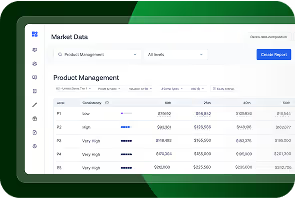
Pave's equity compensation benchmarks come directly from integrated cap table and payroll systems, so equity bands are anchored to the grants companies are making now.
Request a demo to see equity benchmarks by level, job family, and stage, and how they connect to the bands and offers your team runs every day.

Pave is a world-class team committed to unlocking a labor market built on trust. Our mission is to build confidence in every compensation decision.
Frequently asked questions (FAQs):
What is an equity grant in a job offer?
In a job offer, an equity grant is the ownership component of the package: a stated number of stock options or RSUs, the vesting schedule, and, in a well-constructed offer, the current value of the grant at the company's most recent valuation. It becomes an actual grant only once the board approves it after the hire starts, which is why offer letters describe it as subject to approval.
What are equity grants used for?
Employers use equity grants to attract candidates the company could not afford on cash alone, to retain employees through multi-year vesting, and to align employees' financial outcomes with the company's. At later stages they are also the main lever for rewarding tenure and promotion, where more than half of equity spend goes to ongoing grants.
How much equity should a new hire get?
It depends on level, job family, and stage, and the ranges are wide. Early-stage companies usually size grants as a percentage of the company. Past roughly 50 employees, most set a dollar value per level, benchmarked against current market grants for that job family.
The reliable answer is a current benchmark for your level, job family, and stage, refreshed every cycle.
Is an equity grant the same as stock options?
No. Stock options are one type of equity grant, the most common at early-stage private companies. An equity grant is the broader term for any award of company ownership, which also includes restricted stock units, restricted stock, and less common vehicles like stock appreciation rights.
The sizing and banding logic is the same across all of them; the vehicle changes how the value is delivered.