
Key Takeaways
- Merit increases are permanent, performance-based salary adjustments that differ from COLAs, market corrections, or tenure-based raises.
- Pave's H1 2026 Merit Cycle State of the Union shows promoted employees received a median 8.6% raise, non-promoted "Above Expectations" employees received 4.7%, and "Below Expectations" employees received 2.0%.
- Companies have largely stopped giving raises to underperformers. The median raise participation rate for Below Expectations employees is just 1.72% in H1 2026.
- Equity is where companies draw the firmest line. The participation gap between Above and Meets Expectations employees is 22 percentage points.
- A strong merit program depends on clear performance criteria, calibrated ratings, and consistent approval workflows
For compensation professionals, few levers carry as much weight as the annual merit cycle. When managed well, merit increases reward top performers, reinforce a pay-for-performance culture, and help organizations compete for talent without overspending. When handled inconsistently or without strong data, the same process can introduce pay equity risk, manager frustration, and employee disengagement.
According to Pave's 2026 Merit Cycle State of the Union, the median salary increase for eligible employees in H1 2026 was 3.4%, continuing a gradual downward trend. Merit budgets are tighter, and the quality of decisions now matters more than the size of the pool.
Understanding Merit Increases
What is Merit Pay?
Merit pay is a base salary adjustment that recognizes individual performance during a defined review period. Unlike across-the-board raises or cost-of-living adjustments, merit increases tie compensation directly to documented results.
They signal which behaviors and outcomes the organization values most, and most companies structure them as a percentage of base salary, sometimes paired with bonuses or equity awards.
How Does Merit-Based Pay Work?
Merit increases typically follow an annual cycle tied to performance reviews and budgeting. Managers evaluate employee achievements against defined criteria using a rating scale that maps to recommended increase ranges. Based on Pave's H1 2026 data, an employee rated "Above Expectations" receives a median 4.7% increase, while "Meets Expectations" employees receive closer to 3.3%.
Prior to the cycle, managers and employees align on measurable objectives tied to role expectations. When review season arrives, documented achievements form the foundation for merit decisions. The quality of that documentation often determines how defensible the outcomes become.
Per Pave's H1 2026 data, the full end-to-end merit cycle, from performance ratings through calibration, pay planning, and employee communication, typically runs nine to 12 weeks.
Merit Increases vs. Other Types of Raise
Why Companies Give Merit Increases
Rewarding Top Performers
Pay differentiation is one of the strongest signals a compensation program can send. Pave's H1 2026 data shows 87.5% of employees rated "Above Expectations" received a base salary increase, with a median raise of 4.7%.
The median raise participation rate for Below Expectations employees is just 1.72%. Companies have largely stopped hedging on underperformers, and the data reflects it.
Driving Employee Performance
Merit programs work best when employees can draw a clear line between their contributions and their compensation outcomes. When decisions appear inconsistent across teams, employees may perceive increases as arbitrary.
Strong programs reduce this risk by defining performance criteria clearly, documenting outcomes, and calibrating ratings across managers before final decisions are made.
Who Gets a Merit Increase?
Eligibility decisions are one of the key levers a compensation leader can pull when working within a tight budget. Not every employee qualifies automatically, and that is by design.
Eligibility Criteria
Most organizations require at least a "Meets Expectations" rating to qualify for any increase. Position within the salary range also matters.
Employees at the lower end of a pay band may receive larger increases to move toward market rates, while those above the midpoint may receive smaller adjustments. Compensation teams must also review internal equity to ensure similar roles stay aligned.
Performance Review Requirements
Effective reviews document measurable outcomes, specific achievements, and contributions during the evaluation period. Many organizations include self-evaluations, peer feedback, and multi-rater inputs to reduce bias.
Approval workflows typically involve several levels of review, especially for higher-percentage increases, creating consistency across departments.
Average Merit Increase Benchmarks
Raise Benchmarks By Performance Rating (H1 2026, Non-Promoted Employees)
- Above Expectations: 4.7% median raise, 87.5% participation
- Meets Expectations: 3.3% median raise, 84.4% participation
- Below Expectations: 2.0% median raise, 1.72% participation
- Promoted employees: 8.6% median raise, 100% participation
By Cycle Structure
Companies running two or more merit cycles per year have a median full-year salary increase of 5.07%, compared to 3.43% for single-cycle organizations. The second cycle typically targets key talent and high performers rather than the full employee population.
By Function
Within R&D, AI and ML Engineering leads all job families on non-promoted raises at 4.4%. The pattern reflects how companies are competing for technical talent: through the annual raise rather than the promotion event. R&D employees rated "Above Expectations" also receive ongoing equity at a meaningfully higher rate than GTM counterparts.
What Drives Merit Raise Amounts?
Budget constraints are the most immediate factor. Most organizations allocate roughly 3.0 to 4.0% of total payroll to merit budgets. When promoted employees receive larger increases, the remaining pool for non-promoted employees compresses.
Position within the salary range also matters, with employees below the midpoint often receiving larger adjustments to maintain internal equity. Market demand for certain skills can also affect merit outcomes. According to Pave’s AI & ML Compensation Trends report, machine learning employees received the highest raises within R&D job families.
Where Pave’s Compensation Planning Changes the Picture
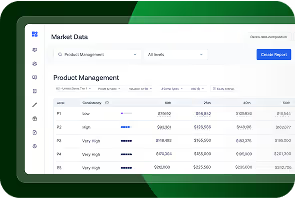
Pave's Compensation Planning module automates the logic behind merit cycles so teams can apply consistent rules across the organization without building everything manually in spreadsheets.
Compensation teams define recommendation logic once, including performance thresholds, budget guardrails, compa-ratio targets, and salary band constraints. Managers work within guided worksheets that surface relevant context, including performance ratings, range position, and recommended increase ranges, without exposing full peer salary data. Approval workflows route higher-percentage increases automatically to the appropriate level. Cycle Insights provides real-time visibility into budget spend, submission progress, and distribution outcomes throughout the cycle.
Building Your Merit Increase Process
Setting Merit-Based Pay Guidelines
Start with a clear compensation philosophy that defines how performance levels translate into salary increases. Performance definitions need to be specific. Rather than vague descriptors, define what exceeding expectations actually looks like in measurable terms, such as achieving stretch goals or improving operational metrics.
Guidelines should also document eligibility requirements, approval workflows, and timing so managers have structure before planning begins.
Creating a Merit Matrix
A merit matrix translates performance ratings into recommended salary increases. The vertical axis reflects performance levels; the horizontal axis represents position within the salary range.
Each intersection defines a recommended increase range, helping organizations reward performance while maintaining internal equity and budget discipline.
Establishing Performance Benchmarks
Benchmarks transform subjective evaluations into measurable outcomes. Sales roles may focus on revenue and pipeline contribution, engineering roles on delivery and system reliability, and people managers on team outcomes and retention.
Calibration sessions are critical: when leaders review ratings collectively before final decisions are made, they catch rating inflation, bias, and inconsistencies across teams before those issues affect pay.
How To Manage Merit Increases
Successfully managing merit increases requires balancing multiple priorities while maintaining fairness and transparency.
Budget Planning for Merit Pay
Merit budget planning typically begins months before increases take effect. Finance and Total Rewards teams allocate budgets, model performance distributions, and prepare manager guidance.
Functions with higher talent competition, such as engineering or product, often receive larger allocations to reflect market dynamics. Separate pools for retention adjustments or market corrections prevent those decisions from compressing the core merit pool.
Timing your merit cycle
The full end-to-end cycle typically runs nine to 12 weeks, based on Pave's H1 2026 data. The active review window may last only a few weeks, but budget modeling, calibration planning, and manager preparation often span several months before it opens.
For example, Pave's Workato case study describes a merit cycle preparation process that lasted approximately 10 weeks, including planning, calibration, and approvals before increases were finalized. The active review period may only last a few weeks, but the preparation behind it often spans several months.
Communicating merit decisions
Managers should receive structured guidance before review conversations begin, including talking points for high performers, standard increases, and employees who did not receive a raise.
Employees accept outcomes more readily when they understand the broader context, including budget constraints and performance expectations going forward.
Other Pay Actions in the Merit Cycle
Merit increases are the most common tool for performance-based pay, but they are not the only one available.
Cost of living adjustments
Cost-of-living adjustments (COLAs) provide salary increases tied to inflation rather than individual performance.
Promotions and role changes
Promotions typically produce larger salary increases than merit adjustments. Pave's H1 2026 data shows the median salary increase for promoted employees was 8.6%, with promotion rates holding steady at 8.6% across all employees and 10.6% across eligible employees.
Incentive pay options
Variable pay programs, such as bonuses or spot awards, allow organizations to recognize performance without permanently increasing base salary costs.
Build a Merit Program Your Team Can Stand Behind
In a market where merit budgets are not expanding, the quality of decisions matters more than the size of the pool. Pave gives compensation teams real-time benchmarks, structured workflows, and built-in pay equity visibility to run cycles that are faster, more transparent, and easier to defend.

Pave is a world-class team committed to unlocking a labor market built on trust. Our mission is to build confidence in every compensation decision.
Frequently Asked Questions (FAQ):
How do you build a merit matrix?
A merit matrix connects performance ratings with salary range position to guide increase decisions. Performance levels appear on one axis, salary band position or compa-ratio on the other. Each intersection defines recommended increase ranges, helping organizations reward performance while maintaining internal equity and staying within budget.
How should merit budgets be allocated across performance ratings?
Allocate based on expected performance distributions, with higher-performing employees receiving larger increases and employees meeting expectations receiving moderate adjustments. Modeling these distributions before the cycle begins helps teams differentiate pay meaningfully without exceeding approved budgets.
How should companies handle employees at the top of their salary band during a merit cycle?
Employees near the top of their range may receive smaller increases or one-time bonuses rather than permanent base salary adjustments, preserving salary band integrity while still recognizing strong performance. In some cases, these employees may also be candidates for promotion or expanded responsibilities.