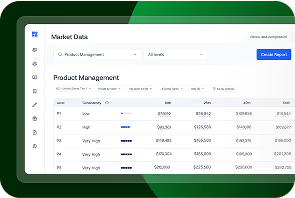


Most companies have decided that candidates should see pay ranges. In Pave’s latest survey with Alpine Rewards, 85% of public companies and 76% of private companies include salary ranges in all United States job postings, regardless of local requirements.
But, organizations haven't decided to have the same transparency with their own employees. Only 16% of public companies and 18% of private companies give employees automatic access to their own ranges.
This article looks at findings from our survey around how companies handle that gap, and how they structure equity—from guidelines by function to the options and RSU mix and more.
Candidates see the range, but employees have to ask
Posting ranges is now the norm, but sharing them internally is not. Where companies do share a range with employees, the default is to wait for them to ask: 65% of public companies and 42% of private companies make a range available on request. Private companies are far more likely to keep it closed: 37% say ranges are not available to employees at all, compared with 12% of public companies.
Note that respondents could select more than one way employees can access their range, so those shares add up to more than 100%.
Companies are building their pay transparency strategies for candidates first, whether to stay ahead of the growing number of legal requirements or to better attract talent in a competitive market. For employees, visibility isn't as straightforward.
{{mid-cta}}
Technology companies build equity guidelines by function
A salary range shows only part of a pay package. When it comes to employee equity, guidelines look very different by industry. 68% of technology companies have separate guidelines for technical and engineering roles, vs. 7% of life sciences companies.
Life sciences companies on the other hand mostly run one structure for everyone: 61% use a single structure with no differentiation by function. Even scientific and R&D roles rarely get their own guidelines in life sciences (5%, vs. 21% in technology).
Again, note that respondents could select more than one answer, so the shares add up to more than 100%.
Executive equity looks distinct at public companies
Seniority changes the equity mix at public companies, but not at private ones. At private companies, executives and non-executives get nearly the same new hire mix, with options making up 54% to 59% of grant value on average and RSUs 36% to 40%.
At public companies, the two groups diverge. Non-executives get mostly RSUs, while executives get more time-vested options and fewer RSUs. Public company executives are also the only group with a visible share of PSUs at 7% (vs. 1% or less for everyone else). Options and PSUs pay out only if the stock or the company performs, which ties executive pay more directly to results.
Refresh grants follow the new hire pattern
Let’s dive into the non-executive group a bit deeper and explore how refresh grants compare with new hire equity. The answer: not much changes.
Within both public and private companies, refresh grants tilt slightly more toward RSUs than new hire grants do, but the ownership split holds. Public companies’ refresh grants are 60% RSUs on average, while private companies’ are 44% RSUs and still 51% options. Performance-based vehicles stay marginal in both groups, at about 3% of grant value or less.
What this means for 2027
Pay transparency is still built around candidates, so the open question for many companies is what employees will see once they’re hired. And on equity, ownership sets the playbook: public companies lean on RSUs, private companies lean on options, and refresh grants mostly follow the same pattern. When you benchmark your own equity program, compare it with companies of the same ownership type first.
The next post turns to workforce risk, including where companies are exposed on AI talent and attrition. The full report provides even more insights, with additional industry and company breakdowns that didn’t fit here.

Sasha is a marketing writer and editor with a background in bringing B2B SaaS brands to life through content.