
Last reviewed: September 2026. Transposition status changes country by country.
Key Takeaways
- The EU Pay Transparency Directive (Directive (EU) 2023/970) requires employers to share pay ranges with candidates, stop asking about pay history, give employees the right to see average pay by gender for their category of work, report gender pay gaps by employer size, and correct any unjustified gap of 5% or more.
- Member states had until 7 June 2026 to transpose it. Most missed the deadline, but the reporting clock did not move. Employers with 250 or more workers report first in 2027 on 2026 pay, which makes 2026 the reference year.
- Compliance is a data problem before it is a legal one. Every obligation depends on grouping jobs into categories of equal value, attaching a gender-neutral rationale to every range, and producing mean, median, variable-pay, and quartile figures by category on demand.
- A joint pay assessment is triggered by a 5% gap that cannot be justified and is not fixed within six months. The way to avoid one is to run the same calculation yourself first, on current data.
The EU Pay Transparency Directive is the European Union law, formally Directive (EU) 2023/970, that requires employers to disclose pay ranges to job applicants, give workers the right to information about pay levels by gender for their category of work, publish gender pay gap reports scaled to employer size, and carry out a joint pay assessment with worker representatives when an unjustified gap of 5% or more persists.
Member states had to transpose it into national law by 7 June 2026. The first gender pay gap reports are due by 7 June 2027.
Law firms and the Commission have documented what the directive says. This page is about what it demands of the compensation data behind your organization.
Which structures have to exist? Which numbers do you have to be able to produce? And how do you know today whether your pay bands would hold up under the assessment the directive is designed to trigger?
EU pay transparency directive summary
The European pay transparency directive was adopted in May 2023 to enforce equal pay for equal work or work of equal value between women and men.
The European Commission's explainer, published as the rules took effect in June 2026, puts the EU gender pay gap at 11.1%.
The directive's method for closing it is transparency. Make pay visible to candidates, to employees, to worker representatives, and to national authorities, and unjustified differences become impossible to sustain.
The EU directive on pay transparency groups its obligations into four areas: transparency before employment, transparency during employment, gender pay gap reporting, and enforcement. The full text is on EUR-Lex. The requirements below follow that structure.
EU pay transparency directive requirements
Under the directive, pay transparency starts before the first interview and continues through every pay decision after it. National laws fill in the detail, and several already go further than the directive. Treat what follows as the floor.
Before employment: pay ranges and the salary history ban
Applicants must receive the starting pay or pay range for the role, either in the vacancy notice or before the interview, without having to ask. Employers may no longer ask applicants about their current or previous pay. Vacancy notices and job titles must be gender-neutral.
During employment: pay-setting criteria and the right to information
Employers must make the criteria used to set pay, pay levels, and pay progression accessible to workers. Those criteria must be objective and gender-neutral. Member states may exempt employers with fewer than 50 workers from the progression-criteria obligation.
Every worker has the right to request, and receive in writing, their own pay level and the average pay levels, broken down by sex, for the category of workers doing the same work or work of equal value.
Employers have to reply within a set period, two months in the directive text. They also have to remind workers of this right every year.
Pay secrecy clauses that stop workers discussing their pay are prohibited.
Gender pay gap reporting
Reporting scales with employer size. The dates below are the directive's; national law can bring them forward.
Each report contains the gender pay gap in mean and median terms; the gap in complementary or variable components; the proportion of female and male workers receiving variable components; the proportion of female and male workers in each quartile pay band; and the gap broken down by category of workers, for ordinary basic salary and for variable components separately.
The category-level figures are shared with workers and their representatives. The headline figures are published and sent to the national monitoring body.
Joint pay assessment
A joint pay assessment, carried out with worker representatives, is required when three things are true. A report shows a gap of at least 5% in any category of workers.
The employer cannot justify it with objective, gender-neutral criteria. And the gap has not been remedied within six months of the report.
The assessment has to identify the share of workers by sex in each category, the gaps, the reasons for them, the measures to correct them, and whether earlier measures worked. It is shared with workers, their representatives, and the authorities.
Enforcement
Workers who suffer pay discrimination are entitled to full compensation, including back pay. Where a worker presents facts suggesting discrimination, the burden of proof shifts to the employer.
Member states set penalties, which must include fines. Employers that fail to meet the transparency obligations lose the protection of the burden-of-proof rule.
Where member states stand on transposition
Member states had to transpose the directive by 7 June 2026. As of late August 2026, five have done so in full: Slovakia, Italy, Lithuania, Malta, and Greece. Estonia and Belgium have partial transpositions in force.
Roughly half of the remaining states have published drafts. Several of those set 1 January 2027 as the national start date (Denmark, the Netherlands, Czechia, Finland). A further group, including Germany, Austria, and Luxembourg, has announced preliminary work without a draft.
Status per Ius Laboris (updated 26 August 2026) and Trusaic (updated 25 August 2026).
Three points matter more than the country count.
- National law sets the operative detail. Thresholds, response deadlines (Poland keeps 30 days for the right to information), report formats, and penalties come from the transposing act. A multi-country employer is complying with several laws at once.
- A late transposition does not move the reference year. Employers with 150 or more workers report in 2027 on 2026 pay under the directive's timetable. A state that starts its law on 1 January 2027 may shift the first report, but the pay decisions being made now are the ones that will be reported.
- Drafts go further than the floor in places. France's draft phases smaller employers in over time; several drafts add reporting items. Track the countries where you have headcount; the EU average tells you nothing about your exposure.
What the reporting obligations demand of your pay data
Every requirement above comes down to one capability. EU employers have to be able to put every employee into a category of workers doing the same work or work of equal value, and produce accurate pay figures for that category, by gender, on demand.
That has five practical implications.
1. A job architecture that can define equal value. The directive leaves the job evaluation method open. It does require categories built on objective criteria: skills, effort, responsibility, and working conditions.
That takes a job architecture with a leveling framework that cuts across job families, so a P4 engineer and a P4 finance analyst can be compared. A title list cannot do this.
2. Every employee mapped, with no exceptions bucket. Unmapped roles cannot be reported. A category with one man and one woman in it produces a meaningless gap. Mapping has to be complete, and categories have to be large enough to compare.
3. Pay components normalized to a common basis. The report separates basic salary from variable and complementary components. National law defines what counts as each.
Bonuses, commission, allowances, equity, and benefits in kind each need their own column on a consistent time basis, usually annualized gross. The equity column needs a valuation method you can defend.
4. A written, gender-neutral rationale for every range. The right to information and the joint pay assessment both test whether pay differences are explained by objective criteria. If a salary range was set by market benchmark, level, and location, that rationale has to be documented against the range. The benchmark also has to be current enough to stand as a justification.
5. Reproducibility. Reports recur every year or every three years. The right to information can be exercised at any time. A calculation that lives in one analyst's spreadsheet is not a compliance capability. The same figures have to come out of the systems of record every time.
The gender pay gap calculations you have to be able to produce
The report asks for a short list of numbers. Each has to be computed per category of workers as well as for the organization as a whole.
The category gap is the one that triggers the assessment. A whole-organization gap of 8% may be explained entirely by representation, with more men at senior levels, and would not by itself trigger anything. A 6% gap inside a single category of equal-value work, with no objective explanation, would.
Two numbers show why the distinction matters. Pave's gender pay gap data shows an unadjusted gap in base salary of 22%.
Controlling for job family, level, and location, it drops to 4%. The role-adjusted gap in equity is 16%.
The directive's reporting is designed to surface exactly that second layer: the gap that remains once you compare like with like, and the components where it hides.
Would your pay bands survive a joint pay assessment?
The assessment is the consequence the directive is built to avoid. The way to know where you stand is to run its logic yourself, now, on current data. Five tests.
- Can you list your categories of workers of equal value, and put every employee in exactly one? If the answer involves a manual reconciliation each time, the structure is not ready.
- For each category, is the mean and median gap in basic salary below 5%? Where it is not, can you name the objective, gender-neutral criteria that explain it, with evidence, for each affected employee?
- Does the same hold for variable components? Bonus and equity gaps are where Pave's data shows the residual gap concentrates, and they are reported separately.
- Is every salary range documented against a rationale, and is the market benchmark behind it current? A range set from a survey collected two years ago is difficult to defend as an objective criterion for today's pay decisions.
- If a category fails, can you cost and fund the correction inside six months? The six-month window starts when the report is delivered. The budget conversation has to happen before that.
A pay equity audit is the analysis behind tests two and three. Run it in 2026 and any correction lands in the reference period for the first report. Run it in 2027 and the same correction is a remediation that has to be explained.
Hiring under the directive
The pre-employment rules change the mechanics of every offer. A pay range has to exist before the vacancy is posted.
It has to hold up against the ranges of current incumbents, who can now ask for the category average. And the negotiation can no longer anchor on the candidate's previous pay.
Organizations with maintained salary bands and a documented rationale for each are most of the way there. What remains is making sure the posted range and the internal range are the same number, and training recruiters to lead with it.
A visual offer letter presents the range, the offer's position in it, and the full package in the format the directive now assumes.
Build the data foundation before the first report
Every obligation in the directive is easier with pay data that is structured, current, and produced from the systems of record instead of assembled by hand.
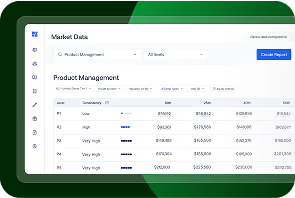
Pave's market pricing holds every salary range in one place with its market rationale and geographic pay differentials. Pave's compensation benchmarking data, drawn from integrated HRIS, payroll, and cap table systems across 8,000+ companies, anchors those ranges to a market number you can show.
Request a demo to see how Pave connects job architecture, ranges, and pay decisions into the record the directive expects you to produce.
This post is provided for general informational purposes only. It is not legal advice and does not describe how any law applies to your organization. Consult your own advisors regarding your obligations.

Pave is a world-class team committed to unlocking a labor market built on trust. Our mission is to build confidence in every compensation decision.
Frequently asked questions (FAQs):
What is the EU pay transparency directive?
The EU pay transparency directive, Directive (EU) 2023/970, is the European Union law that requires employers to share pay ranges with job applicants, give workers the right to information on pay levels by gender for their category of work, report gender pay gaps according to employer size, and carry out a joint pay assessment with worker representatives when an unjustified gap of 5% or more is not corrected within six months.
When does the EU pay transparency directive take effect?
Member states had to transpose the directive into national law by 7 June 2026. The pre-employment and right-to-information rules apply from the date of each national law.
The first gender pay gap reports are due by 7 June 2027 for employers with 150 or more workers, covering 2026 pay, and by 7 June 2031 for employers with 100 to 149 workers.
Which employers have to report under the directive?
Employers with 100 or more workers. Those with 250 or more report every year, those with 150 to 249 every three years from 2027, and those with 100 to 149 every three years from 2031.
Member states may set lower thresholds, and several drafts do. The pay-range, salary-history, and right-to-information rules apply to employers of every size.
What happens if the gender pay gap is over 5%?
A gap of 5% or more in any category of workers has to be justified by objective, gender-neutral criteria. If it cannot be, the employer has six months from the report to correct it.
If the gap is still unjustified after six months, the employer must carry out a joint pay assessment with worker representatives, identify the causes, set corrective measures, and share the assessment with workers and the national authority.