Companies rarely announce their next move in a press release; instead, their hiring activity reveals their intentions. Before a product launch or market entry, teams must be recruited.
As a result, strategy researchers increasingly view hiring as an early and reliable indicator of organizational priorities. Wei Shi, writing in Harvard Business Review this month, argues that job postings are among the clearest and most overlooked insights into competitors’ strategic priorities.
Corporate strategists are taking notice. For compensation leaders, however, this signal has always been central. A surge in postings for a role family indicates increased demand for your talent. Each posted salary range is a public statement of perceived value. Ultimately, compensation teams must answer the key question: Is this what the market is actually paying?
With the Pave Agent’s access to real-time job posting data and the Recent Hire Filter, you can now address both aspects of this question in one conversation and receive a sourced, statistically qualified answer you can act on.
Seeing the Whole Talent Market
Job posting data reflects the market’s stated intent. The Pave Agent analyzes live public postings, including titles, descriptions, and salary data, enriched with location and job family details and updated daily. Since postings are designed to attract candidates, they are often candid, specifying the skills, technologies, and levels companies seek, as well as the salary ranges they are willing to advertise, especially with new pay transparency laws.
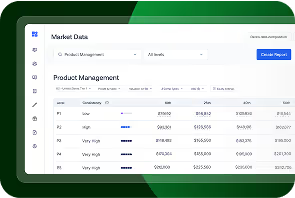
The Recent Hire Filter reveals actual market behavior. Available in Market Data Pro, it benchmarks employees hired in the last six months using Pave’s real-time dataset. This allows you to track recent compensation trends rather than relying on older data. Each data cut includes statistical significance indicators, so you can distinguish meaningful shifts from those in limited samples.
Job postings are forward-looking and public, reflecting what companies say they will pay. Recent hire data is transactional and aggregated, showing what new hires actually received. Each dataset compensates for the other’s limitations. Posted ranges may be aspirational or outdated, while aggregate benchmarks can lag in fast-moving markets.
Together, they help answer a key compensation question: Has the market truly shifted, or is this an isolated data point?
All-in-One Market Intelligence
The Pave Agent does more than compare two data sources. It analyzes your entire Market Data Pro subscription in a single conversation, providing posting trends and recent-hire benchmarks within the context of your broader market.
- Custom peer groups. Instead of referencing the market in general, focus on your specific market. You can compare posted ranges and benchmarks for a role within the peer group you use for benchmarking.
- Community intelligence from Pave Data Lab. Quick polls, pulse surveys, and daily insights from the compensation community provide an additional signal: what your peers report they are doing. When postings increase, recent-hire pay rises, and pulse data indicates peers are planning off-cycle adjustments, this reflects a market event rather than a single data point.
- Market Insights beyond pay. Metrics such as turnover, equity participation, span of control, and organizational structure provide additional context. A hiring surge in a market with elevated turnover indicates both increased demand and churn, which impacts retention strategies.
- Actionable answers. Each response includes data sources, sample sizes, and confidence levels. If you need the underlying data in a spreadsheet, specify the desired cut and columns, and the Agent will generate a custom CSV for download.
The previous workflow of gathering benchmarks, cross-referencing peer groups, searching community threads, and assembling memos—is now streamlined into a single question. The Agent provides the analysis, allowing your team to focus on decision-making.
Pave Agent in Action
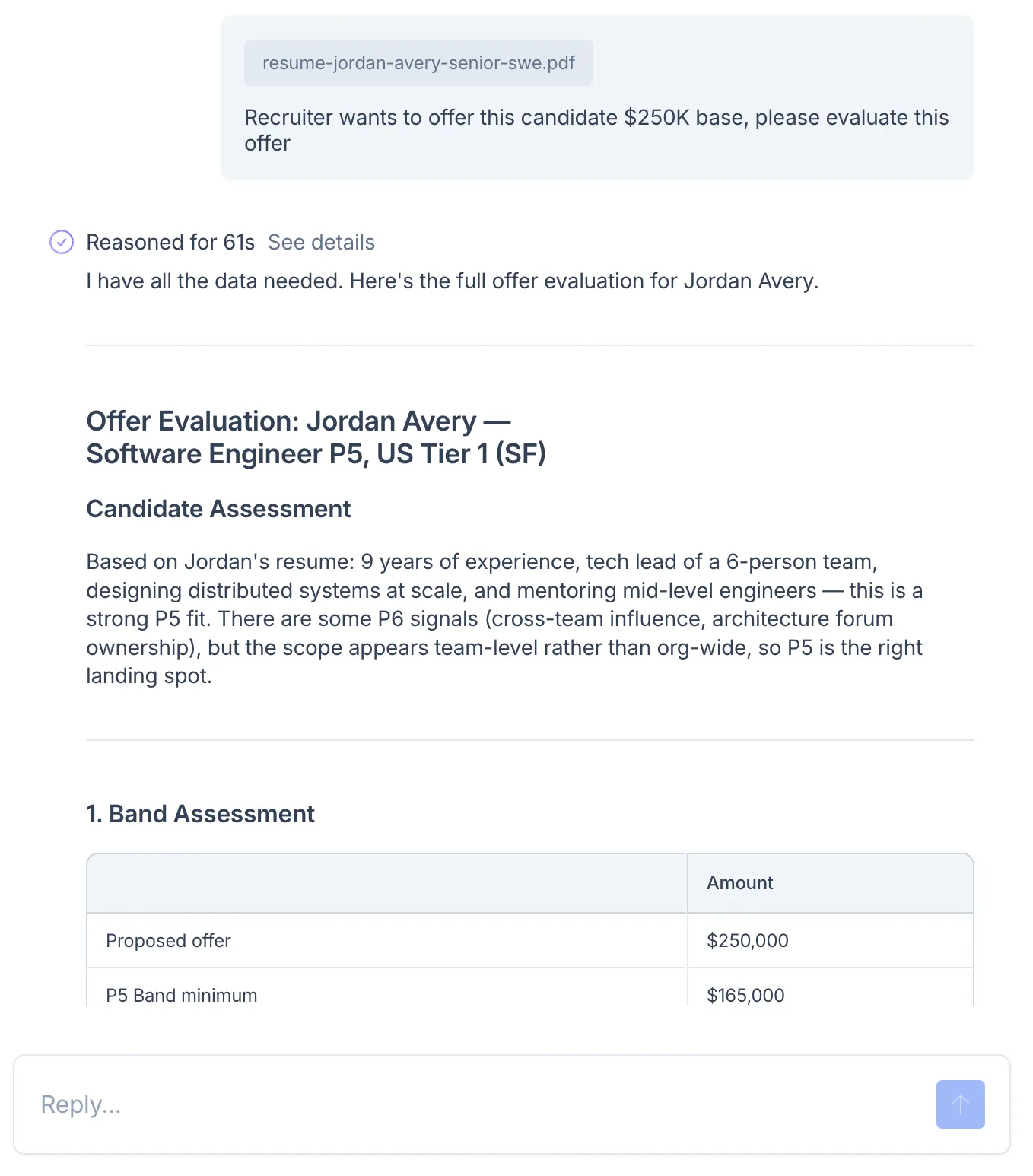
Address the escalation when candidates request higher offers. If a recruiter notes that offers for machine learning engineers are frequently countered, ask the Agent for insights. It will review changes in posted ranges for the role in your markets and compare them to recent-hire pay, including significance indicators. If both signals align, you have a strong case for a band review. If postings are high but recent-hire pay remains flat, negotiation tactics may be at play and your ranges are likely sufficient. In both cases, you respond with evidence rather than anecdote.
Identify talent market shifts early. Sustained growth in postings for a key role family signals rising demand for your employees. The Agent highlights these patterns, links them to role descriptions and levels in current postings, and checks if recent-hire compensation is increasing. This enables proactive band reviews before turnover occurs.
Price roles in new areas. When expanding into a new function, industry, or geography with limited survey coverage, postings reveal how the market currently defines and levels the role, including required skills and responsibilities. Recent-hire benchmarks show what new talent is earning. The Agent combines both with Pave’s full benchmark dataset, citing every source.
Validate your posted ranges. Due to transparency laws, your postings are included in the dataset. Ask the Agent how your advertised ranges compare to peers’ postings for similar roles and whether they are competitive with recent-hire compensation. Attracting candidates begins with the initial salary figure.
Decoding Location-Level Insights
Strategy researchers note that geography is often the most significant aspect of a hiring signal. Companies recruit local talent before announcing a new market and the roles posted in a location indicate the depth of their commitment. For compensation teams, concentrated hiring demand in a location signals movement in that pay market. A surge in postings in an emerging hub can lead to future pay compression challenges for existing employees in that hub.
This is where the two datasets intersect:
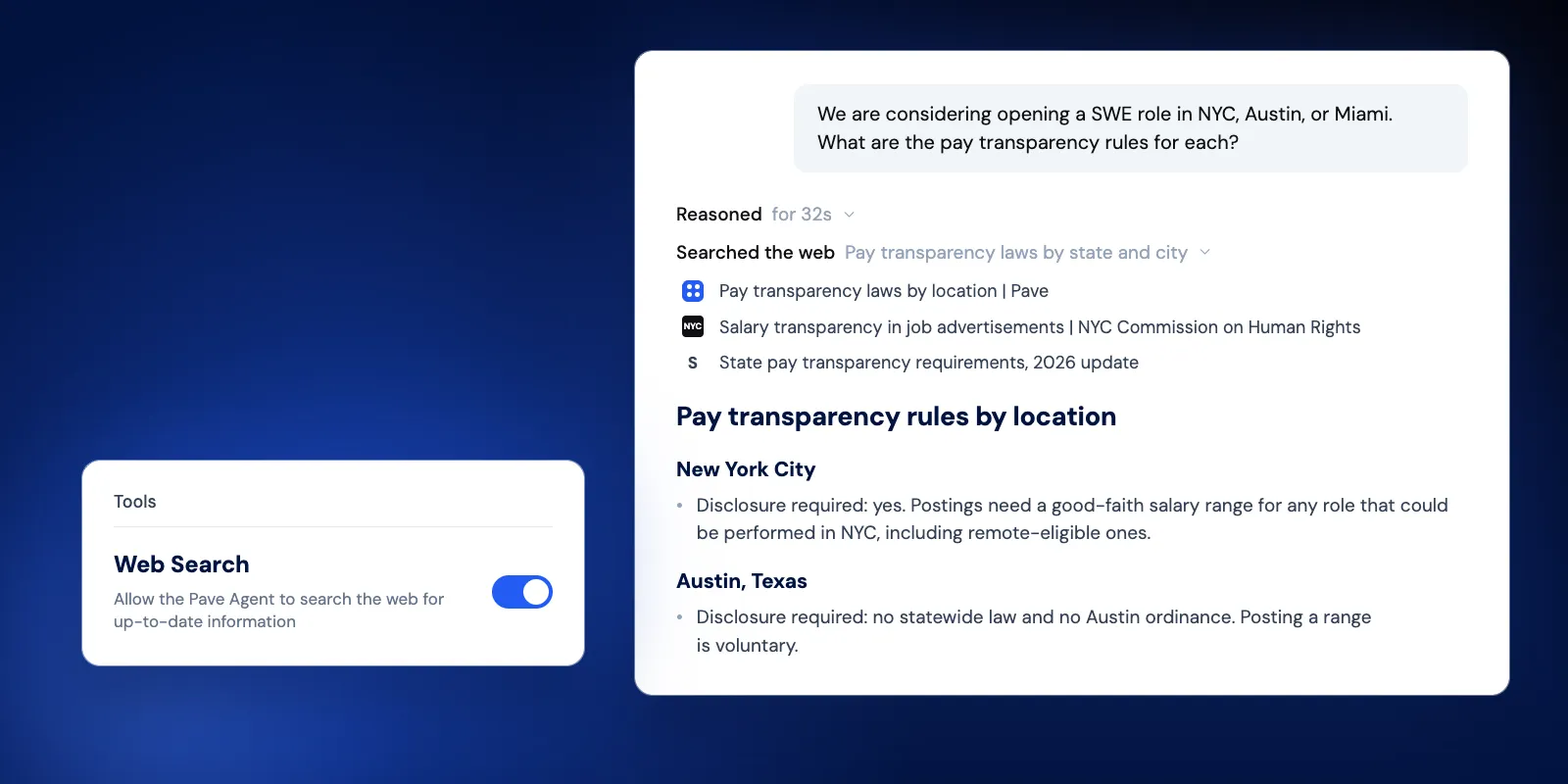
- Every job posting the Agent analyzes includes Pave’s location enrichment, allowing posting activity to be viewed geographically. You can see which roles are being hired in each location, at what advertised salary ranges, and how these trends are changing.
- Market Data Pro benchmarks cover over 170 locations, providing multi-market analysis. The Recent Hire Filter applies to these location-specific cuts, enabling you to determine if pay for recent hires in a particular market is changing. Statistical significance indicators show when a local sample is robust enough to inform decisions.
Ask the Agent a question that previously required a week of analyst work:
“Hiring for senior propulsion engineers in Los Angeles, CA. What are companies posting there, has recent-hire pay in that market changed, and how does it compare to our Austin band and other hubs?”
In one conversation, you receive the demand signal, transaction data, local benchmark, and internal comparison, all sourced and confidence-scored.
.webp)
Use cases include calibrating geographic differentials with current evidence, determining if a hot market requires a location-specific band review, assessing pay before opening a new office or expanding a remote hiring zone, and identifying early signs that a key hub is attracting increased competition. Narrow geographic cuts can lead to misleading small-sample results, which is why significance indicators are especially important and why the Agent highlights them.
Signal, Not Surveillance
A note on process: these two data sources operate under intentionally different rules.
- Job postings are public disclosures. When a company publishes a posting with a salary range, that’s the company speaking for itself, in public. Analyzing that signal—including at the company level—is reading what the market has chosen to say out loud.
- Recent hire benchmarks are aggregated by architecture. They come from Pave’s real-time dataset, protected by minimum company thresholds, dominance controls, and company-level anonymity. They reveal market insight without individual exposure. Every benchmark requires a minimum number of contributing companies. If a peer group segment doesn't meet the threshold, no data is shown—no exceptions.
Moving from Reactive to Proactive
Most compensation teams experience market shifts much like incumbents facing a competitor’s launch: unexpectedly and reactively. Offers become less competitive, counteroffers increase, and by the time the trend is clear, repricing occurs under pressure.
Hiring signals reduce this lag. Postings accumulate for months before market pressure emerges. The Pave Agent monitors these trends, compares them to recent-hire compensation, and provides timely analysis so you can respond proactively.
Competitors hire before they announce. Ask the Agent what roles they are hiring for.
Job posting data is now available in the Pave Agent. The Recent Hire Filter, custom peer groups, Pave Data Lab, Market Insights, and multi-market location coverage are included in Market Data Pro. Log in at app.pave.com or contact your account team to see these features in action.

Charles is a member of Pave's marketing team, bringing nearly 20 years of experience in HR strategy and technology. Prior to Pave, he advised CHROs and other HR leaders at CEB (now Gartner's HR Practice), supported benefits research initiatives at Scoop Technologies, and, most recently, led SoFi's employee benefits business, SoFi at Work. A passionate advocate for talent innovation, Charles is known for championing data-driven HR solutions.