CRB published their 2026 Horizons: Food Safety report, surveying over 300 food and beverage manufacturers across North America on their primary concerns. Common challenges included aging equipment, limited capital, and regulatory pressure.
One finding is particularly relevant for those in compensation: 75–80% of food safety success comes down to people.
It is not automation, facility design, sensors, HVAC systems, or traceability software that drives food safety. It is the people who operate the lines, manage changeovers, and identify mislabeled packages before shipment. Food safety ultimately depends on them.
But the industry is losing these essential workers.
Fifty percent of respondents identified labor availability as their primary production barrier, up 6% from last year. Food processing experiences the highest turnover in manufacturing at 36%, with production roles specifically seeing 30–38% annual turnover. Replacing each departing employee costs $20,000 to $40,000.
However, the greater loss is the expertise that leaves with them: knowledge of equipment requiring extra attention during allergen changeovers, proficiency in sanitation procedures, and the mentoring that prevents errors leading to FDA recalls.
In the first quarter of 2026, USDA recall volumes reached their third-highest level in over twenty years. Undeclared allergens once again led to FDA food recalls, increasing to 57 events from 49 in the previous quarter. These incidents are not equipment failures but labeling errors—human errors. Such mistakes often occur when employees receive minimal training, work undesirable shifts, and are compensated at rates that do not reflect their responsibilities.
Accelerating Automation in Food Processing
Many organizations instinctively seek to resolve these issues through automation. Over 70% of CRB respondents plan to invest in automation within the next three years. However, compared with last year, more companies now estimate that it will take more than four years to achieve their desired levels of automation. The gap between automation goals and implementation is widening.
Therefore, the current workforce will remain the primary safety infrastructure through at least 2030. Still, experts cite that automation is not a direct replacement for human labor. CRB experts note that automation can replicate programmed mistakes much faster than humans. Employees do not become less important with automation; their roles change, requiring higher skill levels and more complex decision-making. The consequences of errors remain significant and may increase due to greater scale.
Which brings us back to comp.
Compensation: The Missing Link in Food Safety
If your safety strategy relies on people, then your compensation strategy is integral to it.
CRB data indicates that companies with structured retention programs reduce turnover by 20–28%. Technical roles experience higher retention when pay progression and training pathways are clearly communicated and accessible to employees, especially those working overnight shifts who are evaluating their long-term commitment.
Many food manufacturers overlook this connection. They invest heavily in facility upgrades and traceability systems, but do not ensure that employees understand how skill development, such as learning allergen protocols, leads to increased compensation. Training and job architectures are often siloed, leaving workers without a clear view of advancement opportunities. As a result, employees may leave for other positions offering higher pay and better working conditions.
The CRB report found that 50% of barriers to adopting food safety technology are cost-related, including high capital costs and unclear ROI. Similar objections are raised regarding compensation infrastructure. However, a single recall can result in millions in direct losses and significantly higher liability throughout the supply chain. Additionally, replacing a production worker costs $20,000 to $40,000, with additional expenses for training and increased safety risks associated with less-experienced staff. These factors underscore the value of real-time benchmarking.
Thirty percent of small companies in the CRB survey cited “lack of support from management” as a primary barrier to executing rapid recalls. This is not a technology issue but a cultural one. CRB experts consistently conclude that the companies with the best safety outcomes are not always the largest or best-funded, but those where leadership prioritizes safety as a core value integrated into technology, facility design, processes, and hiring practices.
Compensation functions similarly. Manufacturers with the highest retention rates are not always those offering the highest pay, but those who clearly communicate advancement opportunities and treat compensation as essential infrastructure rather than overhead.
Leveraging Modern Tools
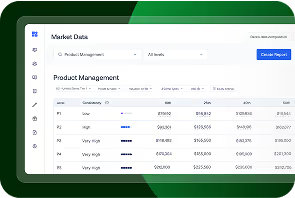
This is where end-to-end compensation tools make a meaningful impact. Leveraging Pave Market Data allows food manufacturers to benchmark pay against real-time, defensible industry standards—supporting both retention and pay equity. The Total Rewards Portal empowers employees to see the full value of their compensation and benefits, reinforcing transparency in what they're actually being paid. And with the Visual Offer Letter, companies can showcase advancement opportunities in a clear, compelling format, helping employees envision a future within your organization.

Charles is a member of Pave's marketing team, bringing nearly 20 years of experience in HR strategy and technology. Prior to Pave, he advised CHROs and other HR leaders at CEB (now Gartner's HR Practice), supported benefits research initiatives at Scoop Technologies, and, most recently, led SoFi's employee benefits business, SoFi at Work. A passionate advocate for talent innovation, Charles is known for championing data-driven HR solutions.