Human Capital Management (HCM) platforms can work well for basic compensation use cases, but they often break down when things get more complicated.
When a merit cycle becomes more complex, an equity refresh needs a workaround, or a manager asks a pay question, teams are left scrambling or relying on technical specialists to find the answer. What starts as an acceptable option can quickly turn into frustrating, ineffective compensation workflows.
Generic AI tools promise to speed things up, but they lack the context needed to make informed decisions.
So how do you know when "fine" has turned into a real gap? Here's where to look.
Where HCMs Fall Flat
HCM platforms are built to track employee records and support workforce management. Compensation gets added as a bolt-on module, not built from the ground up, and it shows in a few places.
Simple annual merit increases with straightforward approval chains are no problem, but variable compensation, equity refreshes, and multi-currency structures push past what most modules were designed to handle. Configuration typically requires technical specialists, so a change that should take an afternoon can take weeks, or even months.
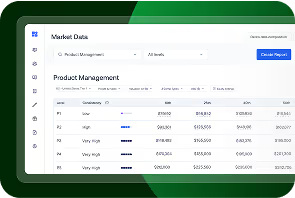
Market data tells a similar story. HCM modules track what you're paying, not what the market is paying, which means benchmarking requires a separate vendor relationship and manual imports. As a result, compensation teams spend time reconciling data instead of using it.
And employee communication is typically lackluster. HCM platforms offer static PDFs, without the ability to dynamically update and communicate pay information.
Generic AI Tools Add to the Problem
Many compensation leaders are also turning to AI, and rightfully so—it can help speed up processes so teams can work faster.
But AI is only as good as the data you feed it.
Generic AI tools are built to generate plausible answers, not accurate ones. A general-purpose AI tool doesn't know your percentile targets, your equity refresh philosophy, or how your leveling framework maps to market data. Without that context, it can sound confident and still be wrong in ways that are hard to catch until a manager or an employee questions the numbers.
General-purpose AI tools are a reasonable choice when speed matters and risk is low, such as drafting job descriptions or writing internal communications. But purpose-built AI for compensation is the better fit when accuracy, defensibility, and governance are essential, such as when conducting market pricing, setting pay recommendations, running equity analyses, and planning for merit cycles.
Outputs tied to verified data sources and an audit trail matter more than speed when the decision is someone's pay.
{{mid-cta}}
A Quick Gut-Check Before You Decide
Before assuming a bigger overhaul is the only option, it's worth running your current stack through a few questions.
- Who's actually in control of configuration? If every change to cycle logic, approval chains, or equity parameters has to route through an internal specialist or an implementation partner, that's friction that’s slowing your team down.
- Is market data built in, or bolted on? If benchmarking means logging into a separate system and importing a spreadsheet, your compensation data and your market data are living in two different places, and someone has to reconcile them by hand.
- What does the employee experience look like? If total rewards communication means a static PDF that arrives once, employees are left without real visibility into their pay. Always-on, dynamic total rewards information gives employees a clearer, more current picture of their compensation.
There isn’t a one-size-fits-all approach to building effective compensation workflows, but these questions help determine what works best for your business.
Get the Full Framework
This gut-check is a starting point, not the whole picture.
The Buyer's Guide to Purpose-Built Compensation Software goes further and provides:
- A full side-by-side comparison of HCM compensation modules and purpose-built platforms
- Questions to bring to any compensation vendor conversation
- Talking points for making the case to your CFO, CHRO, and IT team
Want to learn more?

Jess is a content strategist and writer with a passion for helping small and mid-sized B2B companies tell great stories. Outside of work, Jess is an east-coaster turned west-coaster, a yoga teacher, and a fan of bad reality TV and good food.