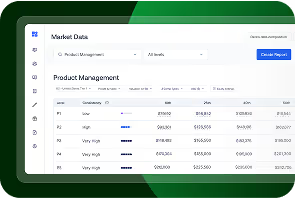
Every comp team has a queue. Now, for the first time, you can clear it.
Ask any Total Rewards or Compensation executive where their team's week goes, and the answer is rarely "strategy." It goes to the queue: a recruiter needs an offer sanity-checked before a candidate call, a manager wants to know why their new hire landed above a tenured report, Finance needs an equity burn number by Thursday, and a business unit is asking whether its ranges have drifted. Each request is reasonable. Each one takes an analyst 30 minutes to half a day to pull, reconcile, and write up. None of them is the work the team was hired to do. For leaders, this is the opportunity cost—every hour in the queue is an hour not spent on the future of pay at your organization.
That queue is what the Pave Agent was built to clear. Since launch, we've seen a fundamental shift: what once took hours now takes moments; what once stalled cycles now accelerates decisions. We've kept a running list of every use case a customer has taken from an open question to a recommendation they could act on. The list tells two stories at once: how far the Agent's capabilities have expanded and how quickly compensation teams—and their executive sponsors—have adopted them. It now runs to more than 70 distinct use cases, and it's growing every week.
Below is that list, organized by the workflows compensation professionals recognize, with a note on what each one unlocks.
How the Pave Agent works (and where it stops)
Before the list, a word on the principle behind every entry: the Pave Agent recommends; your team decides. Your leadership always keeps ultimate accountability and judgment.
The Agent is the AI compensation analyst inside Pave—always on, always current, and always secure. It understands your leveling framework, pay philosophy, and ranges because it sits on the same real-time data layer as the rest of the platform, connected to your HRIS, ATS, equity systems, and Pave's benchmarks. When you ask it a question, it reasons across those sources, shows its work, and returns a recommendation with its data sources, confidence, and the compensation caveats a good analyst would flag.
It does not set pay, approve an offer, or change a range. That's your call, and every recommendation is built to be defended when you make it. For Total Rewards and HR leaders, this means you gain a force multiplier—one that scales your team's impact without compromising rigor or control.
That distinction is why the use cases below have stuck. Teams start with low-risk, high-volume questions, see that the answers hold up, and expand from there.
What compensation teams are using the Pave Agent for
Market pricing and pay bands
Market data analysis
Pay equity, internal alignment, and retention risk
Offers, promotions, and individual comp questions
Comp structure, job architecture, and org design
Merit and comp cycle planning
Equity program design
Getting more out of Pave
What the list tells us
Three things stand out for executives evaluating the shift to AI-driven compensation analysis.
- The center of gravity is where it should be. The most-used categories are market pricing, individual comp questions, and cycle planning: medium-complexity work with high cognitive load and low error tolerance. That's exactly the work an analyst most wants off their plate and exactly where a compensation-specific Agent earns trust.
- Adoption expands along a predictable path. Teams almost always start with pricing and offer questions. Once those recommendations hold up under a recruiter's or manager's scrutiny, they move to structural work: architecture, equity, and cycle design. The Agent's compensation memory makes each step easier than the last.
- Defensibility is the feature. No entry on this list is a chart for its own sake. Each one ends with a recommendation, along with sources, confidence, and caveats, so the person acting on it can explain it to a CEO, a board, or an employee.
What's next
The list above is a snapshot. We add new use cases as customers bring them and we have several categories on our roadmap.
If you're a Pave customer, the fastest way to see where the Agent fits your queue is to bring it the question on your desk right now. If you're not yet, see the Pave Agent in action and book a call today.

Charles is a member of Pave's marketing team, bringing nearly 20 years of experience in HR strategy and technology. Prior to Pave, he advised CHROs and other HR leaders at CEB (now Gartner's HR Practice), supported benefits research initiatives at Scoop Technologies, and, most recently, led SoFi's employee benefits business, SoFi at Work. A passionate advocate for talent innovation, Charles is known for championing data-driven HR solutions.