When it comes to designing fair and sustainable compensation, the distinction between cost of labor and cost of living is critical—but often misunderstood. They sound similar, but they measure fundamentally different things and respond to different forces—one from the employer’s side of the ledger and the other from the employee’s wallet.
What is Cost of Labor?
- Cost of labor is what a business actually pays to employ someone. It’s more than just a paycheck. It includes wages or salary, payroll taxes, benefits like health insurance and retirement plans, paid time off, training, bonuses, and any required employer contributions. In other words, it’s the full price tag of having an employee on the team.
- Cost of living is what it costs a person or household to get by in a particular place. Think rent or mortgage, groceries, transportation, utilities, healthcare, childcare, and taxes. It answers a simple question: how much money do you need to maintain a reasonable standard of living where you live?
Cost of Labor vs Cost of Living in Compensation
The distinction between cost of labor vs cost of living matters, because how you define the problem shapes how you design pay. If you anchor compensation decisions to the wrong metric, you risk solving the wrong problem, inflating payroll without improving competitiveness, performance differentiation, or talent retention.
Cost of labor reflects the price of talent in the labor market. It is driven by supply and demand for specific skills, productivity, competitive hiring pressure, and total rewards structures, not just wages. A Software Engineer and a Customer Success Manager in the same city can face the same rent and grocery prices, yet command very different labor costs because their skills are valued differently in the market.
Cost of living, by contrast, reflects the price of goods and services required to maintain a standard of living in a particular location. It is driven by housing supply, energy costs, food prices, taxes, transportation infrastructure, and local policy. These costs affect everyone in a region similarly, regardless of role, performance level, or scarcity of skills.
Because the drivers are different, the two do not move in lockstep. Living costs can rise rapidly even when labor demand is flat, which constrains employers’ abilities to raise wages. Conversely, labor costs can rise sharply in high-demand roles even when local living costs are stable or falling. Treating them as interchangeable oversimplifies how compensation actually works and can lead to misaligned pay decisions, inefficient allocation of payroll dollars, and weakened pay-for-performance signals.
Focusing on Cost of Labor in Compensation Strategy
Many organizations default to cost-of-living adjustments (COLAs) across the board, giving a standard increase to everyone regardless of performance or where someone is in their competency development journey. While well-intentioned, this approach can inadvertently create salary compression, where high performers reach the top of their range too quickly and distinctions in performance and ability blur.
Instead, focusing on the cost of labor (what the market is paying for a given role in a particular region and industry) aligns your pay practices with competitive realities. It preserves pay range integrity, supports differentiated rewards based on performance and skill growth, and aligns compensation with competitive realities that drive business results.
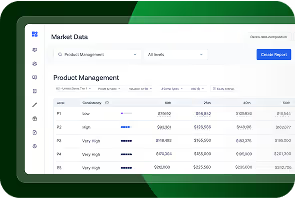
Market data already reflects local living costs because employers must adjust pay to attract and retain talent in each region, and those wage levels are captured in compensation benchmarks over time. Using the cost of labor aligns pay with real market conditions rather than abstract cost-of-living indexes. This preserves pay range integrity and enables differentiated rewards based on performance and skill growth, rather than blanket increases. Any concerns about data lag can be addressed with real-time compensation tools such as Pave.
Balancing Market Pay & Employee Living Costs
Designing a compensation strategy requires balancing paying employees fairly relative to the market and ensuring they can meet their basic living needs. Prioritizing cost of labor is most effective when your goal is to remain competitive in attracting and retaining top talent, differentiate pay based on performance, skill, and career progression, and build a principled, flexible compensation framework that supports long-term growth. By aligning pay with market rates for each role, you reward contribution, maintain pay range integrity, and prevent salary compression that can blur distinctions between high and average performers.
Benchmarking tools that focus on cost of labor, such as Pave, can make this process far more precise. These platforms aggregate market data across industries, regions, and roles, allowing organizations to compare current pay against competitive benchmarks. Importantly, they incorporate local market conditions, skill scarcity, and role-specific demand, capturing much of the same information that drives cost of labor decisions, without conflating it with individual living costs. This allows organizations to make data-driven decisions, set pay ranges that reflect market realities, and adjust offers strategically to attract or retain talent where it matters most.
However, focusing exclusively on market-driven labor costs can leave employees vulnerable if living costs in their region rise sharply. This is where cost-of-living adjustments still play a role. COLAs can help maintain employee morale and stability during sudden economic shifts, inflation spikes, or localized cost surges. Organizations might respond with off-cycle pay adjustments, temporary stipends, geo-pay band updates, or enhanced benefits. We might see this happening where a remote workforce is facing rapid housing cost increases in certain metro areas or a company is launching a new office in a region experiencing high inflation.
The difference between cost of labor and cost of living is not always intuitive. For example, New York City Metro has the highest cost of living in the United States, but it does not have the highest cost of labor, meaning salaries do not always match the expenses employees face. Conversely, the Seattle market commands a relatively high cost of labor, even though its cost of living is lower than cities like New York, San Francisco, and Los Angeles. These examples illustrate why anchoring pay purely to living costs or assuming that high-cost cities always require the highest salaries can lead to misaligned compensation strategies.
Finding the Balance
The tradeoff is clear—prioritizing market pay ensures competitiveness, fairness, and long-term sustainability, but it may not address immediate financial pressures employees face. Prioritizing cost-of-living adjustments can provide short-term relief but risks inflating payroll, reducing differentiation, and diluting incentives for high performance if applied uniformly.
Ultimately, a balanced approach integrates both perspectives. Market-based pay anchors your strategy in objective benchmarks, supported by cost of labor data from tools like Pave, while selective, targeted COLAs or temporary measures protect employee wellbeing in exceptional circumstances. The most effective compensation strategies reward contribution, support career progression, and maintain a sustainable pay structure while creating a system that is fair, competitive, and empowering for all employees.
_
About WOVEN
As former HR executives and operators ourselves, we are equal parts doers, thinkers, and strategists. Our team has decades of in-house and advisory experience across all types of public and private industries: technology, professional services, consumer products, non-profits, and more. Our deep experience gives us the knowledge to help you with what you need for today—and also what you’ll need tomorrow.

Sarah Kors is a Senior Associate at WOVEN HR, a full-service HR consulting firm of former HR executives and operators. With over a decade of building people foundations that power businesses, Sarah brings a long history of partnering with C-level executives and leaders to drive compensation, performance, and operational strategies that deliver results.