
Key Takeaways
- Refresh grants typically run about 30% of a new-hire grant, per Carta data.
- About 20% of employees get a refresh by year one, and nearly 50% by year two.
- Who gets one is driven by level and promotion: in Pave's data, 82% of director-level employees receive refresh grants versus 25% of P1s, and 95% of promoted employees receive an ongoing grant.
- Common strategies: boxcar, traditional, performance, promotion-based, and annual grants.
- Dilution is simple to model: new refresh shares divided by new fully-diluted share count.
- There's no single right approach. It depends on your company's stage and processes.
Originally published August 20, 2021.
An equity refresh is an additional equity grant made to an existing employee, on top of the grant they received when they were hired. Companies use them to keep unvested equity ahead of people as the original grant vests. You will also hear them called equity refresh grants, refresher grants, or simply a refresh grant.
So what is an equity refresh for, and how big should one be? The short answer is retention, and it depends on level, performance, and stage. We will get to the numbers, including what Pave's data shows about who actually receives refresh grants.
First, a bit of history, because the reason refresh grants exist is the reason the four-year vest stopped working. Long before catered lunches, embroidered Patagonias, and 99% covered healthcare premiums, stock options entered the scene.
In fact, stock options for employees can be traced all the way back to the mid-1970s. Though you would never know it with how misunderstood they are.
Why did companies start offering stock options to employees?
- Salaries were lower than big corporations: stock options provided a way to [sort-of] level the playing field and give employees a shot at that big exit
- Ownership aligns incentives: giving employees a stake in the success of the company would motivate them to work harder and see to its success
But how long would you have to burn the midnight oil before you might have a shot at that big pay-out?
Before the Dot-Com Boom, most startups would IPO in 6-8 years. A few names you may know were even quicker.
Amazon: Raised an $8M total Series A in 1996
Founded: 1994, IPO: 1997
Google: Raised $36.1M over 4 funding rounds
Founded: 1998, IPO: 2004
Salesforce: Raised $65.4M over 6 funding rounds
Founded 1999, IPO: 2004
You may also notice that the total amount of funding raised by these companies is nothing compared to today’s standards. Pave, for one, has already raised more venture money than Google did.
The 4-year vest, 1-year cliff was born
Translated: you must stay at least 1 year to play the game at all, and in order to have all your chips, you must stick it out for 4.
With some of the IPOs we looked at above, this made quite a bit of sense. Stick around long enough to play the game, and you might be on the heels of the next IPO.
Still today —by a long shot—this is usually what the fine print of your lotto ticket reads. And so, an employee signs on the dotted line for a chance at the next big startup.
But does this still make sense?
In a look at the 16 SaaS IPOs of 2020, the median time from founding to IPO was 13 years. Yes, 13.
Next Translation: The 4 year vest will not incentivize your employees to stick around for 13 years—or anywhere close.
So how are companies keeping people around given the new circumstances?
Enter: Equity refresh grants
So assuming you want to keep your people around for more than 4 years, you may want to heavily consider additional equity grants.
Common equity refresh grant strategies
A few common strategies:
- The boxcar grant: A new equity grant usually offered in year 2 or 3 of employment that won’t begin vesting until after the 4 year grant concludes. So, the vesting schedules look like boxcars - clever.
- Traditional grant: New grants (usually starting in years 2 or 3) are issued on a 4-year vesting schedule without the cliff and usually begin vesting immediately. In this case, the vesting schedules overlap.
- Performance grant: Grant high-performing employees an additional grant (usually any time after the cliff). Vesting schedules can vary, but typically they start vesting immediately.
- Promotion-commensurate grant: Just as salary changes with a promotion, so the equity grant value should also be commensurate.
- Annual grants: A one-year vesting model granted annually.
How much should an equity refresh grant be, and when?
Carta's data offers a useful starting benchmark:
- Refresh grants typically run about 30% of a new-hire grant for the same role or level.
- About 20% of employees receive a refresh by year one, climbing to nearly 50% by year two.
- Pre-seed to Series A companies allocate roughly 35-37% of their equity pool to refreshes; Series B-E companies allocate 40-50%.
Timing usually follows company maturity, not a fixed calendar: promotion-based refreshes first (once a leveling framework exists), performance-based refreshes next (once reviews are calibrated), and tenure-based refreshes last (once end-of-vesting attrition becomes a recurring pattern).
What Pve's data shows about equity refresh programs
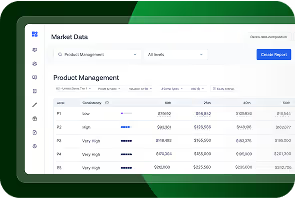
Carta's figures above tell you how big a refresh tends to be and when it lands. What they do not tell you is who receives one, and that is where an equity refresh program is actually designed. Here is what we see across the companies on Pave.
Three things stand out. Promotion is the strongest single trigger, ahead of performance rating and tenure. Function matters even at the same rating, with R&D refreshed far more often than go-to-market roles. And by the later stages, ongoing grants are the larger half of equity spend, which means a refresh policy is a budget policy.
How to model equity refresh dfilution
Modeling dilution from a refresh program comes down to one formula:
New refresh shares ÷ new fully-diluted share count = dilution %
Here's a simple example.
Say your company has 10,000,000 fully-diluted shares outstanding today. You roll out a refresh program that grants 200,000 new options across eligible employees this cycle.
Your new fully-diluted share count becomes 10,200,000 (10,000,000 + 200,000). Dividing the new refresh shares by that new total: 200,000 ÷ 10,200,000 ≈ 1.96%, so this refresh cycle dilutes existing shareholders by roughly 2%.
Run this calculation every cycle, not just once, since refresh grants compound over time as multiple overlapping grants accumulate. Modeling dilution across several years, not just the current cycle, is what actually tells you whether your option pool can sustain the refresh strategy you're planning without an unplanned pool increase.
Considerations before rolling out an equity refresh p-rogram
There is no perfect approach, only considerations to make:
- Annualized total comp: Consider the annualized value of an employee’s salary + stock option value. A decrease in total compensation in coming years does not optimize for retention.
- Compensation philosophy: Do you have a pay-for-performance model? Do you only adjust compensation for role/level changes? Be thoughtful. More importantly - be consistent.
- Company stage & employee tenure: Equity refresh grants are fairly uncommon when a majority of employees haven’t even hit their cliff yet, but if you’re waiting until you’ve had employees for 3-5 years before rolling out an equity refresh program, you’ll be behind the curve.
- Valuation: Is your valuation increasing rapidly? Remember, 409a valuations are refreshed once a year at a minimum (this means the strike price employees will pay increases each year that you wait to grant them more equity).
- Total rewards: Clearly, there is more to the equation than just salary and equity alone. Consider the weight of other forms of compensation and how you want to reward employees (e.g. cash incentives like bonus and commissions).
Retention pressure hasn't disappeared just because the market has cooled since 2021's hiring frenzy. Savvy teams still give retention strategies a fresh look on a regular basis, and equity refreshes are very often part of that equation, even in a more measured hiring environment.
But the impact of equity refresh grants doesn’t stop there.
Candidates are starting to ask about equity refreshes. They’re seen as an additional benefit and a longer term incentive. So they can also serve as a helpful recruiting tool.
Again, be thoughtful. And be consistent. Don’t wait to establish a strategy until you’ve felt the effects of not having one.
Oh, and if you’re struggling to figure out how to roll this sort of thing out in spreadsheets, you may want to check out Pave's platform

Pave is a world-class team committed to unlocking a labor market built on trust. Our mission is to build confidence in every compensation decision.
Frequently Asked Questions (FAQs) About Equity Refresh Grants
What is an equity refresh?
An equity refresh (or equity refresher) is an additional grant of stock options or RSUs to an employee who already holds a new-hire grant. It is usually made as the original grant approaches full vesting, on promotion, or to reward performance, so the employee always has unvested equity ahead of them.
How does a stock refresh work?
The company grants a new award with its own vesting schedule. A traditional refresh starts vesting immediately and overlaps with the original grant; a boxcar grant is made in year two or three but only starts vesting once the new-hire grant is fully vested. Either way, the new shares come out of the option pool, so each refresh cycle should be modeled for dilution.
How big is a typical refresher grant?
Carta's data puts a typical refresh at about 30% of what a new hire in the same role would receive today, and Sequoia's 2025 trends report shows companies moving toward smaller, more frequent grants. In Pave's data, who receives a refresh matters as much as the size: 82% of director-level employees get one, against 25% of entry-level employees, and promotion is the strongest trigger.
What is boxcar vesting?
Boxcar vesting means giving employees equally-sized grants on a regular schedule, typically annually, each vesting on its own 4-year timeline. For example, instead of a large new-hire grant plus small periodic refreshes, a company might grant 4,000 options every year; by year four, an employee has four separate grants vesting at once, creating overlapping schedules that look like linked boxcars on a timeline. For the full breakdown, see Pave's guide on boxcar grants.
What are the best practices for structuring an equity refresh grant at a growth-stage startup?
Start with promotion-based refreshes once you have a leveling framework in place, since they piggyback on a process you're already running. Layer in performance-based refreshes once your review cycle is calibrated enough to differentiate fairly, and add tenure-based refreshes once end-of-vesting attrition becomes a recurring pattern rather than a one-off. Sizing refresh grants around 30% of an equivalent new-hire grant, per Carta's benchmark, is a reasonable starting point.
How do you model the dilution impact of an equity refresh program?
Divide the new refresh shares being granted by your new fully-diluted share count (existing shares plus the new refresh shares) to get the dilution percentage. For example, granting 200,000 new options against a 10,000,000-share fully-diluted count works out to roughly 2% dilution for that cycle. Model this every refresh cycle, since grants compound over multiple years.