


Key Takeaways
- Marketing compensation varies significantly by role, seniority level, and industry segment. A single national average understates the range compensation teams need to plan effectively
- Senior marketing roles, including CMO, VP of Marketing, and Demand Generation Director, command total compensation well above the national marketing median, with equity playing a meaningful role at growth-stage and public companies
- The median marketing salary for a P3 individual contributor in the US is $110,000.
- Pave's marketing salary survey data, refreshed monthly from automated connections to HRIS and ATS systems, gives compensation teams the role-level benchmarks needed to build and maintain competitive marketing pay bands
A marketing salary guide is only useful if the data behind it is current. Marketing compensation has shifted as budget cycles tightened, demand for performance-focused roles grew, and the skills premium for marketing analytics and AI-adjacent specializations widened.
This guide covers average marketing salaries across roles, seniority levels, and industry segments in the United States, drawing on Pave's real-time Market Data and external benchmarks to give compensation teams a complete picture of where the market stands in 2026.
What the Marketing Salary Guide Shows About Average Pay in the United States
Marketing compensation in the United States spans a wide range depending on role type, level, and the industry context in which a marketer operates. Understanding the distribution, not just the median, is what makes a marketing salary guide actionable for compensation planning.
At the national level, the Bureau of Labor Statistics reports a median annual wage of $138,730 for advertising, promotions, and marketing managers, though this figure blends seniority levels and role types in ways that limit its usefulness for setting individual pay bands. Pave's role-level data provides a more granular view.
The geographic market has a significant effect on these figures. Marketing salaries in Tier 1 markets like San Francisco, New York, and Seattle consistently run above national medians for comparable roles.
How a Marketing Salary Guide Helps Compare Roles Across Industries
One of the most practical applications of a marketing salary guide is benchmarking across industry segments, where compensation norms vary considerably even for nominally identical roles.
A Senior Marketing Manager at a B2B software company operates in a very different compensation environment than a Senior Marketing Manager at a consumer packaged goods company or a nonprofit. Industry segment affects not just base salary but the total compensation mix, including bonus structure, equity availability, and the prevalence of performance-based incentives.
For compensation teams managing marketing pay bands, industry-specific benchmarks are more actionable than national averages. A marketing salary survey that blends all industries will consistently misprice roles at companies where the competitive talent set is drawn from a specific sector.
How Specialization Affects Marketing Compensation
Within marketing, role specialization is an increasingly strong predictor of compensation. Field marketing, marketing analytics, and product marketing command higher compensation than generalist marketing roles at the same level, reflecting demand for marketers who can demonstrate direct revenue impact.
- Field Marketing (P3) - $122,500
- Marketing Generalist (P3) - $110,000
Demand Generation and Revenue Marketing roles have seen particular growth in B2B technology companies, where attribution and pipeline contribution are directly measurable.
- Demand Generation (P3) - $122,564
- Marketing Generalist (P3) - $110,000
Which Marketing Jobs Pay the Most
According to Pave's marketing salary survey data, the highest-paying marketing roles in the United States in 2026 are concentrated at the senior individual contributor and leadership levels, with total compensation increasingly differentiated by equity at growth-stage and public companies.
Chief Marketing Officer
The CMO role sits at the top of the marketing compensation range, with total compensation varying significantly by company size, stage, and industry. At public technology companies, equity is often the largest component of CMO total compensation.
- Median base salary: $325,000
- Median annual bonus percent: 32.1%
- Median total equity (Gross, Total, Current value): $3,566,836
VP of Marketing
VP of Marketing (E7) compensation reflects both leadership scope and the revenue accountability that comes with owning the full marketing function. At growth-stage companies, VP of Marketing roles frequently include meaningful equity alongside cash compensation.
- Median base salary: $252,471
- Median new hire equity: $880,500
Director of Demand Generation
Demand Generation Directors (M5) are among the highest-compensated leaders in marketing, particularly in B2B technology. Direct pipeline attribution makes this role easier to tie to business outcomes, which supports stronger compensation positioning.
- Median base salary: $200,000
- Median new hire equity: $231,041
Product Marketing Manager (Senior)
Senior Product Marketing Managers (M4) at technology companies command above-average compensation for the marketing function, reflecting the cross-functional scope of the role and the business impact of effective product positioning and launch execution.
- Median base salary: $195,533
- Median new hire equity: $173,821
Marketing Analytics Manager
Marketing analytics (M3) commands above-median compensation within the marketing function, driven by demand for marketers who can build attribution models, interpret performance data, and connect marketing activity to revenue outcomes.
- Median base salary: $166,700
- Median new hire equity: $193,043
How to Use a Marketing Salary Survey to Build Competitive Pay Bands
A marketing salary guide provides the reference points; market pricing is where compensation teams turn those benchmarks into an actionable structure. The goal is a band wide enough to accommodate progression within a level but anchored tightly enough to reflect actual market rates.
Step One: Define Your Peer Group
National marketing salary averages are a starting point, not a benchmark. Filter by industry, company size, stage, and geography to identify the competitive set your organization draws from when hiring marketing talent.
Step Two: Select Your Percentile Anchor
Most organizations anchor pay band midpoints to the 50th percentile of their defined peer group. Companies competing aggressively for senior marketing talent or operating in high-cost markets may anchor to the 65th or 75th percentile. The right choice depends on your compensation philosophy, not the market average.
Step Three: Set Band Spreads By Level
For marketing roles, a band spread of 50–70% works well for most individual contributor levels. Leadership roles (Director and above) often carry wider spreads to accommodate the broader scope variation that exists within the same level.
Step Four: Review Against Current Data
Marketing compensation, particularly in analytics and performance marketing, is moving fast enough that annual reviews are insufficient. Pave's 2026 compensation budget data shows a 3.5% median salary increase across 243 companies, but role-level movement varies considerably above and below that figure. Pave's marketing salary survey data refreshes monthly, allowing compensation teams to check band alignment regularly and make targeted corrections before significant market drift accumulates.
Build Marketing Pay Bands That Hold Up to Market Scrutiny
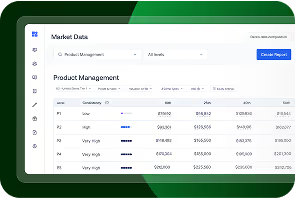
Marketing salary benchmarks from Pave are built on automated connections to HRIS, ATS, and equity management systems across 9,000+ companies, with benchmarks refreshed monthly and job matching handled by machine learning rather than manual title-to-title comparison.
For compensation teams benchmarking marketing roles, that means role-level percentile data updated monthly, total compensation benchmarks covering base, bonus, and equity, and the ability to filter by industry, company size, geography, and stage to match your actual competitive set.

Pave is a world-class team committed to unlocking a labor market built on trust. Our mission is to build confidence in every compensation decision.
Frequently Asked Questions
What does a marketing salary guide show about average pay in the United States?
A marketing salary guide shows median and percentile compensation for marketing roles across levels, specializations, and geographies. National averages from sources like the BLS cover broad occupational categories; role-level guides from compensation data platforms provide more actionable benchmarks by separating out specific roles (Marketing Coordinator, Demand Generation Manager, CMO) and filtering by industry, company size, and location.
How can a marketing salary guide help compare roles across industries?
Marketing compensation norms vary significantly by industry. B2B technology companies typically offer higher total compensation for marketing roles than consumer or nonprofit organizations, largely due to equity availability and performance bonus structures. A marketing salary guide segmented by industry allows compensation teams to benchmark against the specific peer group their organization competes with for talent, rather than a blended national average that may not reflect the actual hiring market.
Which marketing jobs pay the most, according to a United States marketing salary guide?
The highest-paying marketing roles in the United States in 2026 are CMO, VP of Marketing, Director of Demand Generation, Senior Product Marketing Manager, and Marketing Analytics Manager. At growth-stage and public technology companies, total compensation for senior marketing roles is often significantly above base salary figures, driven by equity.