
Key Takeaways
- A typical severance package is most often structured using both tenure and level, the most common approach among the 200+ companies Pave surveyed.
- Public companies cap severance at a median of 26 weeks; private companies cap it at 12 weeks.
- Severance pay is taxed as supplemental wages: 22% federal withholding up to $1 million, 37% above that, plus Social Security and Medicare.
- The WARN Act requires many employers to give 60 days' notice before a mass layoff, but it doesn't require severance pay itself.
- There's no single legal right to severance in most cases. It's typically a matter of company policy or contract, not a federal requirement.
What's a typical severance package? Pave's survey of 200+ companies shows most use a combination of tenure and level to calculate it, with public companies typically capping pay at 26 weeks and private companies at 12.
At least 127,000 tech employees were laid off as part of mass job cuts in 2025. Whether due to ongoing economic uncertainty, advances in AI, or overambitious hiring, companies are being forced to make tough personnel decisions—and org structures built during faster-growth years don't always hold up when headcount needs to shrink.
For compensation leaders, this presents a genuinely difficult task: designing a severance package that's fair, consistent, and legally sound. To help you navigate these decisions, we analyzed Pave survey data to explore the ins and outs of severance pay, from typical formulas to tax treatment to the legal notice requirements that can apply before a layoff even happens.
What is severance pay?
Severance pay is compensation an employer provides to an employee after termination of employment, usually as a lump sum or continued salary for a set period. It's not a requirement under the Fair Labor Standards Act (FLSA), but it's common for companies to offer severance packages when letting employees go.
Severance packages usually include a cash element, but sometimes companies also provide:
- Laptops or tech equipment
- The option to purchase vested stocks
- Vacation or bonus payouts
- Continuation of health insurance benefits
- Career counseling services
- Immigration support services
Providing these additional benefits helps companies part on good (or, better) terms with employees and helps preserve the company’s reputation, showing they care, even during difficult times.
In our survey of compensation leaders at 200+ leading companies, most reported offering severance packages for executives, but fewer offered severance to non-executive employees.
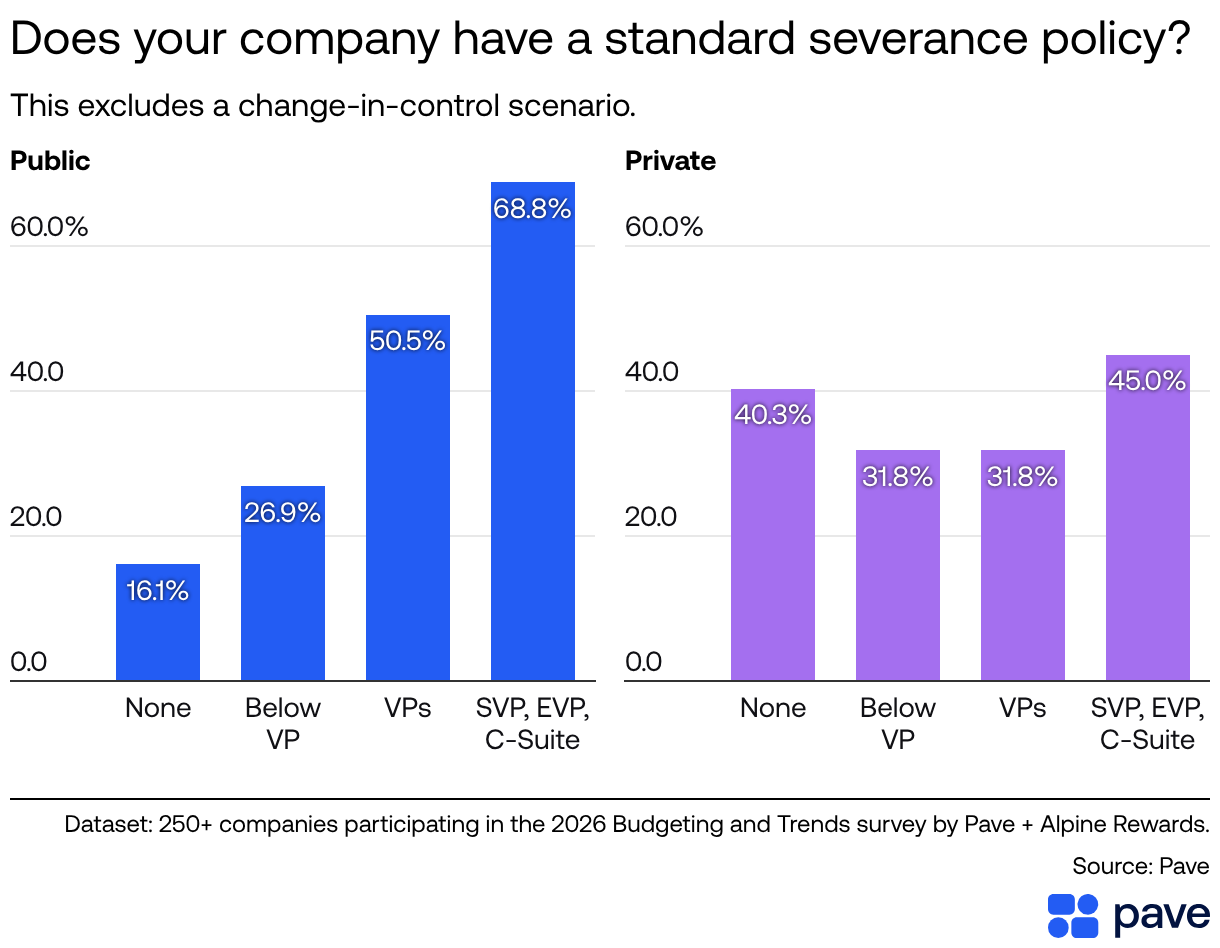
What is a typical severance package?
The size of a severance package depends on the way each company structures this type of pay. Executive severance packages are highly customised, but companies typically structure severance pay packages for non-executives in one of three ways:
- Tenure-based: Severance pay is calculated based on the number of years of service at the company. For example, if an employee has worked at a company for five years and the company offers two weeks of severance pay per year of service, they’d receive 10 weeks of severance pay. According to our data, 50% of companies cap the number of weeks of severance pay they offer. At public companies, the median cap is 26 weeks, and at private companies, it’s 12 weeks.
- Level-based: In this approach, severance pay is tied to the employee’s level or position at the company. Executives and senior leaders typically receive larger severance packages than individual contributors.
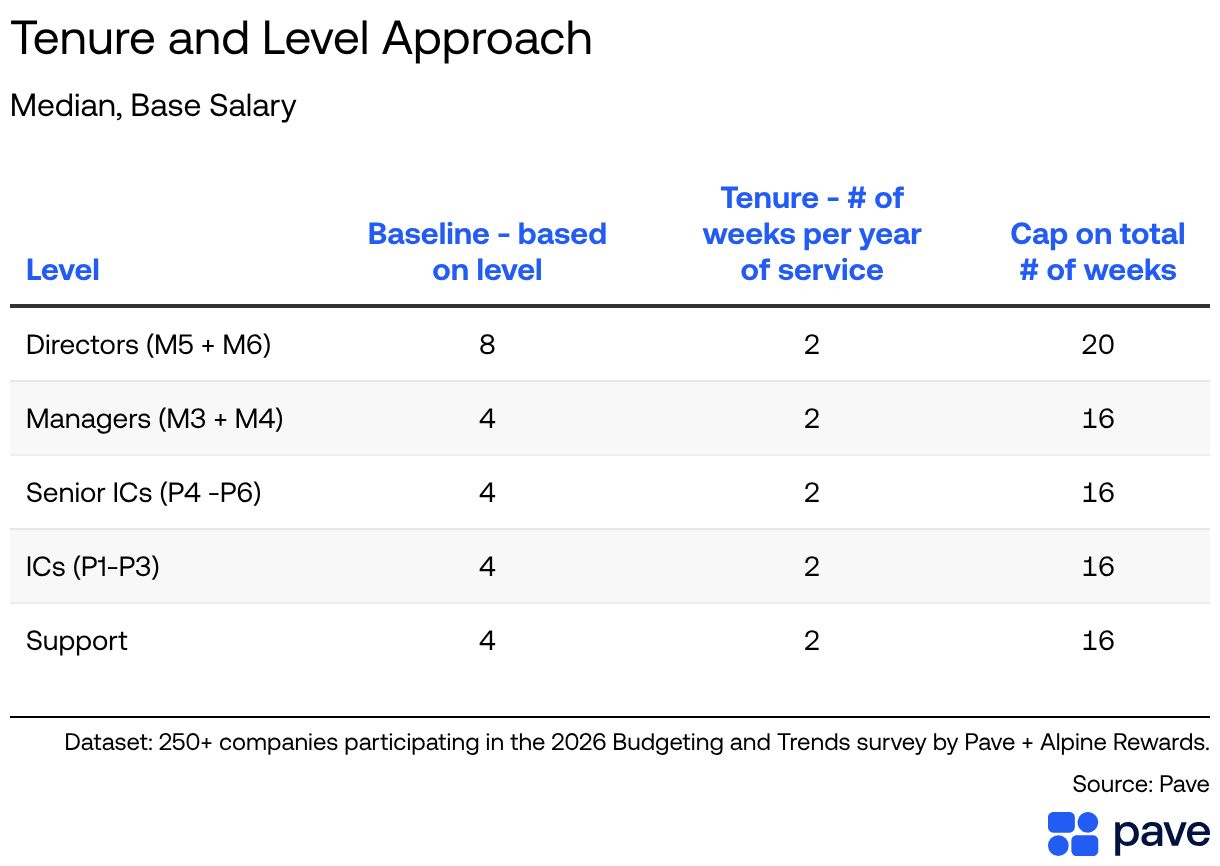
- Level- and tenure-based: This approach combines both the tenure and level methods. Using the data below, a P5 employee who’s been with the company for three years would receive 10 weeks of severance pay.
4 weeks baseline + (3 years of service * 2 weeks) = 10 weeks
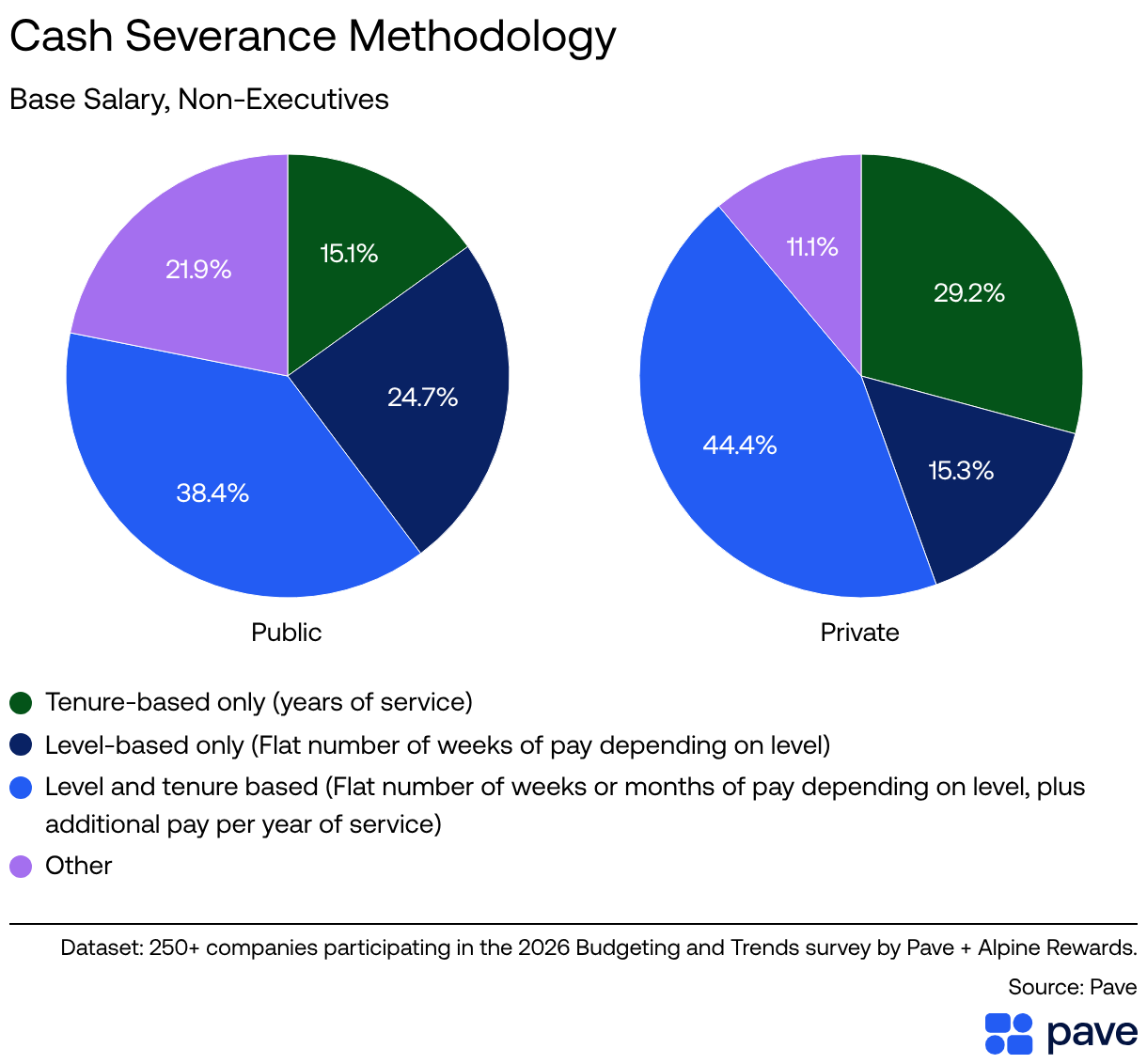
According to Pave’s survey, the level- and tenure-based methodology is the most common severance pay structure at both public and private companies. Among companies who use this approach, here is how the formula breaks down across various employee levels:
A typical severance package built on this formula usually includes a few core components layered together:
- A baseline amount, regardless of tenure or level, often a few weeks of pay.
- Tenure-based pay, added per year of service.
- A cap, most commonly 26 weeks at public companies and 12 weeks at private companies.
- Non-cash elements, like continued health coverage, career counseling, or extended exercise windows for vested equity.
It’s important to note that there can be other components of severance packages that aren’t included in this survey data. For example, when it comes to employee equity, some organizations may have policies around vesting schedules or exercise windows for employees who are laid off.
Severance packages differ in size and scope from company to company, but most competitive organizations offer cash in addition to other resources, like career support and extended health insurance coverage.
Is severance pay taxable?
The short answer is yes, but as with most tax matters, there are nuances.
Severance pay is subject to:
- Federal income tax withholding: When an employer uses the flat rate method, severance payments under $1M are subject to a 22% withholding rate, and that jumps to 37% for amounts over $1M. When companies use the aggregate method, severance pay is included in the employee’s last paycheck and is subject to the same payroll income tax brackets as other wages.
- Social security tax and medicare withholdings: Much like typical wages, severance packages are subject to social security (6.2%) and medicare (1.45%) withholding taxes.
- State income tax: State tax withholdings vary by state and individual situation. States without income tax, like Florida, Nevada, New Hampshire, Texas, and Washington, for example, don’t tax severance packages.
Tax implications vary based on your unique situation, so to get concrete answers, it’s best to consult a tax professional.
Do Employers Have to Offer Severance Pay? (WARN Act Basics)
Severance pay itself generally isn't required by federal law. What often gets confused with it is advance notice of a layoff, a separate requirement worth understanding for both compliance and how you communicate a layoff.
The Worker Adjustment and Retraining Notification (WARN) Act requires employers with 100 or more employees to give at least 60 calendar days' written notice before a plant closing or mass layoff affecting 50 or more employees at a single site. Notice goes to affected employees (or their union), the state's dislocated worker unit, and local government. Exceptions exist for unforeseeable business circumstances, faltering companies, and natural disasters, which can shorten or waive the period.
WARN requires notice, not severance. If a covered employer skips the required notice, the typical remedy is back pay and benefits for each day of notice missed, up to 60 days, not a severance package. Several states also have their own "mini-WARN" laws with different thresholds and triggers, so requirements can vary by location.
Outside WARN, severance eligibility usually comes down to company policy, an employment contract, or a union agreement rather than a blanket legal right. This is general information, not legal advice. WARN coverage and state rules are fact-specific and change over time, so confirm current obligations with legal counsel before finalizing a layoff plan.
Data for Confident Decision Making
Severance pay is only one part of a comprehensive compensation strategy in 2026. Do you know what else your peers are planning and budgeting for in the year ahead?
Join Pave Data Lab to participate in the 2026 Budgeting and Trends survey to gain access to the complete results on key compensation considerations, including:
- 2026 compensation planning
- Merit cycle trends
- Pay transparency insights
- Equity guidelines
- Severance pay best practices
Get the data to help you make more informed compensation decisions. Join Pave Data Lab today.
The information provided is for informational purposes only. Pave does not provide tax, accounting, or legal advice.

Rithika is a data scientist at Pave focused on compensation insights, analytics, data-storytelling, and community. Before Pave, she worked at Karat Financial building a credit card product and launching a personal finance tool for content creators.
Frequently Asked Questions (FAQs)
How is severance pay calculated, and what's included in a typical severance package?
Severance is most commonly calculated using a combination of tenure and level: a baseline amount plus a set number of weeks of pay per year of service, often with a cap around 26 weeks at public companies and 12 weeks at private companies. A typical package includes cash severance and frequently also includes continued health insurance coverage, career counseling, and sometimes extended windows to exercise vested equity.
How does severance pay work?
An employer offers a lump sum or continued salary payments for a set period after termination, usually in exchange for the employee signing a separation agreement. The size and structure vary by company, role, and level, and severance is taxed as supplemental wages rather than regular pay.
Do you get severance if fired?
Not automatically. In most cases, U.S. employers aren't legally required to offer severance pay, whether an employee is laid off or fired, unless a company policy, individual contract, or union agreement says otherwise. A related but separate protection, the WARN Act, can require advance notice (or pay in place of that notice) before a large-scale layoff, but that's a notice requirement, not severance.
What is a typical severance package based on tenure and level?
Under a combined tenure-and-level approach, an employee typically receives a baseline number of weeks of pay plus additional weeks for each year of service, with the total scaling up at senior levels. For example, a mid-level employee with three years of tenure might receive around 10 weeks of pay under a common formula, while a more senior employee with the same tenure would typically receive more.
How do executive severance packages differ from standard employee severance?
Executive severance packages are typically far more customized than standard employee severance, and are often negotiated individually rather than following a standard formula. They're more likely to include extended salary continuation, accelerated equity vesting, and other negotiated terms that go beyond the tenure-and-level formulas used for most other employees.
How much is severance pay?
Most companies calculate severance using tenure and level: a baseline number of weeks of pay plus additional weeks per year of service. In Pave's survey of 200+ companies, public companies cap severance at a median of 26 weeks and private companies at 12 weeks, and totals scale up at more senior levels.
What are the severance pay laws in the U.S.?
There is no federal law requiring severance pay; the Fair Labor Standards Act does not mandate it, so severance pay laws mostly come down to company policy, employment contracts, and union agreements. The main federal rule in the neighborhood is the WARN Act, which requires many employers to give 60 days' notice before a mass layoff (or pay in place of notice), but that is a notice requirement, not severance.