

As companies are going through their annual budgeting exercises for 2027, one of the most impactful decisions they will make is how much additional budget to allocate to employee salaries. This number dictates how most employees will see their pay increase for 2027.
While this increase in budget tends to be relatively stable from year to year, that doesn’t mean all employees receive the same increase every year. To get a better understanding of how companies are approaching these pay increases, as well as a number of other decisions heading into 2027, Pave partnered with Alpine Rewards to survey major employers across industries.
Merit raises are steady, and so are promotion budgets
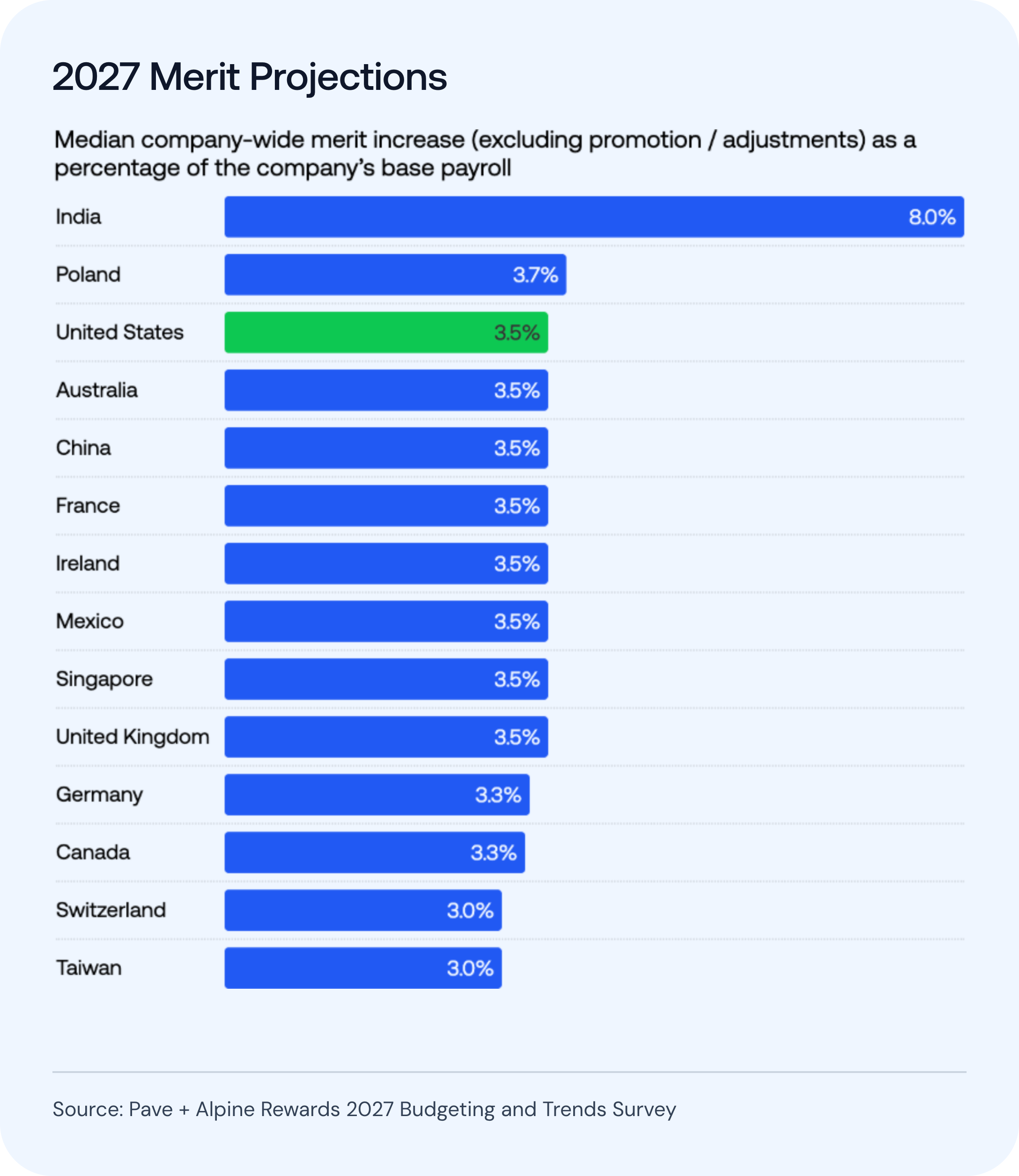
The median merit budget among U.S. companies is 3.5% of payroll for 2027, which is almost identical to what companies actually spent in 2026 and to last year's version of this survey, which also found a 3.5% median planned budget for 2026. Raises have settled into a pattern.
The budget set aside for promotions and market adjustments also looks similar, with a median of about 1.0%
Outside the U.S., the story is much the same:
A 3.5% raise may not feel exciting to some employees, but there are other levers available to companies to reward employees.
Top performers are rewarded with equity
Here is the catch with an overall budget of 3.5%: it is not what everyone gets. Most companies will use performance to differentiate increases for high performance. In fact, we found that 87% of companies use individual performance ratings to set merit increases, and only 9% hand out the same increase across the board.
Beyond salary, companies are leaning on stock to reward high performers. We found that 61% of companies use equity to deliver additional compensation to their top performing employees.
The key takeaway here is that while salary increases sit within tight boundaries, equity is where companies have room to pay a standout employee more.
The fastest route to a big raise is a promotion
If you want a double-digit pay increase, the data says to get promoted. The most common average promotional increase is 9% to 12%, roughly three times a typical merit raise.
Promotions are also not rare. 32% of companies promoted between 10% and 15% of their workforce over the past 12 months, and another 29% promoted more than 15%. Overall, 61% promoted more than one in ten employees. Timing is flexible too: 57% of companies promote employees off-cycle rather than making them wait for the annual review.
A promotion can bring equity along with it. Among companies that offer it, 51% typically make employees eligible for equity in an off-cycle promotion.
Two other interesting findings from our survey revolve around headcount growth and approaches to pay transparency.
1. Most companies expect to grow headcount
There is encouraging news for anyone job hunting or thinking about it. 60% of companies expect to grow headcount in 2027, including 20% that expect more than 15% growth. Another 25% plan flat headcount with replacement hiring only, and just 3% expect a reduction.
2. Pay transparency is also a manager skill
Companies are still figuring out how transparent they want to be around pay. In recent years, providing salary ranges in job postings has become common, with many candidates seeing this as a minimum expectation for applying for a job. Based on our survey, 80% of companies include a salary range in every U.S. job posting, even where the law does not require it.
Beyond putting salary ranges in job postings, approaches to pay transparency are inconsistent. But what many companies are doing is training the people who have the conversations. About half of companies (51%) plan to increase manager training or guidance on pay in 2027, the most common planned approach to transparency identified for 2027. Many of these companies are building on an already established foundation: 42% already give formal pay training to all people managers and 54% provide written talking points.
The reason is simple. A pay decision is only as good as the explanation that comes with it. When managers can clearly describe how a raise, a range or a promotion was determined, employees understand what they are paid and why. If you are not sure how your own pay is set, ask your manager where you sit in your range—and what it would take to move up.

Josh Steinfeld is a Compensation Fellow, bringing over 25 years of experience in the compensation space. Josh started his career as a consultant at Willis Towers Watson, focusing on executive compensation and working directly with Compensation Committees and CEOs on benchmarking, plan design, and corporate governance issues. He then joined the Compensation team at Google, leading compensation for YouTube, Area 120 (Google's corporate incubator), and Google's corporate functions. Prior to joining Pave, Josh spent nearly five years at Carta leading product strategy for Carta Total Compensation.